
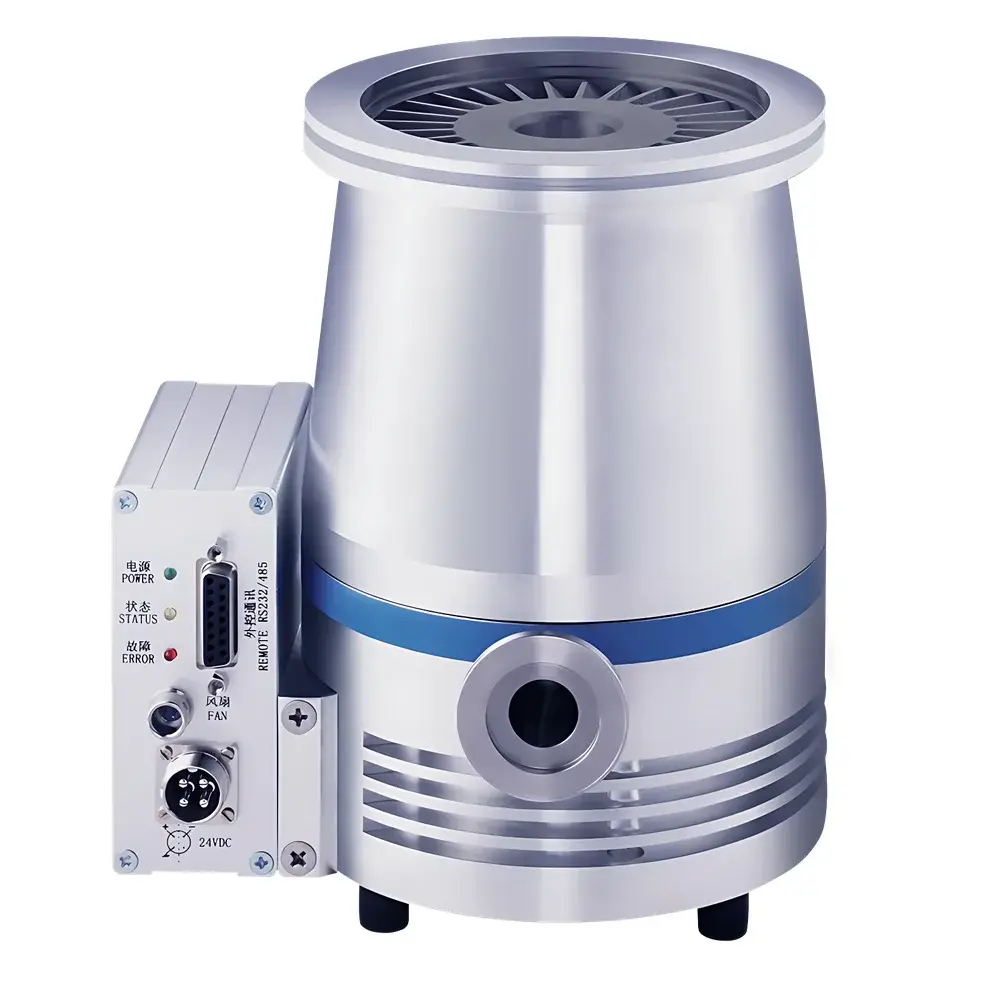
KYKY FF-100/150 Turbo Molecular Pump
| Brand | KYKY |
|---|---|
| Model | FF-100/150 |
| Type | Oil-Free Turbo Molecular Pump |
| Pumping Speed (N₂) | 140 L/s |
| Ultimate Pressure (CF Flange) | 2×10⁻⁷ Pa |
| Ultimate Pressure (ISO-KF Flange) | 2×10⁻⁶ Pa |
| Max. Continuous Forepressure (N₂) | 220 Pa |
| Max. Instantaneous Forepressure (N₂) | 500 Pa |
| Compression Ratio (N₂) | ≥1×10⁷ |
| Compression Ratio (Ar) | ≥1×10⁷ |
| Compression Ratio (He/H₂) | ≥1×10³ |
| Gas Load Capacity (N₂) | 135 sccm |
| Rated Rotational Speed | 51,000 rpm |
| Startup Time | ≤3 min |
| Power Supply | DC 24 V or AC 220 V |
| Max. Power Consumption | 90 W |
| Cooling | Air or Water (Flow Rate: ≥1 L/min |
| Weight (ISO-KF Version) | 6.0 kg |
| Weight (CF Version) | 8.6 kg |
| Inlet Flange | DN100 CF or DN100 ISO-K |
| Outlet Flange | DN25 ISO-KF |
| Compatible Forepumps | 1–2 L/s Rotary Vane or Diaphragm Pumps |
Overview
The KYKY FF-100/150 Turbo Molecular Pump is an oil-free, high-vacuum pumping solution engineered for integration into analytical and scientific instrumentation requiring stable, clean, and ultra-high vacuum (UHV) environments. Operating on the principle of momentum transfer via high-speed rotating blades (turbomolecular stage), it achieves molecular flow conditions where gas molecules collide more frequently with rotor surfaces than with each other—enabling efficient compression and exhaust against a moderate forevacuum. Designed specifically for compatibility with mass spectrometers, electron microscopes, surface analysis systems (e.g., XPS, AES), and UHV research chambers, the FF-100/150 delivers robust performance at ultimate pressures down to 2×10⁻⁷ Pa (with CF flange) while maintaining mechanical stability under variable thermal and vibrational loads.
Key Features
- Compact, modular architecture optimized for OEM integration—supports arbitrary mounting orientation (horizontal, vertical, inverted) without performance degradation.
- Dual-power capability: Operates natively on DC 24 V for embedded instrument control or AC 220 V for standalone lab deployment.
- Low vibration design (<0.5 µm peak-to-peak displacement at operational speed) minimizes coupling into sensitive detectors and optical paths.
- Enhanced forepressure tolerance: Sustains continuous operation up to 220 Pa and withstands transient surges to 500 Pa—critical for applications involving pulsed gas introduction or rapid sample exchange.
- High compression ratios (>10⁷ for N₂ and Ar; >10³ for light gases) ensure effective isolation between high-vacuum and roughing stages, reducing backstreaming risk and extending forepump service intervals.
- Thermally managed cooling options: Air-cooled configuration for space-constrained setups; water-cooled mode (1 L/min @ ≤25 °C) for sustained high-load operation in continuous-duty cycles.
Sample Compatibility & Compliance
The FF-100/150 is compatible with standard UHV-compatible materials (304/316 stainless steel, oxygen-free copper gaskets, metal-sealed CF and ISO-KF flanges) and conforms to vacuum integrity requirements for Class 10⁻⁷ Pa systems per ISO 27893 and ASTM E1565. Its oil-free operation eliminates hydrocarbon contamination—essential for surface-sensitive techniques such as Auger electron spectroscopy and time-of-flight secondary ion mass spectrometry (TOF-SIMS). The pump meets electromagnetic compatibility (EMC) standards IEC 61326-1 for laboratory equipment and supports GLP-compliant vacuum system validation through traceable startup timing (≤3 min), rotational speed monitoring, and pressure ramp profiling.
Software & Data Management
While the FF-100/150 operates autonomously via analog/digital I/O interfaces (0–10 V speed control, TTL-ready status signals), it integrates seamlessly with host instrument control software via RS-485 or optional CAN bus modules. Real-time telemetry—including rotational speed, bearing temperature, power draw, and interlock status—is accessible for logging and audit trails required under FDA 21 CFR Part 11 and ISO/IEC 17025 frameworks. KYKY’s TCP series controllers (e.g., TCP-100, TD-150) provide programmable ramp profiles, fault diagnostics, and password-protected parameter locking—supporting multi-user lab environments and automated vacuum sequencing protocols.
Applications
- Mass spectrometry: Maintains optimal ion transmission efficiency in quadrupole, magnetic sector, and Orbitrap platforms by sustaining base pressures <5×10⁻⁸ Pa during acquisition.
- Electron microscopy: Enables stable beam current and reduced charging artifacts in SEM, TEM, and FIB-SEM systems through low-vibration, hydrocarbon-free pumping.
- Surface science instrumentation: Supports reproducible monolayer deposition and in-situ characterization in UHV chambers used for catalysis, thin-film growth, and spintronics research.
- Additive manufacturing: Provides controlled inert-gas purge environments for metal powder bed fusion systems requiring residual oxygen levels <10 ppm.
- Non-destructive evaluation: Facilitates high-resolution X-ray imaging and neutron radiography by eliminating scattering from residual gas molecules in beamline vacuum sections.
FAQ
What forepump is recommended for the FF-100/150?
A 1–2 L/s dry scroll or diaphragm pump is recommended to maintain optimal forepressure conditions and avoid oil back-diffusion.
Can the FF-100/150 be operated vertically or upside-down?
Yes—its dynamic balancing and bearing design allow unrestricted orientation without impact on lifetime or pumping performance.
Is water cooling mandatory?
No; air cooling suffices for intermittent use below 70% duty cycle. Water cooling is advised for continuous operation above 50% rated speed or ambient temperatures exceeding 30 °C.
Does the pump support remote monitoring and control?
Yes—via RS-485 Modbus RTU or optional CANopen interface, enabling integration into SCADA and LabVIEW-based vacuum management systems.
What vacuum gauge types are compatible with its pressure measurement requirements?
Capacitance manometers (for foreline pressure) and Bayard-Alpert or cold cathode gauges (for high vacuum) are recommended; calibration traceability to NIST standards is supported.



