
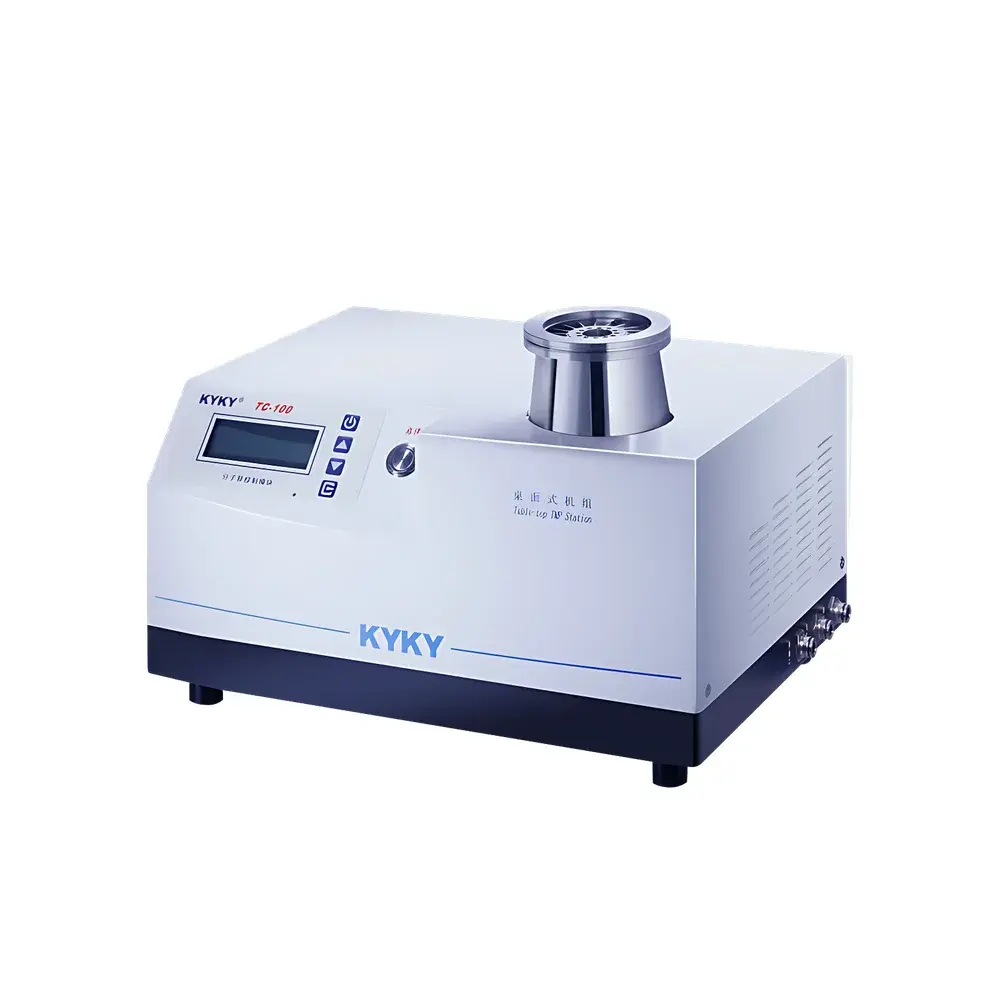
KYKY FJ-80 Molecular Pump System
| Brand | KYKY |
|---|---|
| Origin | Beijing, China |
| Manufacturer Type | Direct Manufacturer |
| Origin Category | Domestic (China) |
| Model | FJ-80 |
| Instrument Category | Other Vacuum Systems |
| Product Type | Oil-Free Turbomolecular Pump System |
| Pumping Speed | N₂: 62 L/s, He: 55 L/s, H₂: 34 L/s, Ar: 65 L/s |
| Ultimate Pressure | 3×10⁻⁵ Pa (ISO-K flange), 5×10⁻⁶ Pa (CF flange) |
| External Dimensions | 400 × 300 × 260 mm |
| Weight | 16–21 kg |
| Motor Power Supply | 220 ± 20 V / 50 Hz |
| Recommended Fore-Vacuum Pressure | < 50 Pa |
| Compression Ratio | N₂: 1×10⁹, He: 1×10⁵, H₂: 1×10⁴, Ar: 1×10⁹ |
| Cooling Method | Air-Cooled |
| Operating Ambient Temperature | 5–40 °C |
| Mounting Orientation | Vertical |
| Inlet Flange | DN63 ISO-K or CF63 (customizable to KF40/KF16) |
| Outlet Flange | ISO-KF |
| Quick-Connect Gas Port | φ8 mm |
| Standard Forepump | GHD-031B Dry Diaphragm Pump |
Overview
The KYKY FJ-80 Molecular Pump System is a compact, high-performance oil-free vacuum solution engineered for demanding laboratory and research applications requiring clean, stable ultra-high vacuum (UHV) environments. Based on the principle of momentum transfer in high-speed rotating blades, the FJ-80 employs a multi-stage turbomolecular pump design operating at up to 90,000 rpm to achieve efficient gas molecule removal across a wide molecular weight range. Its optimized blade geometry delivers exceptional pumping speed for light gases—including hydrogen (34 L/s) and helium (55 L/s)—while maintaining robust compression ratios exceeding 1×10⁹ for nitrogen and argon. Integrated with a GHD-031B dry diaphragm forepump, the system eliminates hydrocarbon contamination risks associated with oil-sealed rotary vane pumps, making it suitable for surface science, residual gas analysis, and mass spectrometry where sample integrity and background signal purity are critical.
Key Features
- Oil-free operation ensures zero hydrocarbon backstreaming—critical for UHV-compatible surface analysis and thin-film deposition processes.
- Intelligent delayed-start control enables programmable startup timing, reducing mechanical stress during pump-down sequences and extending rotor bearing life.
- Modular flange configuration supports rapid integration into existing vacuum systems: standard inlet is DN63 ISO-K or CF63, with optional KF40/KF16 adapters available upon request.
- Air-cooled thermal management eliminates need for external water lines or chillers—ideal for benchtop deployment in shared lab spaces with limited infrastructure.
- Compact footprint (400 × 300 × 260 mm) and lightweight construction (16–21 kg) facilitate repositioning between vacuum chambers or glovebox interfaces without dedicated lifting equipment.
- Stable operation within ambient temperatures from 5 °C to 40 °C meets ISO 14644-1 Class 7 cleanroom compatibility requirements when installed in controlled environments.
Sample Compatibility & Compliance
The FJ-80 is compatible with inert, reactive, and corrosive process gases commonly used in physical vapor deposition (PVD), plasma etching, and electron microscopy sample preparation—including Ar, N₂, O₂, and H₂. While not rated for halogenated or highly condensable vapors (e.g., solvents, mercury), its all-metal internal path and ceramic bearing assembly provide enhanced resistance to mild chemical exposure compared to polymer-sealed alternatives. The system conforms to IEC 61000-6-3 (EMC emission limits) and IEC 61000-6-2 (immunity standards). Its electrical interface complies with GB/T 14048.1–2012 (Chinese national standard equivalent to IEC 60947-1), supporting integration into GLP-compliant laboratories where traceability of vacuum performance parameters is required.
Software & Data Management
The FJ-80 operates as a standalone unit with front-panel digital display showing real-time pressure readout (via connected Pirani or cold cathode gauge), rotational speed, and fault status codes. For automated data logging and remote monitoring, KYKY provides optional RS-485/Modbus RTU interface support—enabling integration with LabVIEW, Python-based SCADA platforms, or custom PLC controllers. When paired with KYKY’s DIVAC 0.8T vacuum controller, the system supports audit-trail-enabled operation logs compliant with FDA 21 CFR Part 11 Annex 11 principles, including user authentication, timestamped event records, and immutable parameter change history—essential for regulated QC/QA workflows in materials R&D labs.
Applications
- Surface analysis techniques: X-ray photoelectron spectroscopy (XPS), Auger electron spectroscopy (AES), and low-energy electron diffraction (LEED).
- Thin-film fabrication: DC/RF magnetron sputtering, thermal and electron-beam evaporation, and atomic layer deposition (ALD) precursor delivery systems.
- Mass spectrometry: Serving as primary vacuum stage for quadrupole, time-of-flight (TOF), and ion trap instruments requiring base pressures ≤ 1×10⁻⁵ Pa.
- Accelerator and detector instrumentation: Beamline vacuum maintenance in small-scale electron linacs and radiation detection test chambers.
- Research-grade vacuum testing: Calibration of vacuum gauges, outgassing rate measurement of novel materials, and permeation studies under controlled partial pressures.
FAQ
What is the recommended fore-vacuum pressure before starting the FJ-80?
The turbomolecular pump must be started only after the foreline pressure drops below 50 Pa—typically achieved using the included GHD-031B dry diaphragm pump. Exceeding this threshold may cause rotor instability or premature bearing wear.
Can the FJ-80 be mounted horizontally?
No. The FJ-80 is designed exclusively for vertical mounting to ensure proper rotor dynamics, thermal convection cooling, and lubricant distribution in its hybrid ceramic-magnetic bearing system.
Is the system compatible with aggressive process gases such as Cl₂ or NF₃?
Not without modification. Standard FJ-80 units are not corrosion-resistant to halogen-based or highly reactive etchant gases. KYKY offers customized versions with nickel-plated rotors and specialized seals upon technical review.
How often does the FJ-80 require preventive maintenance?
Under typical lab usage (≤ 8 hrs/day, clean environment), annual inspection of bearings, fan integrity, and controller firmware update is sufficient. No routine oil changes or filter replacements are needed due to its dry, oil-free architecture.
Does the FJ-80 meet ISO 27422:2014 for vacuum system safety?
Yes—the system incorporates over-temperature shutdown, rotor overspeed protection, and emergency venting logic aligned with Clause 6.3 (Mechanical Safety) and Annex B (Risk Assessment Guidance) of ISO 27422:2014.



