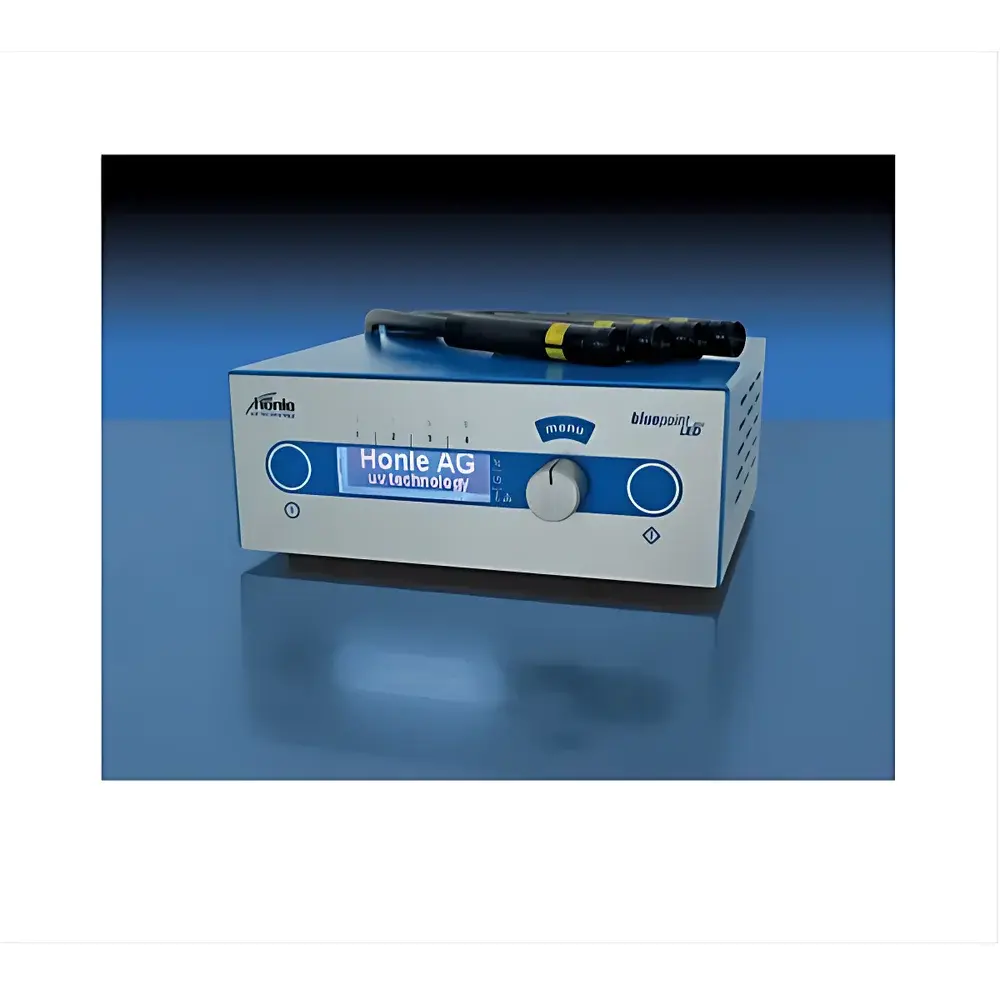
Bluepoint LED Spot UV Light Source
| Brand | Hoenle |
|---|---|
| Origin | Germany |
| Model | Bluepoint LED Eco-Lens Type |
| LED Heads | Up to 4 (independent operation) |
| Wavelength Options | 365 nm, 385 nm, 395 nm, 405 nm (standard UV–violet range) |
| Power Output | Adjustable per head (0–100% continuous dimming) |
| Warm-up Time | 0 s |
| Cooling | Passive thermal management (no external fan or chiller required) |
| Lifetime | ≥20,000 h (L70 at rated drive current) |
| Compliance | CE, RoHS, IEC 62471 (Photobiological Safety) |
Overview
The Bluepoint LED Spot UV Light Source is an engineered solid-state ultraviolet illumination system designed for precision photopolymerization, fluorescence excitation, and controlled photochemical activation in laboratory, R&D, and industrial quality control environments. Unlike traditional mercury-arc or metal-halide UV lamps, this system employs high-efficiency, narrow-bandwidth LED emitters mounted on modular, lens-coupled heads—enabling spatially confined irradiation with minimal thermal load and zero warm-up delay. Its core architecture follows the principles of radiometrically stable, wavelength-specific photon delivery: each LED head operates as an independent optical channel, allowing simultaneous or sequential activation across multiple samples or process zones. The system is optimized for applications requiring reproducible radiant exposure (J/cm²) and irradiance (mW/cm²), particularly where spectral selectivity, operational longevity, and regulatory traceability are critical—such as ISO 15312-compliant adhesive curing validation or USP photostability testing.
Key Features
- Modular multi-head configuration: Supports up to four interchangeable LED heads—each individually addressable via front-panel controls or remote interface.
- Wavelength flexibility: Standard emission peaks at 365 nm, 385 nm, 395 nm, and 405 nm; all calibrated per CIE 127:2007 measurement geometry and traceable to NIST-traceable spectroradiometric standards.
- Continuous power regulation: Linear 0–100% intensity control per head, enabling precise dosimetry without pulse-width modulation artifacts.
- Passive thermal design: Aluminum alloy heat-sink architecture ensures stable junction temperature (<65°C) under continuous operation—eliminating need for forced-air cooling or liquid chillers.
- Zero warm-up latency: Full output intensity achieved instantaneously at power-on, supporting high-throughput inline processes and time-resolved kinetic studies.
- Long-term radiometric stability: Rated lifetime ≥20,000 hours to L70 (70% initial radiant flux), verified per IES LM-80–15 accelerated life testing protocols.
Sample Compatibility & Compliance
The Bluepoint LED system accommodates diverse sample geometries—including microfluidic chips, optical substrates, biological tissue sections, and electronic assemblies—via adjustable mounting brackets and optional fiber-optic couplers (SMA 905 interface). All optical components comply with ISO 10110–7 surface quality specifications and feature anti-reflective coatings optimized for UV transmission (>92% @ 365 nm). From a regulatory standpoint, the device meets CE marking requirements under the EU Electromagnetic Compatibility Directive 2014/30/EU and Low Voltage Directive 2014/35/EU. It conforms to IEC 62471:2006 (Photobiological Safety of Lamps), classified as Risk Group 1 (Exempt) when used with standard lens collimation. For GxP environments, the system supports integration into validated workflows compliant with FDA 21 CFR Part 11 (electronic records/signatures) when paired with Hoenle’s optional BlueControl software suite featuring audit trail, user access levels, and electronic signature capture.
Software & Data Management
While the base unit operates standalone via intuitive rotary encoder and OLED display, optional BlueControl software (Windows-based, USB/RS-485 interface) enables full parameter logging, exposure scheduling, and irradiance mapping. The software records timestamped irradiance values (mW/cm²), cumulative dose (J/cm²), and head status in CSV and XML formats—compatible with LIMS and ELN platforms. All data entries include automatic metadata stamping (operator ID, instrument serial number, calibration certificate expiry). Calibration certificates—issued annually by Hoenle’s DAkkS-accredited metrology lab—are digitally embedded and exportable for internal audit or regulatory submission.
Applications
- UV-curable adhesive bonding and encapsulation in microelectronics and optomechanical assembly (ASTM D4145, IPC-CC-830B).
- Fluorescence microscopy excitation for live-cell imaging, immunofluorescence, and FISH protocols—minimizing phototoxicity through selective wavelength targeting.
- Photostability stress testing per ICH Q1B guidelines, including forced degradation of APIs and excipients under controlled UV-B/A spectra.
- Surface disinfection validation in ISO Class 5–8 cleanrooms using 254 nm–equivalent germicidal efficacy models (validated via biodosimetry with Bacillus atrophaeus spores).
- Photoresist exposure in academic lithography labs and pilot-line semiconductor prototyping.
FAQ
Is the Bluepoint LED system suitable for GLP-compliant photostability studies?
Yes—when operated with BlueControl software and annual DAkkS-accredited calibration, it fulfills documentation, traceability, and audit trail requirements outlined in OECD GLP Principles and ICH Q5C.
Can I mix different wavelengths across the four LED heads simultaneously?
Yes. Each head is independently selectable and controllable; no hardware modification is required to operate 365 nm, 385 nm, and 405 nm heads concurrently.
Does the system require recalibration after lens replacement?
Yes. Optical path changes—including lens swaps or fiber coupling—necessitate revalidation of irradiance output per head using a NIST-traceable UV radiometer (e.g., Gigahertz-Optik X1-1 with UV-A sensor).
What is the maximum working distance for uniform irradiance?
At 365 nm, collimated output maintains ±10% irradiance uniformity over a 10 mm diameter field at 50 mm working distance; performance varies with lens focal length and beam divergence—detailed in the supplied optical characterization report.