
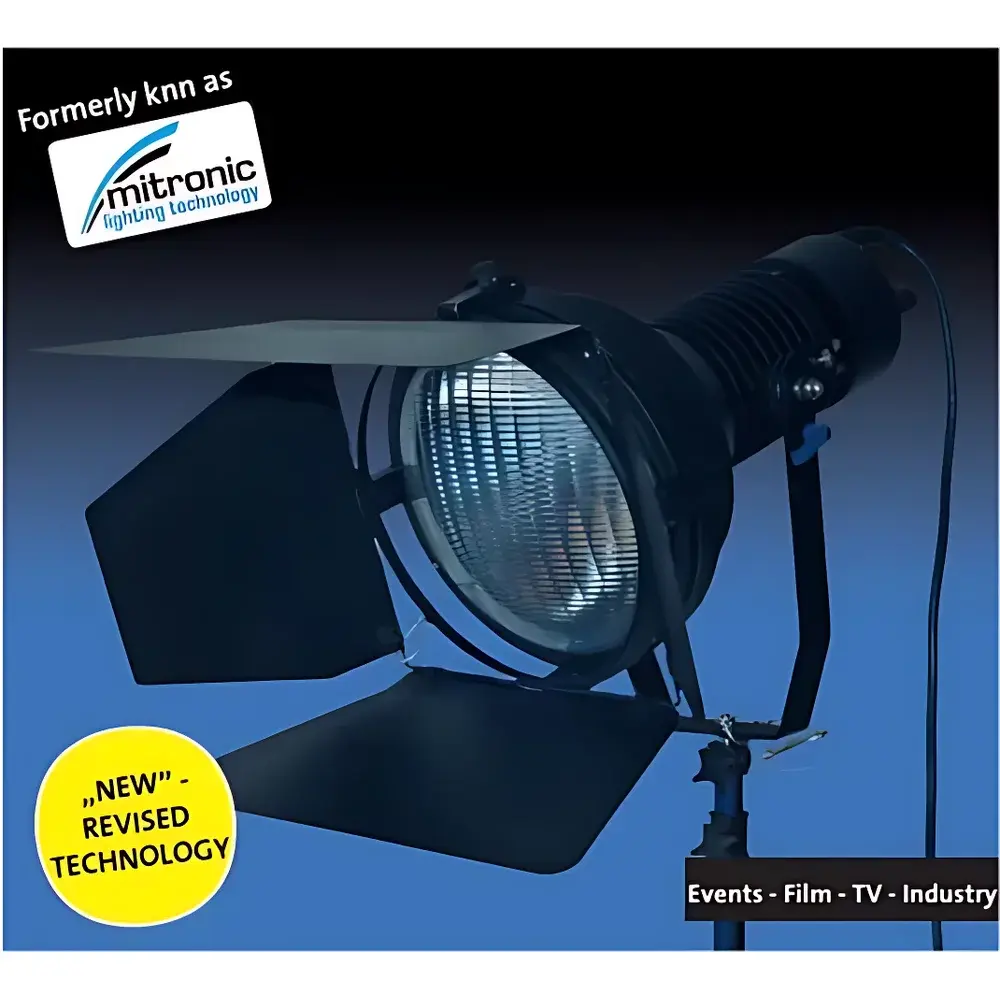
Superspot 1800 W UV Spot Curing System by Hönle
| Brand | Hönle |
|---|---|
| Origin | Germany |
| Model | Superspot 1800 W |
| Light Source | HMI 1800 W/SE/XS |
| Reflector Type | High-Precision Parabolic |
| Cooling | Patented Reflector Cooling System |
| Housing | Three-Part Cast Aluminum with Thermal Decoupling |
| Ignition | Hot-Start Ignition |
| Socket | G38 |
| Diffusers | 4 Interchangeable Options for Variable Irradiance Distribution |
| Lens Diameter | 300 mm |
| Dimensions (W × H × D) | 520 × 330 mm |
| Weight | ~12 kg |
| Surface Finish | High-Temperature-Resistant Black or Aluminum-White Powder Coating |
| Safety | Dual-Pole Automatic Cut-Off When Rear Access Panel Is Open |
| Focusing Mechanism | Tool-Free Spindle, Locking Nut & Toothed Belt for Micron-Level Positioning |
Overview
The Superspot 1800 W UV Spot Curing System is a high-intensity, precision-engineered ultraviolet irradiation platform developed by Hönle AG — a German manufacturer with over five decades of expertise in industrial UV technology. Designed for demanding photopolymerization applications in R&D laboratories, microelectronics assembly, optical component bonding, and medical device manufacturing, this system employs a 1800 W short-arc HMI (Hydrargyrum Medium-Arc Iodide) lamp as its broadband UV-VIS source. Its optical architecture is based on a high-precision parabolic reflector that delivers collimated, high-irradiance output with exceptional spatial uniformity and minimal thermal load at the sample plane. The system operates within the spectral range of approximately 250–450 nm, with peak emission intensity centered near 365 nm — optimal for initiating cationic and free-radical photopolymerizations of acrylates, epoxies, and hybrid formulations. Unlike generic UV lamps, the Superspot 1800 W integrates thermal decoupling between the lamp head and housing, enabling stable radiometric performance during extended operation cycles.
Key Features
- Three-part cast aluminum housing engineered for mechanical rigidity, thermal stability, and electromagnetic compatibility.
- Patented reflector cooling system maintains consistent optical alignment and extends reflector lifetime by minimizing thermal drift.
- Hot-start ignition ensures reliable lamp re-strike without cooldown delay — critical for process continuity in automated integration scenarios.
- G38 lamp socket with dual-pole safety cut-off activated automatically upon rear access panel opening, complying with EN 60204-1 machinery safety standards.
- Tool-free focusing mechanism comprising a calibrated spindle, locking nut, and toothed belt drive enables repeatable, micron-level positioning of the focal spot relative to the substrate surface.
- Four interchangeable diffusers provide selectable irradiance profiles — from tightly focused spots (<5 mm Ø) to broad-area illumination (up to 30 mm Ø) — supporting both high-resolution micro-curing and larger-area pre-cure steps.
- High-temperature-resistant powder coating (black or aluminum-white) withstands prolonged exposure to radiant heat and facilitates cleanroom-compatible maintenance protocols.
Sample Compatibility & Compliance
The Superspot 1800 W is compatible with substrates ranging from silicon wafers and glass optics to flexible polymer films and stainless-steel medical components. Its compact footprint (520 × 330 mm) and low-temperature socket design allow safe integration into gloveboxes, laminar flow hoods, and semi-automated workstations. The system meets CE marking requirements under the EU Machinery Directive 2006/42/EC and Electromagnetic Compatibility Directive 2014/30/EU. Radiometric calibration traceability is supported via optional NIST-traceable irradiance sensors (e.g., ILT950UV), and operational parameters can be logged for GLP-compliant documentation when paired with Hönle’s optional RS-485 interface module. While not intrinsically rated for Class I Div 1 hazardous locations, it may be deployed in ISO Class 5–7 cleanrooms when installed with appropriate exhaust ducting per ISO 14644-1.
Software & Data Management
The Superspot 1800 W operates as a standalone analog-controlled unit; however, it supports digital integration via optional TTL-trigger input (for external shutter control) and analog 0–10 V signal input (for real-time irradiance modulation). When connected to Hönle’s UV-ProcessControl software suite (v4.2+), users gain access to time-resolved irradiance logging, exposure dose accumulation, and audit-trail generation compliant with FDA 21 CFR Part 11 Annex 11 requirements. All configuration changes, lamp runtime hours, and safety interlock events are timestamped and stored locally with tamper-evident encryption. Export formats include CSV and XML for LIMS or MES interoperability.
Applications
- UV-curable adhesive bonding of MEMS packages and fiber optic connectors
- Encapsulation of OLED displays and thin-film photovoltaic cells
- Rapid prototyping of microfluidic devices using SU-8 and Norland Optical Adhesive (NOA)
- Surface modification of biomedical polymers prior to cell seeding
- Quality assurance testing of UV-stabilized coatings and optical filters
- In-process validation of cure depth and crosslink density via FTIR or DSC correlation studies
FAQ
What lamp types are compatible with the Superspot 1800 W?
Only HMI 1800 W/SE/XS lamps with G38 base are certified for use. Substitution with non-Hönle lamps voids warranty and compromises radiometric accuracy and thermal safety.
Is the system suitable for nitrogen-purged curing environments?
Yes — the lamp head and reflector assembly are sealed against inert gas ingress; recommended purge flow rate is ≥5 L/min to maintain O₂ <50 ppm at the irradiation zone.
How often should the parabolic reflector be cleaned or replaced?
Under standard cleanroom conditions, cleaning with spectroscopic-grade isopropanol every 200 operating hours is sufficient; reflector replacement is typically required after 1,500–2,000 hours of cumulative lamp operation.
Can irradiance uniformity be validated in-house?
Yes — using a calibrated UV radiometer (e.g., Ophir PD300-UV) and a motorized XY stage, users may generate ISO 15785-compliant uniformity maps across the focal plane.
Does Hönle provide IQ/OQ documentation for GMP facilities?
Yes — factory-verified Installation Qualification (IQ) and Operational Qualification (OQ) protocols are available upon request, including test scripts, acceptance criteria, and electronic signature support per ALCOA+ principles.






