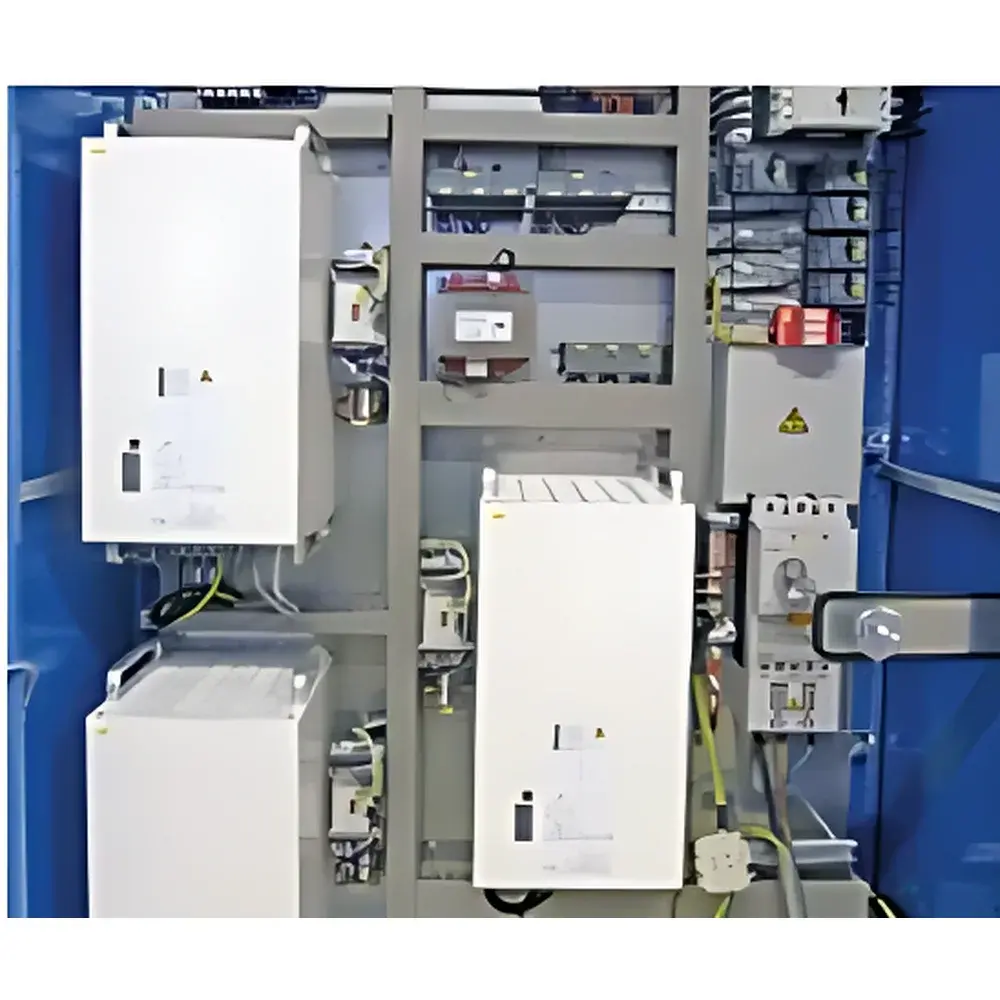
Hoenle EPSA Series Electronic UV Lamp Power Supply
| Brand | Hoenle |
|---|---|
| Origin | Germany |
| Model | EPSA Series (EPSA 80 / EPSA 120 / EPSA 240 / EPSA 340) |
| Input Voltage | 400–480 V AC, 50/60 Hz |
| Power Output Range | 8–32 kW |
| Control | 12–100% stepless dimming |
| Cooling | Integrated forced-air or liquid-cooled variants |
| Compliance | CE, IEC 61000-6-3, IEC 61000-6-4, EN 61204-3 |
| Footprint Reduction | Up to 50% vs. conventional magnetic ballasts |
| Weight | Significantly reduced vs. legacy systems |
| Fault Diagnostics | Real-time monitoring with event logging |
| Restrike Capability | Enhanced hot-restart performance |
| Cable Reduction | Optimized internal bus architecture minimizing external cabling |
Overview
The Hoenle EPSA Series is a high-efficiency, fully electronic power supply system engineered specifically for medium- and high-intensity ultraviolet (UV) discharge lamps used in industrial curing, surface treatment, and photochemical processing applications. Unlike traditional electromagnetic ballasts, the EPSA employs high-frequency switching topology (typically 20–100 kHz) with digital signal processor (DSP)-based regulation to deliver precise, stable arc current and voltage profiles across the full operating range. This architecture enables superior energy conversion efficiency—up to 10% higher UV radiant output per unit of input electrical energy—while maintaining tight spectral stability and lamp lifetime consistency. Designed for integration into OEM UV curing lines or standalone process stations, the EPSA series supports continuous-duty operation under demanding factory environments and meets stringent electromagnetic compatibility (EMC) requirements per IEC 61000-6-3 (emission) and IEC 61000-6-4 (immunity), ensuring reliable coexistence with PLCs, motion controllers, and vision systems.
Key Features
- Stepless dimming from 12% to 100% lamp power—enabling precise dose control without mechanical shuttering or lamp cycling
- Integrated thermal management with configurable cooling modes: forced-air (EPSA 80/120) or liquid-cooled (EPSA 240/340) for sustained high-power operation
- Real-time fault detection and classification—including arc instability, overtemperature, overcurrent, ground fault, and lamp end-of-life prediction—logged with timestamps and severity codes
- Enhanced hot restrike capability: restarts UV lamps within seconds after brief power interruption, minimizing process downtime
- Modular mechanical design reduces footprint by up to 50% compared to equivalent-rated magnetic ballast systems—critical for space-constrained production cells
- Reduced external cabling due to internal DC bus distribution and integrated communication interfaces (RS-485, optional EtherCAT)
- Robust aluminum extrusion housing with IP20 rating (IP54 optional) and conformal-coated PCBs for long-term reliability in dusty or humid industrial settings
Sample Compatibility & Compliance
The EPSA series is compatible with standard medium-pressure mercury (MPM) and amalgam UV lamps ranging from 80 W to 3.4 kW per channel, including common configurations such as linear, U-shaped, and annular geometries. It supports both single-lamp and multi-lamp parallel operation (e.g., 10-lamp arrays) with individual current balancing and independent dimming per channel in multi-unit installations. All models comply with EU Machinery Directive 2006/42/EC, Low Voltage Directive 2014/35/EU, and EMC Directive 2014/30/EU. Safety certification includes TÜV-certified protection class I construction and adherence to EN 61204-3 for power supply safety. For regulated industries (e.g., medical device coating, pharmaceutical packaging), EPSA firmware supports audit-trail-ready operation when paired with Hoenle’s optional SCADA interface module compliant with FDA 21 CFR Part 11 data integrity requirements.
Software & Data Management
The EPSA series features an embedded microcontroller platform running real-time firmware with dual-mode communication: local configuration via front-panel LCD and keypad, and remote supervision via RS-485 Modbus RTU or optional EtherCAT slave interface. Hoenle’s free EPSA ConfigTool software (Windows-based) enables parameter setup, firmware updates, diagnostic log export (CSV), and trending of lamp voltage/current waveforms over time. Event logs include timestamped entries for all fault conditions, operational mode transitions, and manual adjustments—supporting root-cause analysis and preventive maintenance planning. Optional integration with MES/SCADA systems allows for centralized monitoring of UV dose delivery, energy consumption per job, and predictive alerts based on lamp aging algorithms.
Applications
- UV-curable inkjet, flexographic, and gravure printing on flexible packaging and labels
- Adhesive curing in automotive interior bonding and electronics assembly
- Surface functionalization of polymers prior to metallization or painting
- Photolithography mask alignment and exposure systems requiring stable broadband UV output
- Water and air disinfection systems using high-output amalgam lamps
- R&D laboratories conducting accelerated weathering and photostability testing per ISO 4892-3 and ASTM G154
FAQ
What lamp types are supported by the EPSA series?
The EPSA is optimized for medium-pressure mercury vapor and amalgam UV lamps rated between 80 W and 3.4 kW. It does not support low-pressure (LP) UV-C germicidal lamps or LED-based sources.
Can multiple EPSA units be synchronized for uniform irradiance across large-area lamps?
Yes—units can be configured master-slave via RS-485 to maintain phase-synchronized output, minimizing interference patterns and ensuring spatial dose uniformity in wide-web applications.
Is remote firmware update supported?
Firmware updates are performed via USB or RS-485 using EPSA ConfigTool; over-the-air (OTA) updates are not supported for industrial safety and validation reasons.
Does EPSA meet GLP/GMP documentation requirements?
When used with the optional SCADA interface module and validated ConfigTool procedures, EPSA systems support ALCOA+ data integrity principles and are suitable for GxP-regulated environments where traceable UV process parameters are required.
What is the typical service life under continuous operation?
Rated for >30,000 hours MTBF at 40°C ambient with proper ventilation; electrolytic capacitor lifetime is extended through active thermal derating algorithms.