
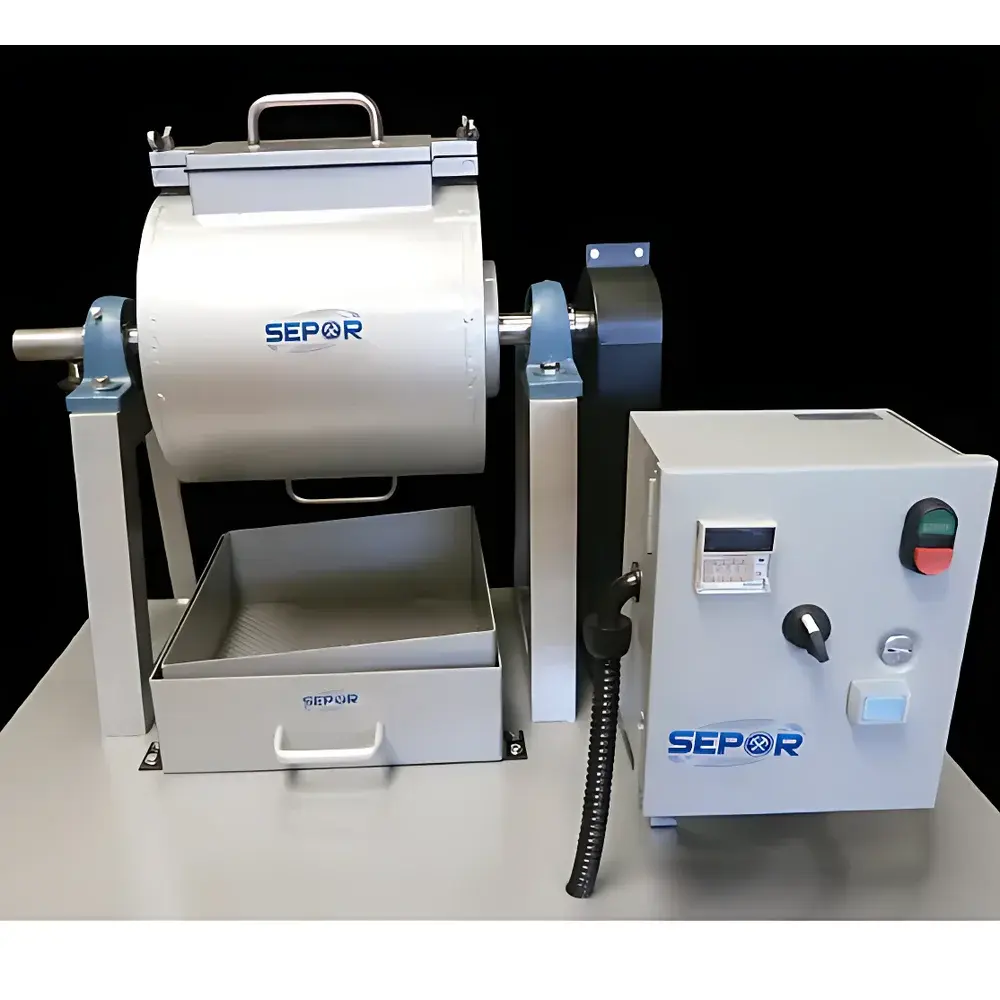
FC Bond Grinding Test Mill (Model 010E-124 / 010E-125 / 010E-126)
| Origin | USA |
|---|---|
| Manufacturer Type | Authorized Distributor |
| Origin Category | Imported |
| Model | 010E-124 / 010E-125 / 010E-126 |
| Pricing | Available Upon Request |
Overview
The FC Bond Grinding Test Mill is a precision-engineered laboratory-scale ball mill designed specifically for determining the Bond Work Index (BWI) — a fundamental parameter in mineral processing engineering that quantifies the specific energy required to reduce a material from theoretically infinite particle size to a product size where 80% passes a 100 µm sieve. Developed by Fred C. Bond and standardized in his seminal publication *“Crushing and Grinding Methods”*, this mill operates on the principle of controlled impact and attrition grinding under reproducible mechanical conditions. Its geometry, mass loading, rotational speed (70 rpm), and charge composition strictly adhere to ASTM E1937–22 and ISO 5068:1981 protocols for grindability testing. The mill’s fixed drum dimensions (12 in. internal diameter × 12 in. length), calibrated steel ball charge (44.5 lb of 1¼-in. forged steel balls), and rigidly synchronized rotation ensure high inter-laboratory repeatability — a critical requirement for metallurgical circuit design, plant scale-up, and comparative ore characterization.
Key Features
- Robust cast iron drum (12 in. ID × 12 in. L) fabricated from low-carbon ASTM A27 Grade 65-35 steel with dimensional tolerances held to ±0.005 in. after stress-relieving and precision machining.
- High-precision drive system comprising TEFC motor, electromagnetic clutch, mechanical revolution counter, and NEMA-rated motor starter — configurable for either 220–440 V / 3-phase / 60 Hz (Model 010E-124) or 380 V / 3-phase / 50 Hz (Model 010E-126).
- Calibrated grinding media set included: 44.5 lb (20.2 kg) of hardened 1¼-inch (31.75 mm) steel balls meeting ASTM A29/A29M specifications for hardness (58–62 HRC) and sphericity (±0.002 in. roundness deviation).
- Integrated bench-mounted frame with vibration-dampening base, adjustable leveling feet, and safety interlock guard for operator protection during operation.
- Complete accessory kit: receiving pan, hand-sieving tray, alignment jigs, and certified copy of Fred C. Bond’s original methodology manual — supplied with every unit shipment.
Sample Compatibility & Compliance
The FC Bond Mill accommodates dry, non-agglomerating feed samples up to 10 kg per test batch, with feed size typically limited to ≤6 mesh (3.35 mm) to satisfy Bond’s standard feed preparation protocol. It is validated for use with hard rock ores (e.g., quartzite, hematite, porphyry copper), industrial minerals (limestone, phosphate rock), and synthetic refractory materials. All structural components conform to ASME B18.2.1 bolt standards and ANSI/ISA-12.12.01 hazardous location guidelines for electrical enclosures. The mill supports GLP-compliant documentation workflows when paired with certified lab notebooks and audit-trail-enabled data loggers — fully traceable to ISO/IEC 17025:2017 requirements for testing laboratories.
Software & Data Management
While the FC Bond Mill is a manually operated, analog-controlled instrument — intentionally designed to eliminate electronic variability and preserve method fidelity — it integrates seamlessly into modern QA/QC environments via standardized digital reporting templates. Users may record revolutions, feed mass, screen analysis results (via ASTM E11-compliant test sieves), and calculated BWI values using validated Excel-based calculators compliant with USP Analytical Instrument Qualification (AIQ) Annex principles. Optional third-party data acquisition modules (e.g., National Instruments DAQmx + LabVIEW) can interface with the revolution counter output signal for automated cycle logging and 21 CFR Part 11–compliant electronic signatures when deployed in regulated pharmaceutical or contract metallurgical labs.
Applications
- Determination of Bond Work Index for comminution circuit simulation in JKSimMet, METSIM, and USIM PAC software platforms.
- Comparative grindability assessment across exploration drill core samples to guide mine planning and resource classification.
- Validation of grinding media wear performance under controlled energy input conditions.
- Process optimization studies involving pre-concentration, HPGR feed conditioning, and SAG/Ball mill partitioning.
- Educational instruction in mineral processing laboratories at accredited universities (e.g., Colorado School of Mines, University of Queensland, RWTH Aachen).
FAQ
What is the standard operating speed of the FC Bond Mill?
The mill rotates at a fixed speed of 70 ± 0.5 rpm, as specified in Bond’s original methodology and maintained via calibrated gearmotor and clutch assembly.
Is the 44.5 lb ball charge included with Model 010E-124?
Yes — the standard configuration includes the full 44.5 lb (20.2 kg) steel ball charge. Additional replacement charges are available under Model 010E-125.
Can the mill be used for wet grinding?
No — the FC Bond Mill is designed exclusively for dry grinding tests per ASTM E1937. Wet grinding alters slurry rheology and violates the empirical basis of the Bond Work Index calculation.
Does the mill comply with CE marking requirements?
Model 010E-126 (380 V / 50 Hz) is supplied with CE-marked motor starters and conforms to EN 60204-1:2018 safety standards for machinery; Model 010E-124 requires local certification for North American deployment.
How is calibration verified prior to shipment?
Each unit undergoes concentricity verification using dial indicator measurement (<0.005 in. TIR), drum dimension validation (ID = 12.030 ± 0.005 in.), and rotational speed certification via optical tachometer — documented in the Certificate of Conformance shipped with the unit.
Related Products







