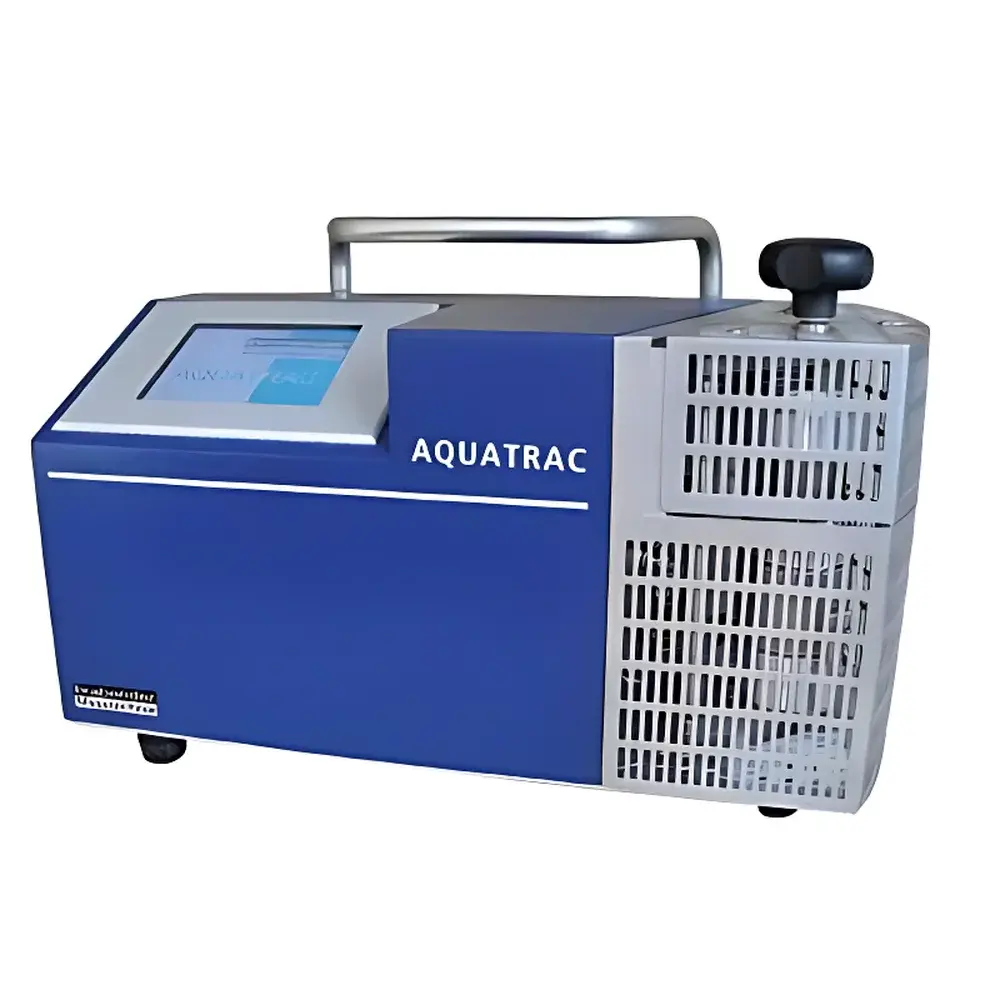
Brabender AQUATRAC-3E Karl Fischer-Type Calcium Hydride Moisture Analyzer for Plastic Granules
| Brand | Brabender |
|---|---|
| Origin | Germany |
| Model | AQUATRAC-3E |
| Measurement Principle | Calcium Hydride (CaH₂) Reaction-Based Quantitative Hydrogen Gas Evolution |
| Moisture Ranges | <0.1% |
| Sample Mass | 0.1–100 g (range-dependent) |
| Test Duration | 10–30 min (sample-dependent) |
| Temperature Control | 60–200 °C (1 °C increments) |
| Readout Units | % H₂O or ppm |
| Accuracy | ±2% of reading or ±1% of range, whichever is greater |
| Repeatability | ±1% of selected range |
| CaH₂ Cartridge Lifetime | ≥1000 determinations (standard cartridge) |
Overview
The Brabender AQUATRAC-3E is a dedicated, reaction-based moisture analyzer engineered for precise quantification of trace water content in hygroscopic polymer granules and pellets. Unlike optical or capacitance-based systems, the AQUATRAC-3E employs a well-established, stoichiometric chemical method: controlled reaction of sample-bound water with solid calcium hydride (CaH₂) under inert atmosphere, generating hydrogen gas proportional to water mass. The evolved hydrogen is measured volumetrically via a precision gas burette system, enabling direct gravimetric calculation of moisture without calibration curves or solvent dependency. This principle delivers high specificity for water—free from interference by solvents, volatiles, or matrix effects common in thermogravimetric (TGA) or near-infrared (NIR) methods. Designed for industrial QC environments, the AQUATRAC-3E integrates robust thermal control (60–200 °C, adjustable in 1 °C steps), sealed reaction chamber architecture, and real-time pressure compensation to ensure reproducibility across diverse polymer types—including PET, PA6, PA66, PC, PBT, and ABS—where residual moisture as low as 50 ppm critically impacts melt viscosity, hydrolytic degradation, and final part integrity.
Key Features
- Three auto-ranging moisture modes (0.5%) with automatic dilution logic for high-moisture samples
- Integrated temperature-controlled heating block with PID regulation and independent chamber sealing
- Calibration-free operation: absolute quantification based on CaH₂ stoichiometry (2 mol H₂O per 1 mol CaH₂)
- Dual readout capability: % H₂O (w/w) and ppm, selectable per test sequence
- Standard CaH₂ reagent cartridges rated for ≥1000 determinations—low cost-per-test and minimal operator handling
- Compact benchtop footprint (380 × 290 × 240 mm) with integrated gas handling manifold and pressure-equalized burette
- No consumable solvents or electrolytes; compliant with ISO 15512 and ASTM D6869 for plastics moisture analysis
Sample Compatibility & Compliance
The AQUATRAC-3E accommodates heterogeneous plastic feedstocks including virgin pellets, regrind, masterbatches, and multi-component blends—without requiring grinding or homogenization beyond standard lab preparation. Its wide sample mass range (0.1–100 g) enables optimization for both high-sensitivity trace work (e.g., 5–10 g for <100 ppm detection) and bulk process verification (e.g., 50–100 g for dryer outlet validation). The instrument meets core regulatory expectations for pharmaceutical-grade polymer processing: data integrity is maintained through non-volatile memory storage, user-accessible audit trails, and configurable password-protected method templates. While not a 21 CFR Part 11–certified system out-of-the-box, its deterministic chemistry, fixed reagent stoichiometry, and manual result verification workflow align with GLP/GMP documentation requirements for raw material release testing under ICH Q5C and USP .
Software & Data Management
Data capture is performed via front-panel keypad with LCD display; no external PC is required for routine operation. All test parameters (temperature setpoint, sample mass, range selection, start time) and results (% H₂O, ppm, elapsed time, ambient pressure) are stored internally with timestamping. Up to 200 test records are retained in non-volatile memory. Optional RS-232 interface supports ASCII-formatted data export to LIMS or Excel for trending analysis. Method files—including default drying profiles for common resins (e.g., 160 °C/20 min for PET, 80 °C/15 min for PA6)—can be preloaded and recalled by operator ID. No proprietary software installation is needed; exported logs comply with ISO/IEC 17025 clause 7.7 on result reporting.
Applications
- Incoming raw material inspection: rapid verification of supplier-certified moisture levels prior to warehouse acceptance
- Dryer performance validation: correlation of inlet/outlet moisture to optimize dew point, airflow, and residence time
- Pre-processing release testing: final moisture check immediately before hopper charging of extruders or injection molding machines
- Blend uniformity assessment: quantifying moisture distribution after high-speed dry blending of multiple polymer streams
- Stability studies: monitoring moisture regain during ambient or accelerated aging of packaged resin
- Root cause analysis: differentiating hydrolytic degradation signatures from thermal oxidation in failed parts
FAQ
Is the AQUATRAC-3E suitable for measuring moisture in filled or reinforced polymers (e.g., glass-filled PA6)?
Yes—the CaH₂ reaction is insensitive to inorganic fillers, pigments, or flame retardants, provided the sample is physically representative and fully exposed to reagent contact.
How does ambient pressure affect measurement accuracy?
The integrated pressure-compensated burette automatically corrects hydrogen volume to STP conditions; no manual barometric adjustment is required.
Can the same CaH₂ cartridge be used across all moisture ranges?
Yes—cartridge chemistry is range-agnostic; range selection only adjusts calculation scaling and gas volume interpretation logic.
What maintenance is required beyond cartridge replacement?
Annual verification of burette seal integrity and temperature sensor calibration (traceable to NIST standards) is recommended; no routine optical or electronic recalibration is necessary.
Does the instrument support GLP-compliant report generation?
Raw data export includes operator ID, timestamp, method ID, and full parameter set—enabling reconstruction of each determination per GLP Annex 11 principles.