
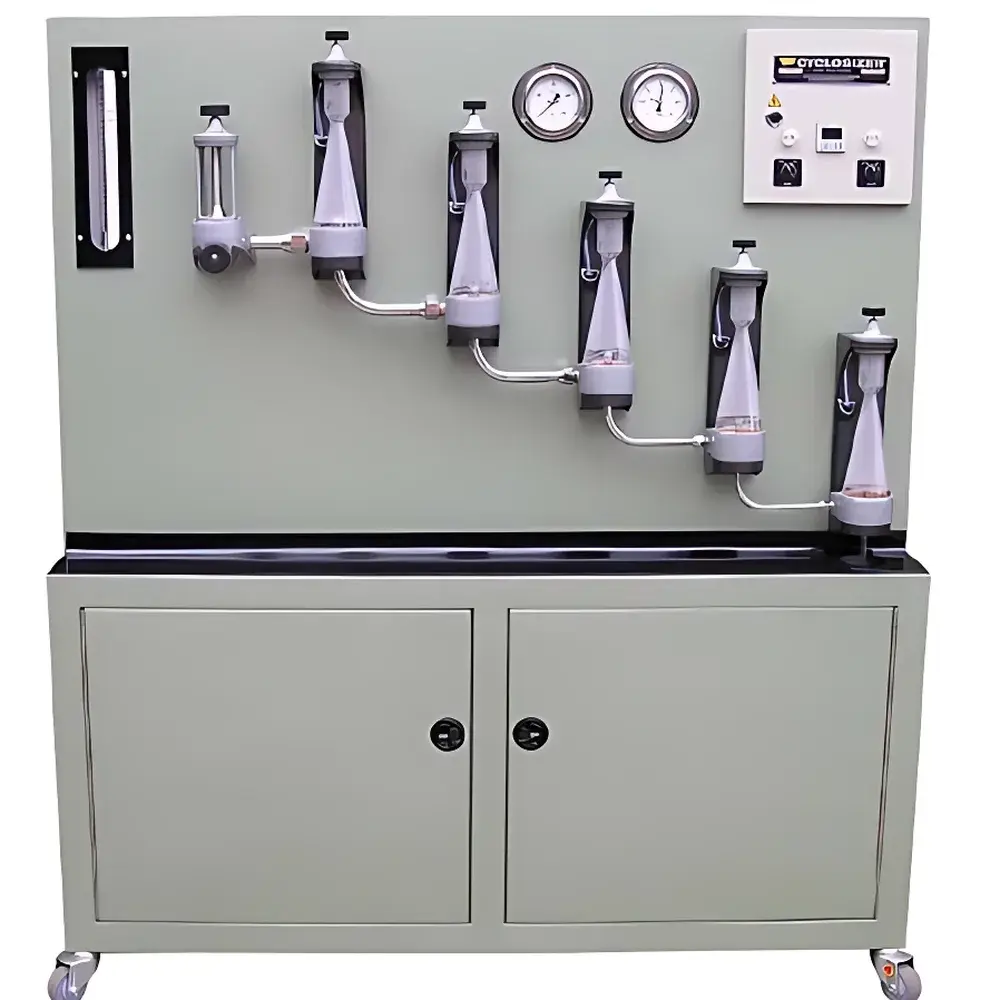
Cyclosizer 050B-001 Laboratory Cyclonic Particle Size Classifier
| Origin | USA |
|---|---|
| Manufacturer Type | Authorized Distributor |
| Origin Category | Imported |
| Model | 050B-001 |
| Pricing | Available Upon Request |
| Construction Material | Mild Steel or Stainless Steel (Configurable) |
| Power Supply | 50/60 Hz |
| Shipping Weight | 850 lbs |
| Overall Dimensions | 64 in × 19 in × 73 in (H) |
Overview
The Cyclosizer 050B-001 is a precision laboratory cyclonic particle size classifier engineered for reproducible, gravity-driven hydrodynamic separation of dry or wet particulate samples based on Stokes’ equivalent diameter. Unlike sieve-based or laser diffraction methods, the Cyclosizer leverages controlled centrifugal force within an array of five parallel 3-inch-diameter hydrocyclones to classify particles according to their terminal settling velocity in liquid suspension—directly correlating to size and specific gravity. It is specifically calibrated for materials with a specific gravity of ~2.7 (e.g., quartz, feldspar, silicates), delivering discrete size fractions at nominal cut points of approximately 40, 30, 20, 15, and 12 µm. Designed for mineralogical liberation analysis, process feed characterization, and comminution efficiency assessment, the system operates without moving parts in the classification zone, ensuring mechanical stability and long-term calibration integrity.
Key Features
- Five vertically mounted, identical 3-inch hydrocyclones integrated into a rigid console-mounted frame—factory-assembled and ready for operational validation
- Stokes-based classification principle enabling gravimetrically referenced size partitioning independent of optical assumptions
- Configurable construction: mild steel (standard) or 316 stainless steel (optional) for corrosion resistance in aggressive slurries or regulated environments
- Single-pass batch processing capacity up to 100 g of material finer than 200 mesh (74 µm) or 325 mesh (44 µm), yielding five physically separated size fractions
- No internal pumps or rotating components in the cyclone manifold—reducing maintenance requirements and enhancing measurement repeatability
- Integrated fluid handling infrastructure including feed tank, adjustable flow control valves, and fraction collection ports compatible with standard laboratory glassware
Sample Compatibility & Compliance
The Cyclosizer 050B-001 is validated for use with mineral ores, industrial powders, ceramic precursors, and metallurgical concentrates where liberation behavior and grain-size-dependent density response are critical parameters. It supports both aqueous and low-viscosity non-aqueous suspensions (e.g., ethanol-based dispersions). While not intrinsically compliant with ISO 13320 or ASTM D422, its output fractions are fully compatible with downstream analytical workflows requiring traceable size-classified material—including SEM-EDS, QEMSCAN®, XRD phase quantification, and automated mineralogy. The stainless steel configuration meets ASME BPE surface finish requirements for pharmaceutical excipient testing under GLP conditions. All electrical components conform to UL 508A and CE marking directives for industrial control panels operating at 50/60 Hz.
Software & Data Management
The Cyclosizer 050B-001 is a hardware-only classification platform with no embedded firmware or proprietary software. Fraction mass data is recorded manually or via external balance integration using standardized laboratory notebooks or LIMS-compatible spreadsheets. Users may implement audit-trail-capable digital logbooks aligned with FDA 21 CFR Part 11 requirements when paired with validated electronic signatures and version-controlled templates. Calibration verification procedures—including water throughput checks and reference sample runs—are documented per ISO/IEC 17025–accredited laboratory protocols. Raw fraction weights support direct calculation of cumulative undersize distributions and Rosin-Rammler or Gates-Gaudin-Schuhmann modeling.
Applications
- Mineral processing circuit optimization: evaluating grinding efficiency, overgrinding, and slurry rheology drivers through liberated vs. composite particle yield
- Coal preparation plant feed characterization—quantifying washability response across near-density size classes
- Geotechnical soil gradation refinement where hydrometer limitations exist below 10 µm
- Quality control of abrasive grains, foundry sands, and refractory aggregates requiring strict upper-limit sizing
- Research-scale beneficiation studies involving rare earth element carriers, heavy mineral sands, or PGM-bearing placers
- Validation benchmarking for computational fluid dynamics (CFD) models of hydrocyclone flow fields
FAQ
What particle size range is reliably resolved by the Cyclosizer 050B-001?
For materials with SG ≈ 2.7, the system delivers five discrete fractions centered at ~40, 30, 20, 15, and 12 µm Stokes diameter—with practical resolution limits constrained by feed uniformity and suspension stability.
Can the Cyclosizer handle high-specific-gravity minerals such as hematite or ilmenite?
Yes; however, cut points shift downward proportionally to √(SGparticle/SGreference). A calibration curve must be established for each material class using certified reference standards.
Is operator training or certification required prior to use?
No formal certification is mandated, but users must complete documented competency assessments covering slurry preparation, flow rate stabilization, fraction recovery technique, and mass balance reconciliation per internal QA SOPs.
Does the unit include flow metering or pressure monitoring instrumentation?
No—these are external accessories. Recommended configurations include a calibrated rotameter (0–10 GPM range) and a dual-port differential pressure gauge (0–30 psi) for cyclone inlet/outlet monitoring.
How is method transfer validated between different Cyclosizer units?
Inter-unit equivalence is demonstrated via round-robin testing using NIST-traceable silica sand standards (e.g., SRM 1990), with acceptance criteria set at ≤5% RSD for cumulative weight % passing each cut point across ≥3 replicates.






