
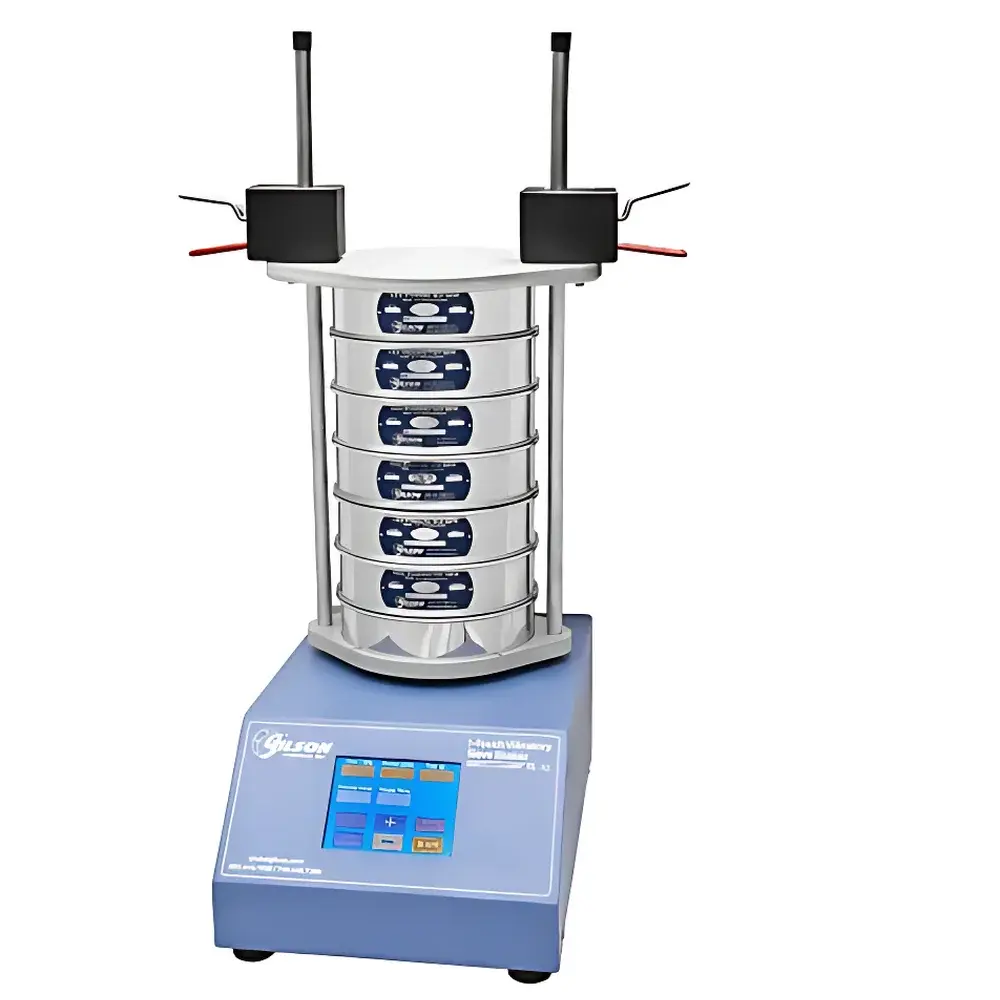
Gilson SS-10 8-inch Vibratory Sieve Shaker
| Origin | USA |
|---|---|
| Manufacturer Type | Authorized Distributor |
| Origin Category | Imported |
| Model | SS-10 |
| Pricing | Upon Request |
Overview
The Gilson SS-10 8-inch Vibratory Sieve Shaker is an electronically controlled, programmable particle size analyzer engineered for precision dry sieve analysis in accordance with ASTM E11, ISO 3310-1, and USP <786> standards. Utilizing three-dimensional orbital vibration—comprising horizontal circular motion combined with vertical lift and rotational reorientation—the SS-10 ensures uniform sample dispersion across the full sieve surface while continuously repositioning particles to maximize passage probability through apertures. This dynamic motion eliminates preferential channeling and promotes statistically representative fractionation, particularly critical for cohesive powders, granular pharmaceuticals, mineral aggregates, and fine ceramic precursors. Designed explicitly for 8-inch (203 mm) diameter test sieves—including both full-height and half-height configurations—the system supports up to eight full-height or sixteen half-height sieves plus receiver pan in a single stack. Its compact benchtop footprint (54.6 × 40.6 × 45.7 cm), low-noise operation (<65 dBA at 1 m), and powder-coated steel enclosure with adjustable leveling feet and anti-slip rubber pads ensure stable integration into regulated QC laboratories, R&D cleanrooms, and GLP-compliant testing environments.
Key Features
- Programmable touchscreen controller with 5.6-inch (142.2 mm) diagonal high-contrast LCD display for intuitive parameter input and real-time status feedback
- 10-step adjustable vibration amplitude control—optimized for material-specific energy delivery without over-agitation or particle fracture
- Timer range: 00:00 to 99:59 (minutes:seconds), enabling precise duration control for method validation and SOP compliance
- Non-volatile memory stores up to 99 user-defined test profiles—including amplitude, time, pause intervals, and sequence logic—for repeatable execution across shifts and operators
- Quick-action stack clamping mechanism ensures rigid, zero-play sieve alignment; maintains consistent energy transfer throughout the entire stack height
- GA-19 transparent acrylic viewing shield compatible with 8-inch/200-mm sieves—enables real-time visual assessment of particle motion, stratification, and blinding behavior during method development
- Robust powder-coated steel chassis with vibration-dampening base design minimizes transmission to adjacent instrumentation and lab surfaces
Sample Compatibility & Compliance
The SS-10 accommodates dry, free-flowing to moderately cohesive particulates within the nominal sizing range of No. 10 to No. 635 (2.0 mm to 20 µm), as defined by ASTM E11 standard sieve series. It is routinely deployed for sieve analysis of API powders, excipients, catalysts, metal alloys, soil fractions, foundry sands, and battery-grade graphite. All operational parameters—including vibration intensity, timing, and profile recall—are fully traceable and auditable, supporting compliance with FDA 21 CFR Part 11 requirements when integrated with validated LIMS or ELN platforms. The unit meets CE marking requirements for electromagnetic compatibility (EMC Directive 2014/30/EU) and low-voltage safety (LVD Directive 2014/35/EU). Optional calibration verification kits (e.g., certified reference sieve sets traceable to NIST) facilitate periodic performance qualification per ISO/IEC 17025.
Software & Data Management
While the SS-10 operates as a standalone instrument, its programmable architecture supports seamless integration into laboratory digital workflows. Test profiles can be exported via USB port for backup, version control, and cross-instrument synchronization. Audit trails—including operator ID (via optional RFID badge reader), timestamped start/stop events, and parameter change logs—are retained in internal memory for ≥12 months. When connected to Gilson’s optional G-Link™ data acquisition module, raw vibration metrics (e.g., frequency stability, amplitude decay curves) may be streamed to third-party SCADA or MES systems for predictive maintenance analytics and trend monitoring across multi-unit installations.
Applications
- Pharmaceutical quality control: Granule size distribution verification prior to tableting or capsule filling per USP <786>
- Geotechnical engineering: Soil gradation analysis per ASTM D6913 and AASHTO T 27
- Materials science: Particle size characterization of additive manufacturing feedstocks (e.g., Ti-6Al-4V, Inconel 718)
- Food & beverage: Flour, sugar, and spice particle consistency screening under HACCP and BRCGS protocols
- Environmental testing: Sediment and sludge particle classification for regulatory reporting (EPA Method 1684)
- Research & development: Method optimization for novel nanocomposites and spray-dried formulations
FAQ
What sieve diameters and configurations does the SS-10 support?
The SS-10 accepts only 8-inch (203 mm) diameter test sieves, configured as either eight full-height or sixteen half-height units stacked with a receiver pan.
Is the GA-19 viewing shield required for routine operation?
No—it is an optional accessory used primarily during method development or troubleshooting to observe particle dynamics and screen blinding behavior.
Can test profiles be edited remotely or via computer interface?
Profiles are configured and managed locally via the touchscreen; however, they can be exported/imported using a USB flash drive for centralized management.
Does the SS-10 comply with FDA 21 CFR Part 11 for electronic records?
Yes—when operated with enabled audit trail logging and paired with appropriate procedural controls (e.g., role-based access, electronic signatures), it satisfies Part 11 requirements for electronic records and signatures.
What maintenance is recommended for long-term accuracy?
Annual verification using certified reference sieves and amplitude calibration tools is recommended; routine cleaning of clamping surfaces and inspection of rubber isolation feet should occur after every 200 operating hours.






