
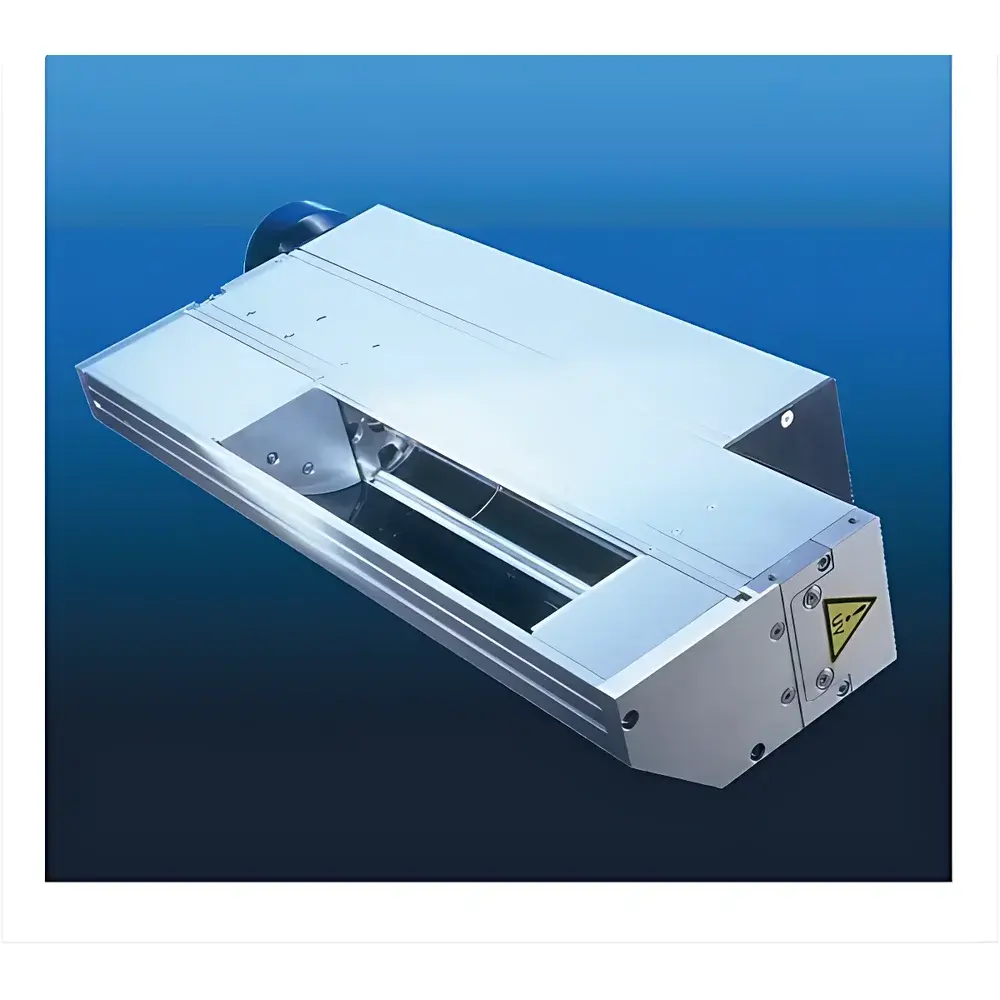
Hoenle UVAPRINT ACM UV Cold-Source UV Irradiation System
| Brand | Hoenle |
|---|---|
| Origin | Germany |
| Model | UVAPRINT ACM UV |
| Lamp Length | up to 2350 mm |
| UV Output Power Density | up to 236 W/cm |
| Max Total Air-Cooled UV Power | 17 kW |
| IR Reduction vs. Conventional UV Systems | >85% |
| Operating Principle | Cold-Mirror-Filtered UV Radiation (200–400 nm) |
| Compliance | CE, RoHS, IEC 60335-1, EN 62471 (Photobiological Safety) |
Overview
The Hoenle UVAPRINT ACM UV Cold-Source UV Irradiation System is an engineered solution for high-intensity ultraviolet curing in thermally sensitive industrial processes. Unlike conventional mercury arc or metal halide UV systems that emit substantial broadband infrared (IR) radiation—leading to substrate heating, warping, or degradation—the UVAPRINT ACM employs a proprietary cold-mirror optical architecture to selectively transmit UV wavelengths (200–400 nm) while reflecting and diverting >85% of incident IR energy away from the irradiated surface. This spectral separation enables stable, high-flux UV exposure without thermal load accumulation, making it especially suitable for thin-film printing, shrink-sleeve labeling, flexible packaging lamination, and precision coating of heat-sensitive substrates such as PETG, polycarbonate, PVC films, and pre-formed polymer containers.
Key Features
- Cold-Mirror Optical Architecture: Full-system integration of dielectric-coated ACM (Advanced Cold Mirror) reflectors ensures >85% reduction in IR irradiance compared to standard direct-radiation UV systems—validated per EN 62471 measurement protocols.
- Air-Cooled High-Power Design: Delivers up to 236 W/cm linear UV output density with total system power up to 17 kW, fully air-cooled—eliminating the need for water chillers, cooling drums, or active substrate cooling plates.
- Modular Lamp Configuration: Supports lamp lengths up to 2350 mm; scalable linear arrays allow seamless integration into web-fed, sheet-fed, or rotary press environments.
- Thermal Stability: Substrate surface temperature rise remains ≤15 °C under continuous operation at rated power—critical for maintaining dimensional stability in shrink-sleeve and label applications.
- CE & Photobiological Compliance: Certified to EN 62471 (Risk Group 3 classification), IEC 60335-1 (safety), and RoHS 2011/65/EU; designed for integration into Class 1 laser safety-compliant production lines.
Sample Compatibility & Compliance
The UVAPRINT ACM UV system accommodates a broad range of low-thermal-mass substrates including polyolefin films, PET, OPP, metallized foils, and UV-curable inkjet, flexo, and gravure inks formulated for UVA (320–390 nm) and UVV (395–445 nm) photoinitiators. Its spectral output profile aligns with ISO 12042:2021 (UV curing equipment characterization) and supports process validation under GMP-relevant frameworks where thermal excursion must remain within ±2 °C across full-width exposure zones. The system meets mechanical and electrical safety requirements per EN 61000-6-2/6-4 for industrial environments and is compatible with PLC-based line synchronization (24 VDC trigger, analog 0–10 V intensity control).
Software & Data Management
While the UVAPRINT ACM UV operates as a hardware-integrated irradiation module, optional digital interface modules support integration into Industry 4.0 data ecosystems. A DIN-rail-mounted controller provides real-time monitoring of lamp voltage, current, operating hours, and thermal sensor feedback from critical mirror mounts and lamp housings. All operational parameters—including on/off state, intensity setpoint, and fault logs—are accessible via Modbus TCP or Profibus DP for traceability in regulated manufacturing settings. Audit trails comply with FDA 21 CFR Part 11 requirements when paired with validated SCADA or MES platforms supporting electronic signature and user-level access control.
Applications
- High-speed shrink-sleeve application and post-forming UV curing on PET and PVC containers
- Inline UV drying of water-based and solvent-free UV inks on heat-sensitive flexible packaging webs
- Surface functionalization of medical device films (e.g., plasma-treated PET catheter tubing)
- Optical bonding and adhesive curing in display assembly lines with OLED and micro-LED substrates
- Photopolymerization of dental and orthodontic resins requiring controlled thermal budgets
FAQ
What UV wavelength range does the ACM system emit?
The system delivers broadband UV output spanning 200–445 nm, with peak irradiance in the UVA band (320–390 nm); spectral distribution is optimized for common acylphosphine oxide and α-hydroxyketone photoinitiators.
Can the UVAPRINT ACM be integrated into existing printing presses?
Yes—modular lamp heads and standardized mounting interfaces (ISO 9409-1-150-10-125 flange) enable retrofitting onto offset, flexographic, and digital hybrid presses; mechanical and electrical integration kits are available per OEM specification.
Is IR reduction performance verified per international standards?
Yes—spectral irradiance measurements were conducted per CIE S 026/E:2019 and EN 62471 using calibrated spectroradiometers (Bentham IL1700 + QM1000 monochromator); IR attenuation data reflects total radiant power (780–3000 nm) relative to unfiltered reference sources.
Does the system support intensity modulation during operation?
Yes—0–10 V analog input enables dynamic intensity control (10–100% nominal UV output) synchronized with web speed or print registration signals; response time <100 ms.
What maintenance intervals are recommended for ACM reflectors and lamps?
Lamp replacement interval is 1,200–1,500 operating hours depending on duty cycle; ACM mirror reflectivity is maintained for ≥5,000 hours under clean-room or filtered-air environments; annual calibration of irradiance sensors is recommended per ISO/IEC 17025 guidelines.




