
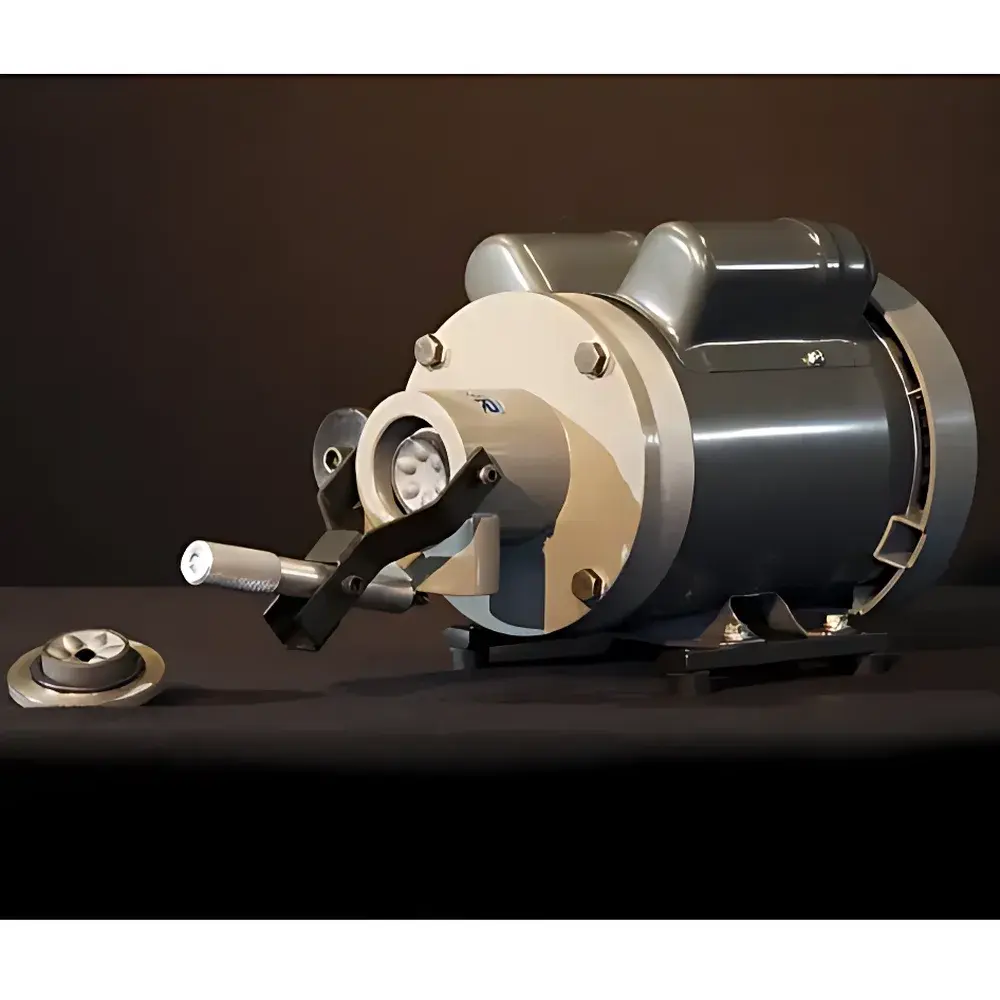
Sepor Mini Pulverizer 010F-030/031
| Origin | USA |
|---|---|
| Manufacturer Type | Authorized Distributor |
| Origin Category | Imported |
| Model | 010F-030 (Alumina Plates) / 010F-031 (Tungsten Carbide Plates) |
| Motor | 1/3 HP Capacitor-Start |
| Bearing Type | Sealed Ball Bearings |
| Grinding Adjustment | Cam-Actuated Variable Control |
| Adjustable Particle Size Range | 40–150 Mesh |
| Nominal Sample Capacity | 1–20 g (quartz ore, ≤1/8″ feed) |
| Plate Life | 1,000–3,000 batches (10 g quartz to 150 mesh) |
| Weight (Unit) | 35 lb (010F-030/031), 40 lb (shipped with accessories) |
Overview
The Sepor Mini Pulverizer (Models 010F-030 and 010F-031) is a compact, benchtop disc pulverizer engineered for reproducible, controlled size reduction of small-volume geological, mineralogical, and metallurgical samples. It operates on the principle of high-pressure compression and shearing between two counter-rotating, parallel grinding plates—one stationary and one rotating—driven by a robust 1/3 HP capacitor-start motor. This mechanical comminution mechanism ensures consistent particle size distribution without thermal degradation or contamination from moving parts beyond the grinding interface. Designed specifically for laboratory-scale preparation of analytical samples, the unit accepts feed material up to 1/8 inch (3.2 mm) in maximum dimension and reduces it reliably to ≤150 mesh (106 µm), meeting standard sieve specifications per ASTM E11 and ISO 3310-1. Its fixed geometry and cam-actuated gap adjustment provide precise, repeatable control over final grind fineness—critical for downstream XRF, ICP-OES, or fire assay workflows where homogeneity and representative sub-sampling are non-negotiable.
Key Features
- Interchangeable grinding plates: High-purity alumina (010F-030) or tungsten carbide (010F-031) plates—chemically inert, wear-resistant, and compatible with siliceous and moderately abrasive ores.
- Reversible plate rotation: A dedicated front-panel toggle switch enables reversal of plate rotational direction, distributing wear evenly across both plate surfaces and extending service life to 1,000–3,000 batches (10 g quartz each, ground to 150 mesh).
- Precision cam-actuated adjustment: Enables fine-tuned control of the inter-plate clearance, supporting reproducible grind settings from 40 mesh (425 µm) to 150 mesh (106 µm) without recalibration.
- Sealed bearing assembly: Prevents dust ingress and eliminates routine lubrication requirements—ensuring long-term mechanical stability under intermittent lab use.
- Low-mass, rigid cast-iron housing: Dampens operational vibration and maintains alignment integrity during repeated loading cycles.
- Tool-free cleaning access: Grinding chamber opens fully for manual cleaning using soft brushes, compressed air, or vacuum aspiration—minimizing cross-contamination risk between sample sets.
Sample Compatibility & Compliance
The Mini Pulverizer is validated for use with hard, brittle, and moderately abrasive materials including quartz, feldspar, limestone, bauxite, and base-metal sulfides. It is not recommended for ductile metals, polymers, or hygroscopic compounds requiring cryogenic or inert-atmosphere milling. All models comply with UL 508A industrial control panel standards for motor control circuits and meet CE electromagnetic compatibility (EMC) directives when operated within specified ambient conditions (5–40°C, <80% RH non-condensing). While not certified as GLP/GMP equipment per se, its mechanical simplicity, absence of software-controlled parameters, and traceable plate replacement history (via catalog numbers 010F-032 and 010F-033) support audit-ready documentation in regulated QA/QC environments.
Software & Data Management
This is a purely electromechanical instrument with no embedded firmware, digital interface, or data logging capability. Operational parameters—including batch mass, feed size, plate type, rotation direction, and grind setting—are recorded manually in laboratory notebooks or LIMS-compatible spreadsheets. The absence of electronic controls eliminates validation complexity associated with FDA 21 CFR Part 11 compliance; however, users implementing this device in regulated workflows are advised to maintain a controlled log of plate usage cycles and calibration verification (e.g., sieve analysis of representative output batches every 50–100 runs) to satisfy internal SOPs and external audit requirements.
Applications
- Preparation of homogenized sub-samples for geochemical analysis (XRF, ICP-MS, AA) in exploration and mine development labs.
- Routine crushing of drill core chips and RC cuttings prior to assaying for gold, copper, or nickel.
- Particle size standardization in method development studies for leach kinetics or mineral liberation analysis (MLA).
- Small-batch comminution in academic research labs where space, power, and budget constraints preclude larger jaw or ring mills.
- Reference material production for proficiency testing programs requiring traceable, matrix-matched particulate standards.
FAQ
What is the maximum feed size the Mini Pulverizer can accept?
The unit accepts feed particles up to 1/8 inch (3.2 mm) in largest dimension. Oversized material must be pre-crushed using a mortar and pestle or jaw crusher.
Can the same grinding plates be used for both silica-rich and sulfide-bearing ores?
Yes—both alumina and tungsten carbide plates exhibit excellent resistance to chemical attack from acidic and alkaline mineral matrices. However, tungsten carbide (010F-031) is preferred for highly abrasive sulfides due to superior hardness (1,500–1,800 HV).
How often should plate wear be verified?
We recommend performing a sieve analysis on a representative 10 g output batch after every 50–100 operational cycles—or whenever observed grind coarseness exceeds specification—to confirm plate integrity and adjust cam setting accordingly.
Is the 010F-032 alumina plate a direct replacement for the 010F-030 unit?
Yes—010F-032 is a drop-in spare set identical in dimensions, tolerance, and surface finish to the original plates supplied with model 010F-030.
Does Sepor provide calibration certificates or performance verification reports?
No—this is a mechanical process tool, not a metrological instrument. Users are responsible for establishing their own verification protocol using NIST-traceable sieves and documented test batches.






