
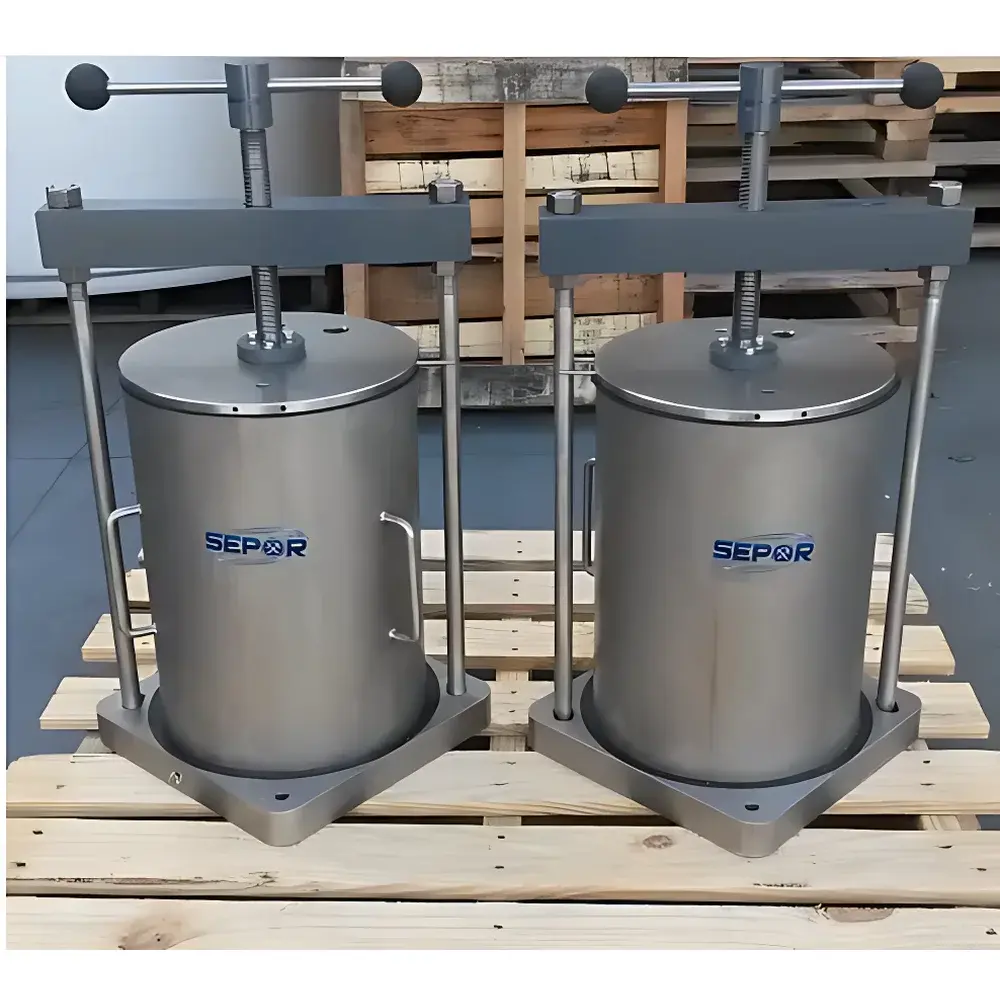
Benchtop 4.2-Gallon Pressure Filter System
| Origin | USA |
|---|---|
| Manufacturer Type | Authorized Distributor |
| Origin Category | Imported |
| Model | Bench 4.2 Gallon Pr |
| Quotation | Available Upon Request |
| Construction Options | Carbon Steel / ASTM A240 304 SS / ASTM A240 316 SS |
| Working Pressure Range | 60–75 psi (4.1–5.2 bar) |
| Test Pressure | 80 psi (5.5 bar) |
| Vessel Dimensions | 10″ ID × 14″ H (254 mm × 356 mm) |
| Filtration Area | ~0.55 ft² (0.051 m²) |
| Standard Filter Media | Polypropylene Mesh (25 µm nominal pore size) + 100 pcs High-Wet-Strength Filter Paper (25 µm) |
| Fittings | 1/4″ NPT Quick-Connect Air Inlet |
| Instrumentation | Dual-Range Pressure Gauge (0–100 psi), Manual Feed/Exhaust Ball Valve, Safety Relief Valve (ASME Section VIII compliant) |
| Base | Precision-Machined, Threaded Drain Ports (Bottom & Side), Rotatable Lid with Sealed Gasket |
Overview
The Benchtop 4.2-Gallon Pressure Filter System is an engineered laboratory-scale filtration unit designed for controlled, repeatable solid–liquid separation under positive pressure. Based on the principle of pressure-driven crossflow and dead-end filtration, this system applies regulated compressed air or inert gas to a slurry contained within a sealed cylindrical vessel, forcing liquid phase through a retained filter medium while retaining suspended solids on the cake surface. Its 4.2-gallon (15.9 L) capacity supports batch processing of moderate-volume samples—ideal for process development, catalyst recovery, crystallization workups, and pre-pilot scale filtration validation. The vessel’s ASME-stamped design basis, validated hydrostatic test pressure of 80 psi, and operational limit of 75 psi ensure compliance with standard laboratory pressure equipment safety protocols. Constructed for durability and chemical compatibility, it accommodates aggressive solvents, acidic or alkaline slurries, and thermally sensitive suspensions when paired with appropriate filter media.
Key Features
- Robust pressure-rated vessel available in carbon steel (ASTM A106/A516), 304 stainless steel (ASTM A240), or 316 stainless steel (ASTM A240) for corrosion resistance in demanding chemical environments
- Precision-machined base with dual threaded drain ports (bottom and side) enabling flexible discharge routing and complete slurry evacuation
- Rotatable, gasket-sealed lid with ergonomic clamping mechanism for rapid loading, cake inspection, and residue removal without tooling
- Integrated instrumentation suite: calibrated 0–100 psi dual-range pressure gauge, manual feed/exhaust ball valve, and ASME-certified spring-loaded safety relief valve (set at 80 psi)
- Factory-assembled and leak-tested; includes 1/4″ NPT quick-connect air inlet fitting, standard 25 µm polypropylene mesh filter cloth, and 100-sheet pack of high-wet-strength cellulose filter paper (25 µm nominal rating)
- No electrical components—fully pneumatic operation ensures intrinsic safety in solvent-rich or explosive atmospheres (Class I, Div 2 compatible when used with appropriate air supply)
Sample Compatibility & Compliance
This pressure filter system is suitable for aqueous, organic, and mixed-phase slurries across pharmaceutical, fine chemical, materials science, and environmental testing laboratories. It complies with fundamental mechanical integrity requirements per ASME Boiler and Pressure Vessel Code, Section VIII, Division 1, and supports Good Laboratory Practice (GLP) documentation workflows. While not inherently FDA 21 CFR Part 11–compliant (as it lacks electronic data capture), its mechanical design facilitates integration into validated processes where manual log entries, pressure traceability via gauge photography, and media lot tracking meet regulatory expectations for non-automated unit operations. Filter media options—including PTFE-coated membranes, sintered metal discs, and graded glass fiber papers—can be substituted to meet ISO 13320 particle retention validation or USP particulate matter testing needs.
Software & Data Management
The Benchtop 4.2-Gallon Pressure Filter operates as a standalone mechanical system without embedded firmware or digital control interfaces. All operational parameters—including applied pressure, filtration time, filtrate volume, and observed cake thickness—are recorded manually using standardized lab notebooks or LIMS-integrated templates. For reproducible method transfer, users are advised to document pressure ramp profiles, hold durations, and vacuum-assisted drying steps (if applicable) using traceable analog gauges and calibrated volumetric receivers. Optional external pressure dataloggers (e.g., Omega PX409 series) can be connected via the 1/4″ NPT port to generate time-stamped pressure logs compatible with CSV export and statistical process analysis (SPC).
Applications
- Pharmaceutical: Isolation of active pharmaceutical ingredients (APIs) post-crystallization, excipient purification, and filter aid evaluation (e.g., diatomaceous earth, activated carbon)
- Materials Science: Recovery of nanoparticles, metal-organic frameworks (MOFs), and battery electrode slurries prior to SEM/TEM characterization
- Environmental Testing: Solid-phase extraction of suspended solids from wastewater effluents per EPA Method 160.1
- Academic Research: Teaching unit operations in chemical engineering labs—demonstrating Darcy’s law, specific cake resistance, and compressibility index determination
- Quality Control: Batch consistency checks for pigment dispersions, polymer latexes, and ceramic slip formulations
FAQ
What is the maximum recommended operating pressure?
The system is rated for continuous operation up to 75 psi (5.2 bar); the 80 psi hydrotest value is for factory certification only and must not be exceeded during use.
Can I use alternative filter media?
Yes—the 10-inch diameter support plate accepts any circular filter medium with outer diameter ≤ 10.0 inches and thickness ≤ 0.25 inches, including sintered stainless steel frits, PTFE membranes, and ceramic discs.
Is the vessel suitable for vacuum-assisted drying after filtration?
No—this unit is designed exclusively for positive-pressure filtration. Vacuum application may compromise seal integrity and is not supported by the mechanical design.
Does the system include calibration certificates for the pressure gauge?
A factory-installed gauge is provided; NIST-traceable calibration certificates are available upon request at time of order (additional lead time and cost apply).
How is cleaning and maintenance performed?
All wetted parts are accessible via the rotatable lid and removable base plate; CIP-compatible designs allow for solvent flush, ultrasonic bath cleaning, or steam sterilization (316 SS variant only, max 121°C, non-pressurized).




