
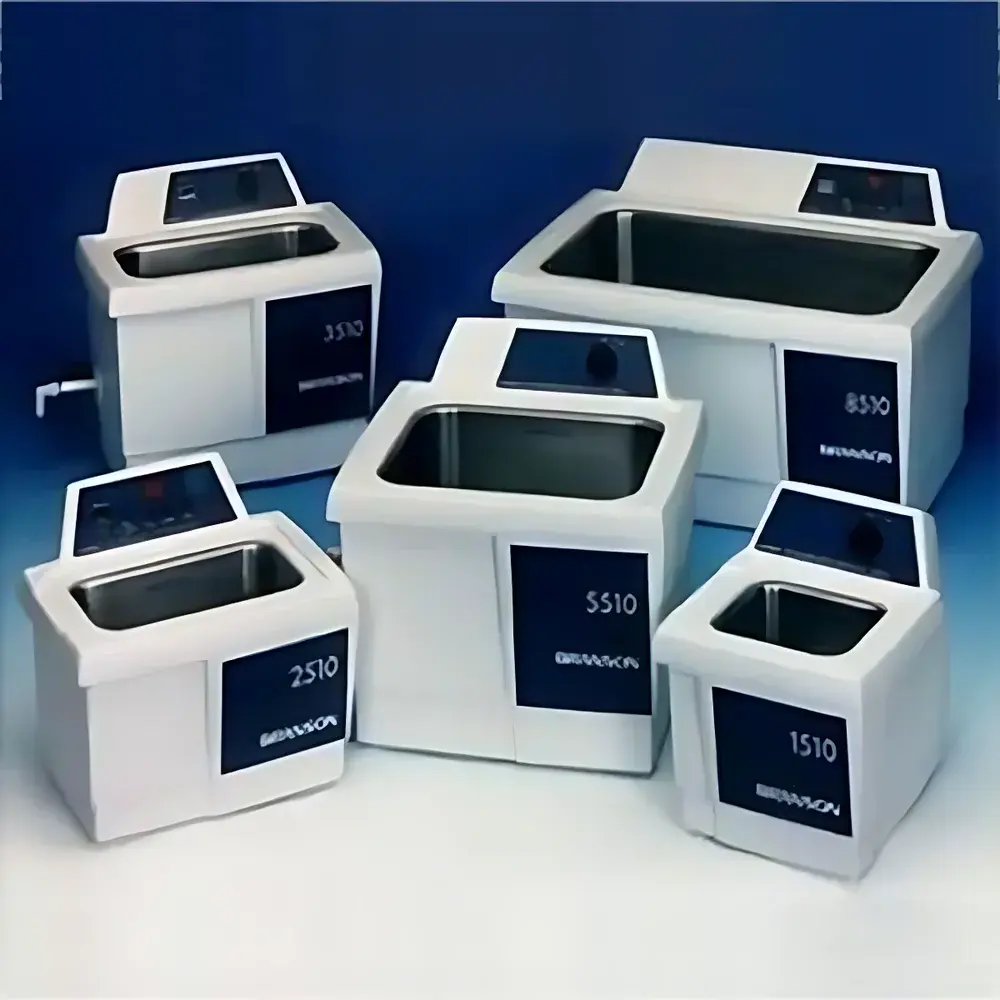
Branson B2510E-MT Ultrasonic Cleaner
| Brand | Branson |
|---|---|
| Origin | USA |
| Model | B2510E-MT |
| Capacity | 1.9 L (tank volume) |
| Ultrasonic Frequency | 40 kHz |
| Ultrasonic Power Output | 63 W |
| Adjustable Power | Yes |
| Adjustable Temperature | Yes (0–70 °C) |
| Adjustable Timer | Yes (1–99 min) |
| Sound-Dampening Lid | Included |
| Manual Fill/Drain | Yes |
| Heating Power | 109 W |
| Total Power Consumption | 239 W |
| Input Voltage | 220 V, 50/60 Hz |
| Tank Dimensions | 241 × 139 × 101 mm (L × W × H) |
| Construction | Stainless steel tank |
| Transducer Type | Langevin-type metal-ceramic |
| Frequency Sweep Capability | Yes |
| Control Interface | Digital panel with dual temperature display (current bath temp & setpoint) |
Overview
The Branson B2510E-MT Ultrasonic Cleaner is a precision-engineered benchtop cleaning system designed for routine laboratory, quality control, and light industrial applications requiring consistent, non-abrasive removal of particulates, oils, biofilms, and loosely adhered contaminants. It operates on the principle of acoustic cavitation: high-frequency ultrasonic energy (40 kHz) is transmitted through a liquid medium—typically deionized water, aqueous detergents, or low-concentration solvents—generating controlled microbubble formation and implosive collapse. This transient cavitation delivers localized shear forces and microstreaming effects that dislodge surface-bound residues without mechanical contact or thermal degradation of sensitive substrates. The unit’s optimized transducer architecture, combined with frequency sweep functionality, ensures uniform energy distribution across the tank volume and minimizes standing wave interference—critical for reproducible cleaning performance in regulated environments.
Key Features
- Digital microprocessor-controlled interface with intuitive push-button operation and real-time LED display of elapsed time, set temperature, and actual bath temperature
- Adjustable ultrasonic power output (0–100% in discrete steps), enabling method optimization for delicate components (e.g., optical lenses, microfluidic chips) or robust contamination loads
- Precise thermostatic control (0–70 °C) with independent heating element (109 W) and PID-based regulation for stable thermal conditions during extended cleaning cycles
- Extended timer range (1–99 minutes), supporting both rapid pre-rinses and prolonged immersion protocols required for organic residue dissolution
- Stainless steel (304-grade) ultrasonic tank (241 × 139 × 101 mm internal dimensions) with corrosion-resistant polypropylene (PP) housing for chemical compatibility with mild alkaline and acidic solutions
- Langevin-type piezoelectric transducer assembly—metal-ceramic composite construction—engineered for long-term stability, high electromechanical coupling efficiency, and resistance to thermal drift
- Integrated sound-dampening lid reduces ambient noise by >15 dB(A) and prevents solvent evaporation during heated operation
- Vertical PCB orientation and elevated control platform minimize moisture ingress risk and enhance serviceability and long-term reliability
- Optimized cavity geometry and calibrated fill line ensure consistent acoustic field homogeneity at nominal operating level (2.8 L total capacity)
Sample Compatibility & Compliance
The B2510E-MT is routinely employed for cleaning glassware (volumetric flasks, cuvettes, pipettes), metal parts (surgical instruments, calibration standards), ceramic substrates, and polymer-based components (PCB stencils, filtration membranes). Its 40 kHz operating frequency provides an optimal balance between cavitation intensity and penetration depth—suited for general-purpose cleaning per ASTM D2291 (Standard Practice for Cleaning Laboratory Glassware) and ISO 15883-1 (Washer-disinfectors for medical devices). While not certified as a medical device washer under EN ISO 15883, the unit supports GLP/GMP-aligned workflows when integrated into documented cleaning validation protocols. All electrical components comply with IEC 61010-1 safety standards for laboratory equipment; CE marking applies for EU market deployment.
Software & Data Management
The B2510E-MT operates as a standalone instrument with no embedded data logging or network connectivity. However, its digital control architecture supports full traceability via manual logbook entry or integration with external environmental monitoring systems (e.g., USB-connected thermocouple dataloggers). For laboratories subject to FDA 21 CFR Part 11 requirements, the unit may be included in validated cleaning SOPs where operator actions (time, temperature, power settings) are recorded contemporaneously and reviewed during audit preparation. Optional accessories—including basket inserts, beaker holders, and degassing modules—extend functional flexibility without compromising regulatory alignment.
Applications
- Routine decontamination of analytical glassware prior to spectroscopic or chromatographic analysis
- Preparation of substrates for thin-film deposition, surface characterization (XPS, AFM), or adhesion testing
- Cleaning of reusable labware in academic, pharmaceutical, and contract research organizations
- Removal of flux residues from electronic assemblies before solderability testing
- Supporting ASTM E1747 (Standard Guide for Cleaning and Preparing Surfaces for Adhesive Bonding) in materials science labs
- Low-risk disinfection adjunct for non-critical surfaces when used with EPA-registered aqueous disinfectants (not a substitute for sterilization)
FAQ
Is the B2510E-MT suitable for cleaning delicate optics or MEMS devices?
Yes—when operated at reduced power (≤30%) and lower temperatures (25–40 °C) with low-surface-tension, non-ionic detergents, it achieves effective particle removal while minimizing risk of pitting or coating damage.
Can this unit be used with flammable solvents?
No. The B2510E-MT is not explosion-proof and lacks solvent recovery or vapor management features. Only aqueous or non-flammable, low-volatility cleaning solutions should be used.
Does the unit include automatic degassing functionality?
No. Degassing must be performed manually using the “degas” mode (if enabled via firmware update) or by cycling ultrasonication and pause intervals prior to initiating the main cleaning cycle.
What maintenance is required to sustain optimal cavitation performance?
Monthly inspection of tank integrity, transducer mounting bolts, and lid seal condition is recommended. Annual verification of frequency stability and power output against factory specifications ensures compliance with internal QA benchmarks.
Is the stainless steel tank passivated?
Yes—the 304 stainless steel tank undergoes electropolishing and nitric acid passivation per ASTM A967 to maximize corrosion resistance in chloride-containing or detergent-rich media.
Related Products



