
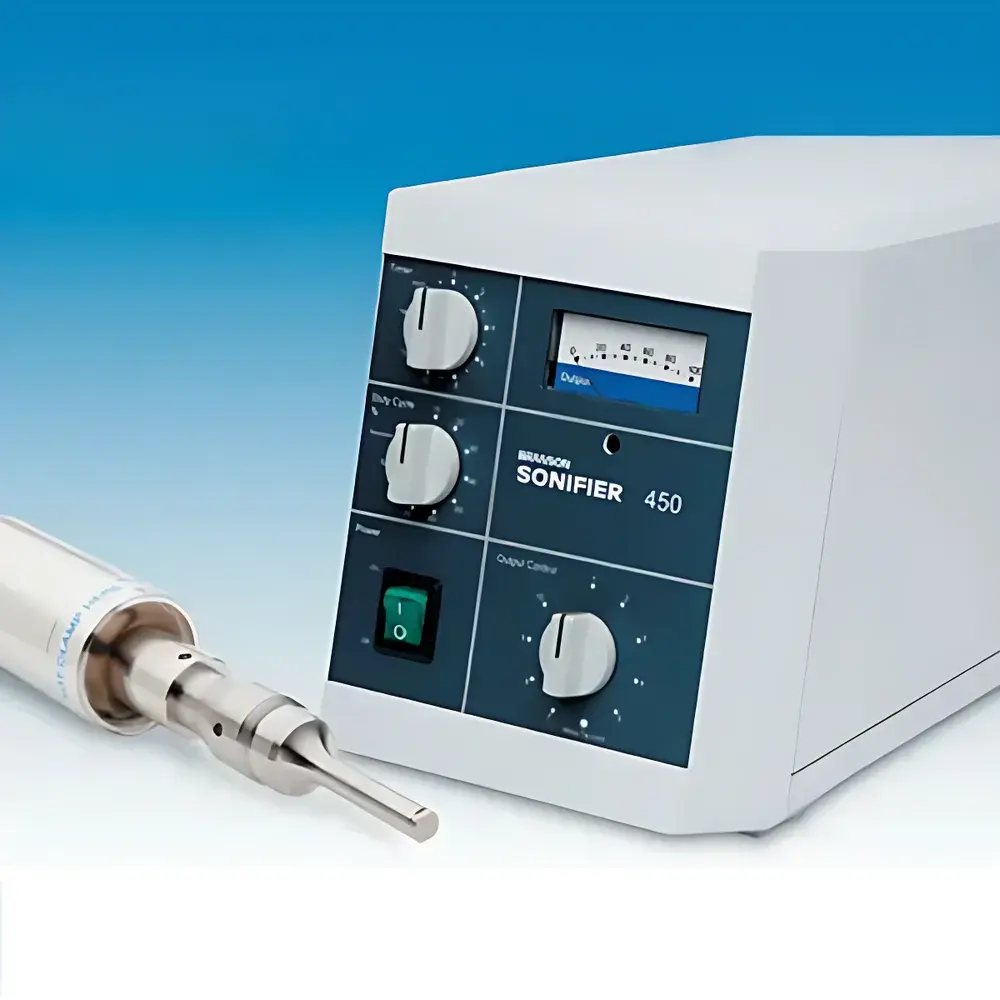
Branson Sonifier 250A Analog Ultrasonic Cell Disruptor
| Brand | Branson |
|---|---|
| Origin | USA |
| Model | Sonifier 250A |
| Output Power | 200 W |
| Operating Frequency | 20 kHz |
| Temperature Range | 0–99 °C |
| Sample Volume Capacity | 1 mL to 500 mL (batch or continuous flow) |
| Probe Type | Removable 1/2″ (13 mm) threaded horn |
| Input Voltage | 230 V AC, 50/60 Hz |
| Dimensions (W×H×D) | 19 × 25 × 45 cm |
| Weight | 8.62 kg |
| Compliance | CE, UL-listed power supply |
| Software Interface | Analog control (knob-based amplitude & time setting), no digital connectivity |
Overview
The Branson Sonifier 250A Analog Ultrasonic Cell Disruptor is a benchtop laboratory instrument engineered for controlled mechanical disruption of biological samples via high-intensity ultrasonic cavitation. Operating at a fixed frequency of 20 kHz, the system delivers precise acoustic energy through a piezoelectric transducer coupled to a titanium alloy probe (horn), generating localized pressure differentials that induce microbubble formation, growth, and violent collapse in liquid media. This cavitation process imparts intense shear forces, microstreaming, and localized heating—enabling efficient lysis of cells, homogenization of tissues, and dispersion of particulates without chemical additives. Designed for reproducible, operator-controlled processing in regulated environments, the Sonifier 250A serves as a foundational tool in molecular biology, protein biochemistry, nanomaterial synthesis, and upstream bioprocessing workflows where thermal management and amplitude linearity are critical.
Key Features
- 200 W nominal output power with analog amplitude control (0–100% full-scale), enabling fine-tuned energy delivery for sensitive samples such as primary neurons or membrane proteins
- Robust 20 kHz resonant frequency stabilized by Branson’s proprietary 102C transducer architecture, ensuring consistent cavitation threshold across extended operation cycles
- Interchangeable 13 mm (1/2″) threaded titanium horn with standardized threading (M12×1.75), compatible with optional tapered, microtip, and cup-horn accessories for volume- and geometry-specific applications
- Integrated temperature monitoring port (optional PT100 sensor input) supports external feedback loops when used with recirculating chillers—critical for heat-sensitive nucleic acid or enzyme extractions
- Front-panel analog timer (0–999 s) with pulse mode (ON/OFF duty cycle adjustable from 0.1–10 s) to minimize cumulative thermal load during prolonged sonication
- CE- and UL-certified power supply with overcurrent and overtemperature protection circuits compliant with IEC 61010-1 safety standards for Class II laboratory equipment
Sample Compatibility & Compliance
The Sonifier 250A accommodates sample volumes ranging from 1 mL (microtube lysis using microtip horns) to 500 mL (beaker-based homogenization with standard 13 mm probes), supporting both static batch and continuous-flow configurations via optional flow-through cells. It is routinely validated for use with mammalian cell lines (e.g., HEK293, CHO), bacterial cultures (E. coli BL21), plant leaf tissue, yeast suspensions, and liposomal formulations. The instrument meets essential regulatory prerequisites for GLP-compliant laboratories: its analog control architecture eliminates software-based audit trail requirements under FDA 21 CFR Part 11, while mechanical repeatability supports SOP-driven validation per ISO/IEC 17025 and ASTM E2872 (Standard Guide for Ultrasonic Processing of Biological Samples). All wetted components—including probe, gasket, and cup-horn adapters—are autoclavable (121 °C, 20 min), facilitating aseptic operation in GMP-aligned cell therapy development.
Software & Data Management
As an analog-controlled platform, the Sonifier 250A does not incorporate embedded firmware, network interfaces, or digital data logging. This design intentionally avoids electronic complexity to maximize operational reliability, reduce calibration drift, and simplify IQ/OQ validation in regulated settings. Process parameters—amplitude setting, duration, and pulse interval—are manually recorded in laboratory notebooks or integrated into LIMS via external time-stamped loggers. For users requiring traceability, Branson provides a companion Validation Support Package including probe calibration certificates (traceable to NIST), transducer resonance verification reports, and documented maintenance intervals aligned with ISO 9001 quality system requirements.
Applications
- Cell lysis and organelle isolation: Efficient disruption of Gram-negative bacteria and eukaryotic cells with minimal protease release, suitable for native co-immunoprecipitation and subcellular fractionation
- Nucleic acid shearing: Controlled fragmentation of genomic DNA for library preparation in next-generation sequencing (NGS), achieving narrow size distributions (±100 bp) under chilled conditions
- Nanoparticle dispersion: Deagglomeration of carbon nanotubes, metal oxides, and polymeric micelles in aqueous or organic solvents for formulation stability studies
- Emulsion and nanoemulsion generation: Production of oil-in-water systems with droplet diameters <200 nm, validated by dynamic light scattering (DLS)
- Tissue homogenization: Rapid, uniform breakdown of fibrous or lipid-rich tissues (liver, adipose, brain) prior to metabolite extraction or RNA stabilization
- Surface cleaning and microcontaminant removal: Precision cleaning of microfluidic chips, MEMS devices, and optical substrates where solvent-free debridement is required
FAQ
Is the Sonifier 250A compatible with hazardous solvents such as chloroform or DMSO?
Yes—provided appropriate probe material selection (e.g., corrosion-resistant titanium Grade 5), ventilation, and containment per OSHA 1910.1200. Probes must be rinsed immediately post-use to prevent solvent-induced stress cracking.
Can I use this instrument for continuous-flow processing?
Yes—when paired with Branson’s Model 101 Flow Cell accessory (sold separately), it supports flow rates up to 100 mL/min with temperature-controlled jacketing.
What is the expected service life of the transducer under normal lab usage?
With proper cooling and adherence to recommended duty cycles (<50% ON-time), Branson specifies ≥5,000 hours of operational life for the 102C transducer assembly.
Does the analog interface support integration with programmable logic controllers (PLCs)?
No—this model lacks analog voltage outputs or relay triggers; for automated integration, consider the digital Sonifier SFX series with 0–10 V control inputs and RS-232/USB interfaces.
How often should the probe tip be inspected for erosion?
Visual inspection is recommended before each use; measurable tip wear (>0.2 mm diameter reduction) necessitates replacement to maintain cavitation efficiency and amplitude fidelity.






