
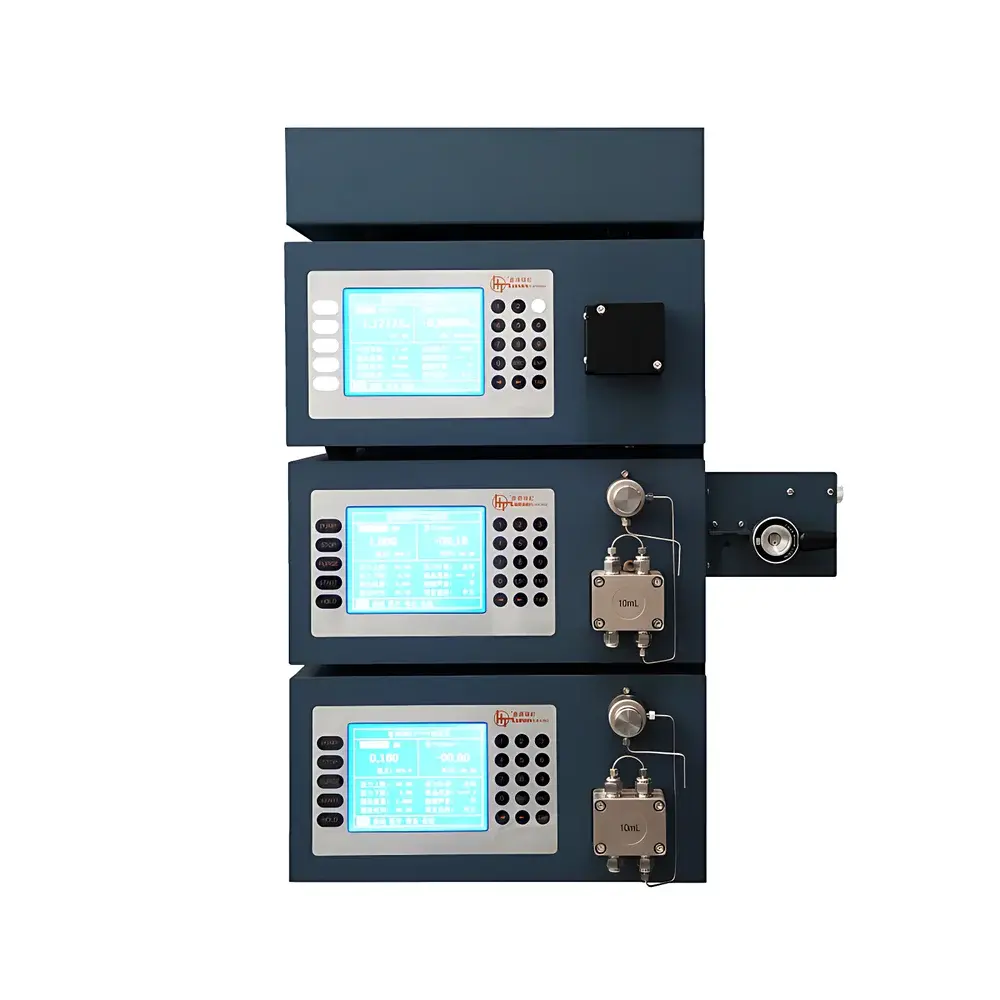
LuNan RuiHong LC-1000D Ultra-High Performance Liquid Chromatograph
| [Brand | LuNan RuiHong |
|---|---|
| Model | LC-1000D |
| Flow Rate Range | 0.001–9.999 mL/min |
| Max Operating Pressure | ≤ 42 MPa |
| Flow Precision | ≤ 0.1% RSD |
| Injection Volume Range | 0–30 µL |
| Column Oven Temperature Range | Ambient to 80 °C |
| UV-Vis Wavelength Range | 190–900 nm |
| Detector Type | Dual-Wavelength UV-Vis Photodiode Array (PDA)-Capable Optical System |
| Compliance | AIA/CDF File Support, GLP-Compliant Audit Trail, 21 CFR Part 11 Ready (Software-Configurable)] |
Overview
The LuNan RuiHong LC-1000D Ultra-High Performance Liquid Chromatograph (UHPLC) is a fully integrated, modular HPLC system engineered for precision, robustness, and regulatory readiness in routine and method-development laboratories. Based on high-pressure liquid chromatography principles—employing gradient elution, isocratic separation, and post-column derivatization compatibility—the LC-1000D delivers reproducible retention time stability and quantitative accuracy across diverse analyte classes including small-molecule pharmaceuticals, natural products, environmental contaminants, and food additives. Its dual-wavelength UV-Vis detection architecture leverages a double-beam optical path to minimize baseline drift induced by lamp intensity fluctuations or solvent absorption shifts. Coupled with digitally controlled monochromator actuation and TTL-regulated deuterium lamp power management, the system ensures long-term wavelength accuracy ( 2,000 h under typical usage). The instrument’s hydraulic architecture supports both standard 4.6 mm ID analytical columns and narrow-bore (2.1 mm ID) UHPLC columns, enabling seamless transition between legacy HPLC methods and modern high-resolution separations.
Key Features
- High-stability binary or quaternary gradient pumping system with electronic pulse damping and multi-point flow calibration across the full 0.001–9.999 mL/min range
- Dual-wavelength UV-Vis detector featuring real-time simultaneous monitoring at two user-selectable wavelengths (190–900 nm), with automatic wavelength self-calibration at startup
- Column compartment with precise Peltier-based temperature control (ambient to 80 °C, ±0.2 °C stability), supporting method transfer and retention time reproducibility
- Autosampler with programmable injection volumes (0–30 µL), low carryover (< 0.01%), and needle wash capability for trace-level analysis
- Integrated digital signal processing electronics that reduce electrical noise contribution to baseline RMS noise < 0.5 × 10⁻⁵ AU at 254 nm
- Modular design allowing field-upgradeable components: detector cell options (10 mm, 6 mm, or microflow cells), pump heads, and autosampler trays
Sample Compatibility & Compliance
The LC-1000D accommodates a broad spectrum of sample matrices—including aqueous extracts, organic solvent dilutions, protein digests (post-enzymatic cleavage), and ion-paired mobile phases—without compromising seal lifetime or baseline integrity. Its fluidic pathway employs chemically resistant stainless steel and PEEK tubing rated for pH 1.5–12.5 and compatible with acetonitrile, methanol, THF, and aggressive buffers (e.g., TFA, ammonium formate). From a regulatory perspective, the system meets foundational requirements for Good Laboratory Practice (GLP) and current Good Manufacturing Practice (cGMP) environments. The chromatography data system (CDS) supports AIA-standard CDF file import/export, full electronic audit trail (user actions, parameter changes, sequence edits), and configurable 21 CFR Part 11 compliance—including electronic signatures, role-based access control, and immutable raw data archiving. It is validated for use in accordance with ICH Q2(R2), USP , and ISO/IEC 17025-accredited testing workflows.
Software & Data Management
The LC-1000D is operated via a Windows-native CDS platform designed for analytical traceability and workflow efficiency. Unlike legacy chromatography data systems that replicate mainframe-era paradigms, this software implements intelligent peak detection algorithms based on second-derivative thresholding and adaptive baseline modeling—reducing manual integration interventions by >60% in complex biological matrices. Quantitative reports comply with LIMS-ready templates and export directly to Microsoft Word (formatted reports), Excel (calibration curves, summary tables), and Access (structured database ingestion). Spectral overlays, spectral library matching (NIST-compatible), and arithmetic operations (peak subtraction, co-elution masking, spectral deconvolution) are natively supported. All raw acquisition files (.raw) retain full metadata—including instrument configuration, method parameters, and environmental logs—for retrospective reprocessing and regulatory inspection readiness.
Applications
- Pharmaceutical QC/QA: Assay, related substances, residual solvents, and dissolution testing per USP/EP monographs
- Clinical research: Therapeutic drug monitoring (TDM) of immunosuppressants, antiepileptics, and antibiotics
- Environmental analysis: PAHs, PCBs, pesticides, and endocrine disruptors in water and soil extracts
- Food & beverage safety: Mycotoxins (aflatoxin B1, ochratoxin A), preservatives (sorbates, benzoates), and artificial colors
- Natural product characterization: Flavonoid profiling, alkaloid quantification, and saponin fingerprinting in herbal extracts
- Academic method development: Robustness testing, forced degradation studies, and column selectivity screening
FAQ
Is the LC-1000D compatible with mass spectrometry interfaces?
Yes—the system features standard 1/16″ stainless steel capillary ports and pressure-rated fittings suitable for direct coupling to ESI or APCI sources; optional split-flow modules are available for optimal flow matching.
Does the software support multi-user environments with permission tiers?
Yes—administrator, analyst, and reviewer roles can be assigned with granular controls over method editing, sequence execution, report generation, and audit log access.
Can the detector perform full-spectrum scanning during gradient runs?
Yes—the PDA-capable optical module supports time-resolved spectral acquisition at up to 20 Hz, enabling peak purity assessment and spectral library searching without interrupting the chromatographic run.
What validation documentation is provided with the instrument?
Factory-installed IQ/OQ protocols compliant with ASTM E2500-13 and ISO/IEC 17025 are included, along with editable templates for PQ execution and periodic performance verification.
Is remote monitoring and control supported?
Yes—via secure HTTPS-based web interface (optional license), enabling real-time status checks, queue management, and alarm notifications through enterprise IT infrastructure.



