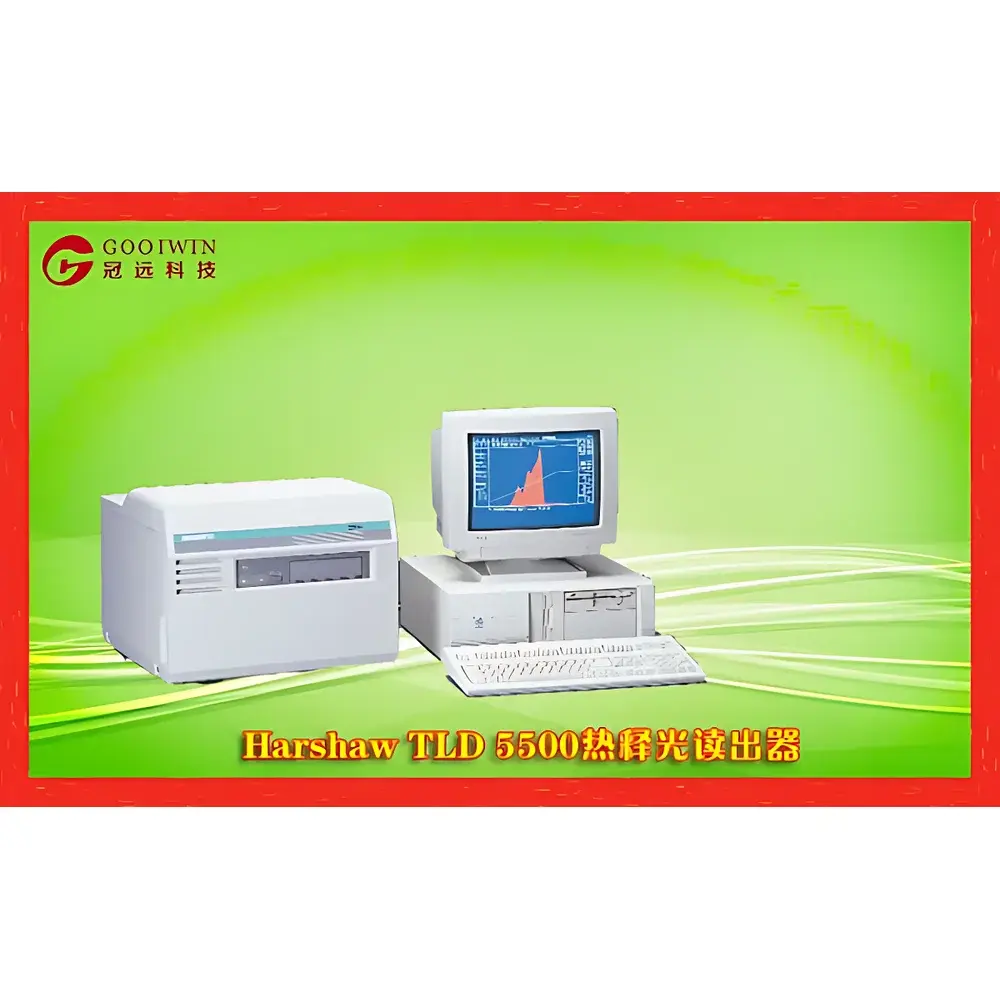
Harshaw TLD 5500 Thermoluminescence Reader
| Brand | UNION |
|---|---|
| Origin | USA |
| Manufacturer Type | Authorized Distributor |
| Origin Category | Imported |
| Model | TLD 5500 |
| Pricing | Available Upon Request |
Overview
The Harshaw TLD 5500 Thermoluminescence Reader is a precision-engineered instrument designed for qualitative detection of ionizing radiation exposure in food and botanical materials. It operates on the fundamental principle of thermoluminescence (TL): when crystalline inorganic minerals—such as quartz, feldspar, or silicates—adsorbed on food surfaces (e.g., spices, herbs, dried vegetables, seafood, and fruits) are exposed to ionizing radiation (e.g., gamma, X-ray, or electron beam), lattice defects (trapped electrons/holes) are formed. Upon controlled heating in the TLD 5500, these defects recombine, emitting photons in the visible–near-UV range. The resulting TL glow curve—intensity vs. temperature—is characteristic of irradiated material and distinct from non-irradiated controls. This method does not quantify absorbed dose but provides robust, standardized discrimination between irradiated and non-irradiated samples per internationally recognized screening protocols.
Key Features
- Programmable heating profile with precise temperature ramp control (typically 1–10 °C/s) and high-resolution thermocouple feedback
- Low-noise photomultiplier tube (PMT) detector optimized for spectral sensitivity in the 300–600 nm range, aligned with typical TL emission maxima of silicate minerals
- Dual-sample chamber design enabling simultaneous readout of reference and test specimens under identical thermal conditions
- Integrated dark-count compensation and background subtraction algorithms to enhance signal-to-noise ratio for low-intensity TL signals
- Robust mechanical architecture compliant with ISO/IEC 17025 laboratory environmental requirements (vibration-damped base, EMI-shielded enclosure)
- Calibration traceable to NIST-traceable TL standards; supports routine performance verification using reference mineral dosimeters
Sample Compatibility & Compliance
The TLD 5500 is validated for use with mineral extracts isolated from a broad spectrum of food matrices—including ground spices (e.g., paprika, black pepper), dried herbs (e.g., oregano, thyme), shellfish, leafy greens, and freeze-dried fruits—following standardized pre-treatment protocols (e.g., ISO/ASTM 13751, EN 1788). Sample preparation involves density separation (e.g., sodium polytungstate flotation), acid etching (to remove organic residues), and sedimentation to isolate TL-active silicate fractions. The system meets the technical requirements for screening-level analysis as stipulated in EU Directive 1999/2/EC and FDA 21 CFR Part 179.26. Data integrity complies with ALCOA+ principles; audit trails, user access logs, and electronic signatures support GLP/GMP-regulated environments.
Software & Data Management
The instrument is operated via dedicated Windows-based software (TLD Analyst v4.x) supporting full ICH-GCP and FDA 21 CFR Part 11 compliance. Software features include automated glow curve acquisition, peak deconvolution (Gaussian/Lorentzian fitting), integrated threshold calculation (based on ≥30 non-irradiated control measurements per matrix), and pass/fail decision logic per EN 1788 Annex B. Raw data (ASCII .txt) and processed reports (PDF/XLSX) are exportable with embedded metadata (operator ID, date/time, calibration status, instrument ID). All data modifications are time-stamped and attributable; electronic records are stored with write-once-read-many (WORM) archiving capability.
Applications
- Regulatory screening of imported spices and dried botanicals for unauthorized irradiation
- Verification of irradiation treatment claims in certified organic or halal/kosher supply chains
- Post-process validation in industrial food irradiation facilities (gamma, e-beam, X-ray)
- Research applications in radiation-induced defect kinetics of natural silicates
- Interlaboratory proficiency testing under FAPAS or IRMM reference material programs
FAQ
What types of food samples can be analyzed with the TLD 5500?
Spices, dried herbs, shellfish, frozen or dried fruits/vegetables, and any food matrix containing separable inorganic mineral contaminants (e.g., soil-derived quartz or feldspar).
Is the TLD 5500 suitable for quantitative dose measurement?
No—it is a qualitative screening tool. Quantitative dosimetry requires calibrated TLD chips (e.g., LiF:Mg,Ti) and separate calibration curves; this system is configured exclusively for regulatory identification of irradiation history.
Does the method require destructive sample preparation?
Yes. Mineral extraction involves chemical (HCl/HF) and physical (density separation, centrifugation) steps per ISO 13751. The original food product is not preserved.
How is the irradiation threshold determined?
Thresholds are matrix-specific and established statistically (mean + 3σ of TL intensity from ≥30 non-irradiated controls), validated annually and documented in the laboratory’s SOP.
Can the TLD 5500 be used for environmental or medical TL dosimetry?
Not without hardware and firmware modification. Its optical path, thermal program, and software logic are optimized solely for food mineral TL screening per EN 1788 and ASTM 13751.