
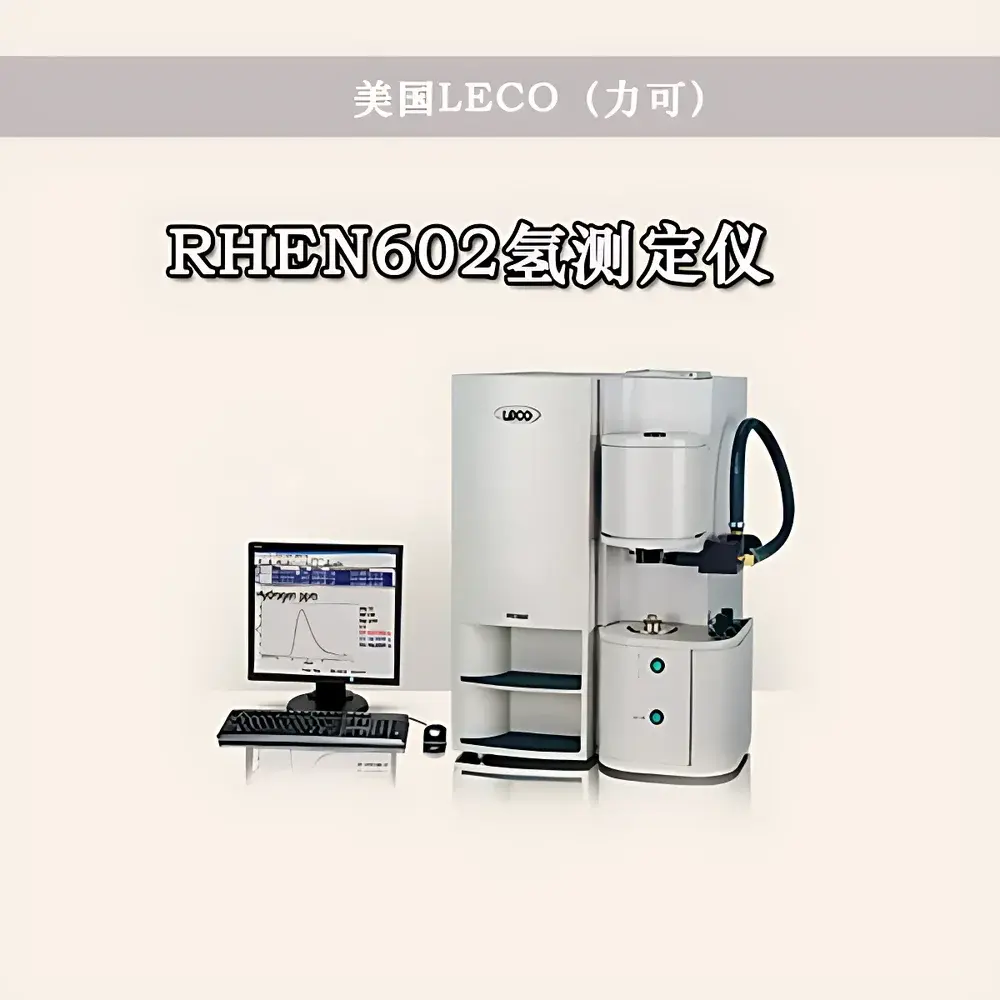
Leco RHEN602 Hydrogen Determinator
| Origin | USA |
|---|---|
| Manufacturer Type | Authorized Distributor |
| Origin Category | Imported |
| Model | RHEN602 |
| Instrument Type | Hydrogen Analyzer |
| Sample Capacity | Up to 6 g |
| Detection Limit | 0.05 ppm H in 1 g sample |
| Analysis Method | Inert Gas Fusion Thermal Conductivity Detection |
| Calibration Options | Certified Reference Materials & Standard Gases |
| Software Platform | Windows-based LECO SmartSoft™ |
| Compliance Ready | ASTM E1447, ISO 14284, USP <233>, GLP/GMP audit trail capable |
| Remote Support | Optional SmartLine® Diagnostic Interface |
Overview
The LECO RHEN602 Hydrogen Determinator is a high-precision inert gas fusion (IGF) analyzer engineered for the quantitative determination of hydrogen in metallic and inorganic solid materials. It operates on the principle of thermal decomposition under high-purity helium or argon atmosphere, followed by quantitative detection of evolved hydrogen gas via high-stability solid-state thermal conductivity detection (TCD). Designed specifically for demanding applications in metallurgy, aerospace, nuclear materials, and advanced alloy development, the RHEN602 delivers reliable quantification of ultra-trace hydrogen concentrations—down to 0.05 ppm in a 1 g sample—without matrix interference from nitrogen or oxygen. Its robust graphite crucible-based electrode furnace enables controlled, programmable ramping profiles (up to 3000 °C), allowing differentiation between surface-adsorbed hydrogen and bulk-dissolved (matrix) hydrogen through sequential temperature-zone analysis. This capability is critical for failure analysis of embrittled components and qualification of high-purity titanium, zirconium, niobium, and aluminum alloys where hydrogen-induced cracking remains a primary reliability concern.
Key Features
- Programmable graphite electrode furnace with multi-stage ramp/hold thermal profiles for selective release and distinction of surface vs. matrix hydrogen
- Maximum sample mass capacity of 6 g—enhancing signal-to-noise ratio and statistical reproducibility for low-concentration measurements
- Solid-state thermal conductivity detector with drift-compensated electronics, optimized for H2 selectivity in helium carrier gas streams
- Dual calibration methodology: certified solid reference materials (e.g., NIST SRM 1261a, LECO HR-1) and certified hydrogen-in-helium standard gases
- Preset application methods pre-configured for aluminum, titanium, stainless steels, superalloys, ceramics, and refractory metals
- Embedded self-diagnostic firmware continuously monitors furnace current, gas flow stability, detector baseline, and vacuum integrity—reducing unscheduled downtime
- SmartSoft™ software platform compliant with FDA 21 CFR Part 11 requirements, supporting electronic signatures, audit trails, and user role-based access control
- Optional SmartLine® remote connectivity enabling secure, encrypted technician-assisted diagnostics and real-time parameter optimization
Sample Compatibility & Compliance
The RHEN602 accommodates diverse solid sample forms—including chips, turnings, powders, and machined discs—within standardized graphite crucibles. It is validated for use with non-ferrous metals (Al, Ti, Mg, Cu), refractory metals (Nb, Ta, Mo, W), reactive metals (Zr, Hf), and oxide ceramics (Al2O3, SiO2). All analytical protocols align with internationally recognized standards: ASTM E1447 (Standard Test Method for Determination of Hydrogen in Titanium and Titanium Alloys), ISO 14284 (Steel and Iron—Determination of Hydrogen), and ISO 16920 (Aluminum and Aluminum Alloys—Determination of Hydrogen). System validation documentation supports GLP and GMP environments, including IQ/OQ/PQ templates, calibration logs, and raw data archiving per ALCOA+ principles.
Software & Data Management
LECO SmartSoft™ provides a fully integrated Windows-based interface with modular workflows for method setup, run execution, real-time chromatogram visualization, peak integration, and report generation. Data tables support batch-level metadata tagging (operator ID, lot number, heat ID), automatic statistical summaries (mean, SD, RSD, confidence intervals), and export to CSV, XML, or LIMS-compatible formats. Audit trail functionality records all user actions—including method edits, calibration events, and result overrides—with timestamp, operator ID, and reason-for-change fields. Raw detector voltage traces and furnace temperature profiles are retained with full traceability for regulatory review.
Applications
- Quality control of aerospace-grade titanium ingots and forgings for hydrogen embrittlement risk assessment
- Process validation of vacuum arc remelting (VAR) and electron beam melting (EBM) operations
- Research into hydrogen diffusion kinetics and trapping behavior in high-entropy alloys
- Failure analysis of cracked turbine blades, landing gear components, and nuclear fuel cladding
- Specification compliance testing per AMS 2301, ASTM B265, and MIL-T-9047
- Hydrogen content certification for medical-grade cobalt-chromium and nickel-titanium implants
FAQ
What sample preparation is required prior to analysis?
Samples must be clean, dry, and free of oils or coolants; machining debris should be removed via ultrasonic cleaning in acetone or isopropanol. Surface oxidation is acceptable but excessive scale may require light abrasion.
Can the RHEN602 quantify hydrogen in ceramic or composite matrices?
Yes—provided the material is thermally stable below 3000 °C and does not generate interfering volatiles (e.g., halogens, sulfur compounds) during fusion. Method validation with matrix-matched CRMs is recommended.
Is helium the only carrier gas option?
Helium is standard for optimal TCD sensitivity and baseline stability; argon may be used for specific high-temperature applications where helium permeation is a concern—but requires recalibration.
How often must the thermal conductivity detector be calibrated?
Detector zero and span calibration is performed automatically before each sequence using internal reference gas valves; full system calibration with CRMs is recommended every 40–60 analyses or per shift in high-throughput labs.
Does SmartLine® remote access require permanent internet connectivity?
No—SmartLine® operates over secure, on-demand TLS-encrypted sessions initiated by the user; no open ports or persistent connections are established on the local network.
Related Products






