
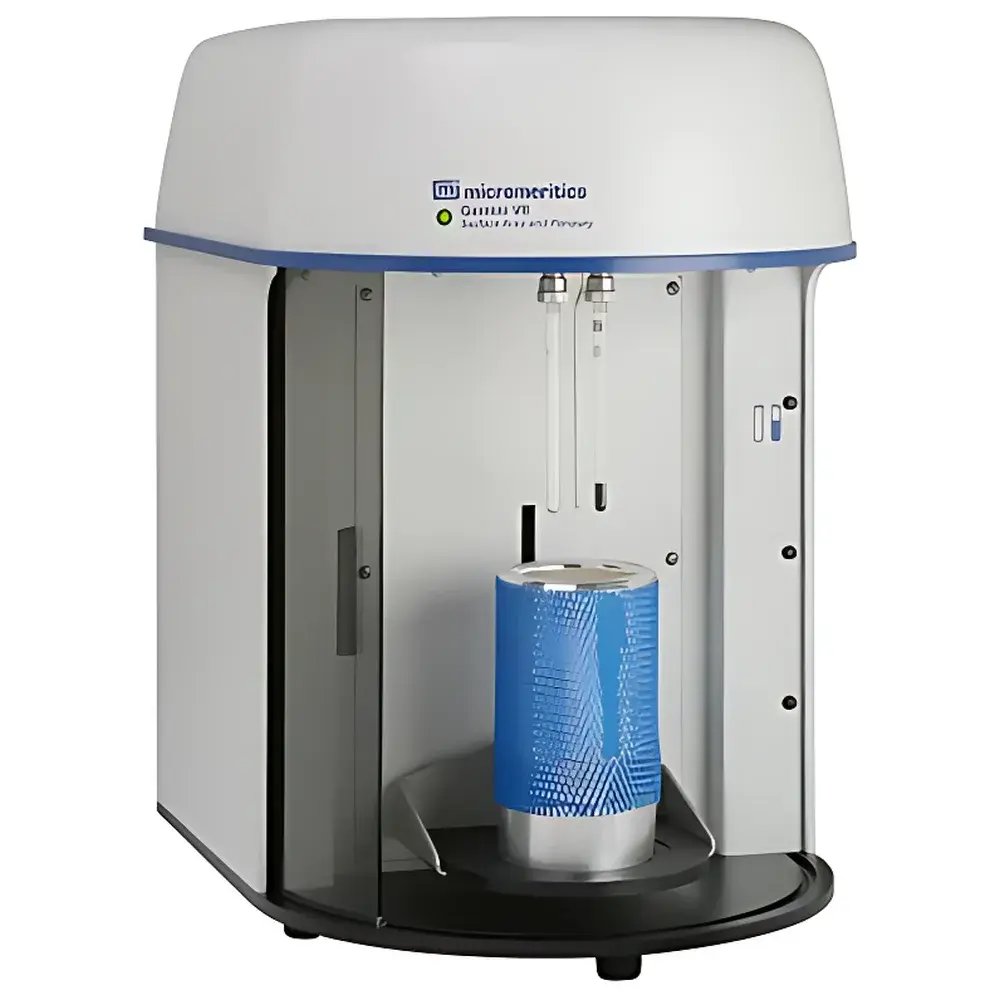
Micromeritics Gemini VII 2390 Surface Area and Porosimetry Analyzer
| Brand | Micromeritics |
|---|---|
| Origin | USA |
| Model | Gemini VII 2390 |
| Sample Analysis Principle | Gas Adsorption (N₂, Ar, Kr, or other non-reactive gases) |
| BET Surface Area Range | 0.01–5000 m²/g (typical) |
| Pore Size Analysis Range | 0.35–500 nm (micro- to macropores) |
| Measurement Technique | Static Volumetric Gas Adsorption with Reference Balance Tube Design |
| Software Platform | Micromeritics Gemini VII Windows® Software |
| Compliance Options | 21 CFR Part 11 Ready (optional Confirm™ module), IQ/OQ Documentation Available |
| Gas Flexibility | Helium-free dead volume calibration, multi-gas compatibility (N₂, Ar, Kr, CO₂) |
| Data Points per Isotherm | Up to 2000 |
| Automation Level | Fully computer-controlled (no front-panel buttons) |
| Standards Supported | ASTM D3765, ASTM D6556, ISO 9277, ISO 18852, ISO 4652 |
Overview
The Micromeritics Gemini VII 2390 Surface Area and Porosimetry Analyzer is a static volumetric gas adsorption instrument engineered for high-precision, high-reproducibility measurement of specific surface area, pore volume, and pore size distribution across micro-, meso-, and macroporous materials. It operates on the fundamental principle of physical gas adsorption—most commonly nitrogen at 77 K—to generate adsorption and desorption isotherms. The system employs a patented dual-tube reference balance design, where a dedicated reference tube compensates in real time for changes in liquid nitrogen level during analysis. This architecture eliminates systematic error associated with variable free space volume—a known limitation in single-tube manometric systems—and ensures traceable accuracy without reliance on helium for free space calibration. Designed for laboratory environments requiring regulatory compliance, research-grade data integrity, and teaching-ready simplicity, the Gemini VII 2390 delivers robust performance across academic, industrial QC, and R&D settings.
Key Features
- Reference balance tube technology for automatic compensation of cryogen level drift, enabling stable, drift-free isotherm acquisition
- Helium-free dead volume determination using gas expansion or pressure-step methods—reducing operational cost and gas dependency
- Multi-gas capability: supports N₂, Ar, Kr, CO₂, and other inert gases for tailored surface area and pore analysis (e.g., CO₂ at 273 K for ultramicropore characterization)
- Integrated P₀ (saturation pressure) monitoring tube for high-resolution isotherm capture near P/P₀ = 1, critical for accurate BJH and DFT-based pore size distribution modeling
- Optional large-capacity Dewar and extended sample tubes enable full adsorption-desorption isotherms with up to 2000 data points per branch
- Fully automated operation: no manual controls on instrument front panel; all sequences initiated and monitored via PC
- Comprehensive built-in data processing: single- and multi-point BET, Langmuir, t-plot, αs-plot, BJH, MP, DFT/NLDFT, Temkin, Freundlich, and STSA (per ASTM D6556 & D3765)
Sample Compatibility & Compliance
The Gemini VII 2390 accommodates a broad spectrum of solid materials—including zeolites, activated carbons, MOFs, silica gels, alumina catalysts, clays, soils, pharmaceutical excipients, and battery electrode materials—without requiring specialized sample holders or pre-conditioning beyond standard degassing. Its modular vacuum manifold and programmable degas station options (sold separately) support thermal, vacuum, or flow-through sample preparation per ASTM D7608 and ISO 15901. For regulated environments, optional Confirm™ software provides 21 CFR Part 11 compliance with electronic signatures, audit trails, user access control, and data immutability. Factory-installed IQ/OQ documentation packages are available to support GLP, GMP, and ISO/IEC 17025 laboratory accreditation requirements.
Software & Data Management
The Gemini VII Windows® software serves as both instrument controller and analytical engine. It features intuitive workflow-driven method setup, real-time isotherm visualization, and batch processing for comparative analysis across sample sets. All raw pressure, temperature, and time-stamped data are stored in encrypted binary format with embedded metadata (operator ID, date/time, calibration history, gas lot numbers). Export options include CSV, PDF reports (customizable templates), and XML for LIMS integration. Advanced users may access raw isotherm data for third-party modeling (e.g., QSDFT, Monte Carlo simulations). Audit trail logs record every parameter change, report generation event, and user login—fully compliant with FDA and EMA data integrity expectations.
Applications
This analyzer is routinely deployed in catalyst development labs to quantify active surface area loss after thermal aging; in battery material R&D to correlate BET surface area with SEI formation kinetics; in environmental science for assessing contaminant adsorption capacity of biochars and clay minerals; and in quality assurance workflows for incoming raw material verification against specification limits (e.g., USP for pharmaceutical excipients). Its ability to compute STSA per ASTM D3765 makes it indispensable for carbon black producers validating reinforcement efficiency in rubber compounding. The t-plot and αs-plot modules provide rigorous micropore quantification for MOF screening, while NLDFT kernel libraries allow pore geometry inference in disordered silicas and carbons.
FAQ
Does the Gemini VII 2390 require helium for free space calibration?
No. The system supports helium-free free volume determination using pressure-step or gas expansion techniques, reducing consumable costs and supply chain dependencies.
Can I perform CO₂ adsorption at 0 °C for ultramicropore analysis?
Yes. With appropriate gas handling accessories and temperature control modules, CO₂ adsorption at 273 K is fully supported for sub-0.7 nm pore characterization.
Is the software validated for regulated pharmaceutical use?
The optional Confirm™ software package includes documented IQ/OQ protocols and meets 21 CFR Part 11 technical requirements for electronic records and signatures.
What degassing options integrate with the Gemini VII 2390?
Micromeritics offers standalone and integrated degas stations (e.g., VacPrep 061, FlowPrep 061) with programmable temperature ramps, vacuum levels, and purge gas flow control—compatible with all Gemini VII models.
How does the reference tube design improve measurement reproducibility?
By continuously tracking and compensating for buoyancy and thermal expansion effects induced by liquid nitrogen level changes, the reference tube minimizes baseline drift and enhances repeatability across long-duration isotherms.





