
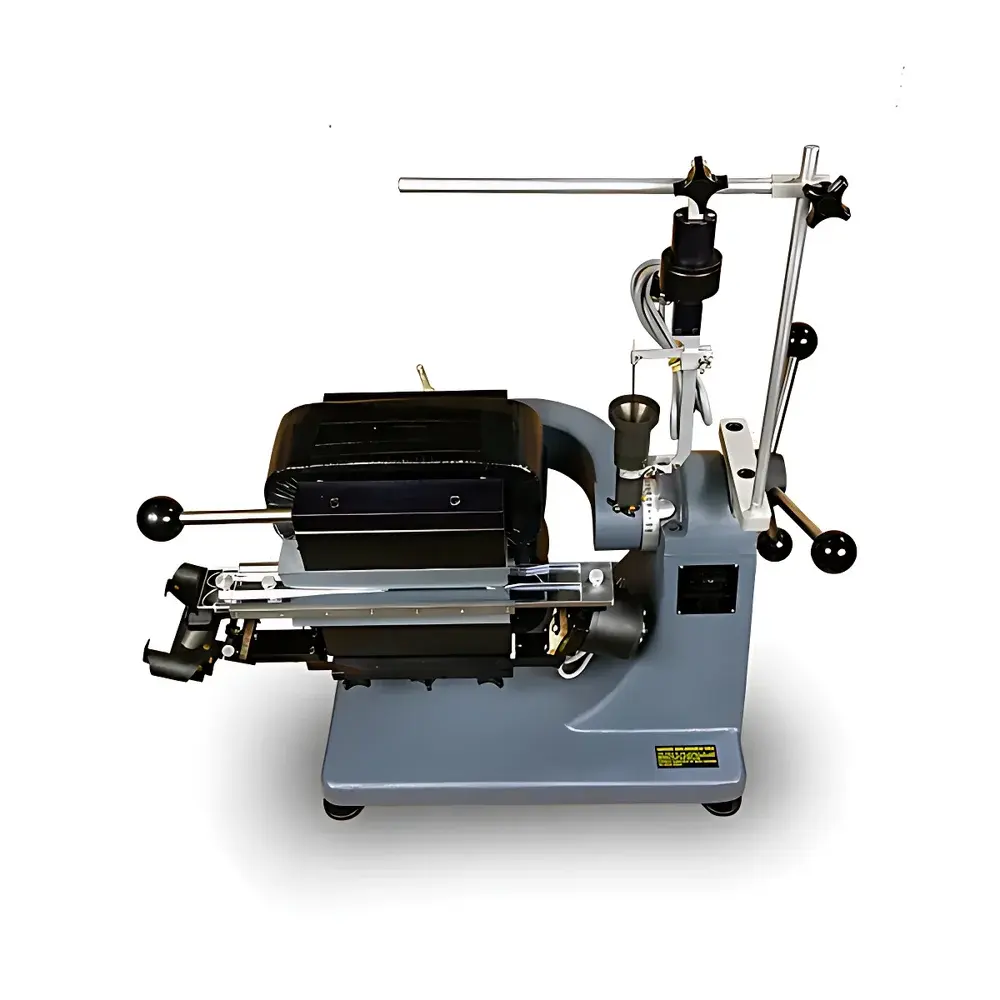
Frantz LB-1 High-Gradient Magnetic Separator
| Brand | Frantz |
|---|---|
| Origin | USA |
| Model | LB-1 |
| Voltage | 110–120 V AC, 3.0 A, 50–60 Hz |
| Dimensions (W×D×H) | 41 × 81 × 86 cm |
| Net Weight | 150 kg |
| Shipping Weight | 252 kg |
| Magnetic Field Range | 1–20 kG (in vacuum) |
Overview
The Frantz LB-1 High-Gradient Magnetic Separator is an electromagnetically driven, gravity-assisted continuous separation system engineered for precise isolation of paramagnetic, diamagnetic, and ferromagnetic particles from heterogeneous solid, slurry, or dry powder feedstocks. Operating on the principle of high-gradient magnetic separation (HGMS), the LB-1 generates controlled magnetic field gradients across a packed matrix—typically stainless steel wool or expanded metal—where magnetic susceptibility differences induce differential trajectories under combined gravitational and Lorentz forces. Unlike low-gradient systems relying solely on bulk magnetization, the LB-1’s inclined magnet geometry ensures particles traverse the active separation zone at defined velocities, enabling reproducible fractionation based on magnetic susceptibility (χ), particle size, and density. Designed for laboratory-scale mineralogical, geochemical, and materials science applications, it supports both qualitative phase enrichment and quantitative susceptibility-based sorting under ambient or controlled environmental conditions.
Key Features
- Adjustable electromagnetic field strength ranging from 1 to 20 kG (measured in vacuum), calibrated via precision current regulation and thermally compensated power supply.
- Inclined magnetic matrix architecture that leverages gravity-driven particle flow while maximizing exposure time within the high-gradient region.
- Modular, large-volume magnetic matrix assembly—fully enclosed within the separation chamber—enabling scalable throughput without compromising gradient uniformity.
- Integrated matrix deactivation and rapid rinse protocol: magnetic field can be fully quenched in <5 seconds; automated or manual matrix cleaning cycles minimize carryover between samples.
- Robust construction rated for operation in chemically aggressive environments—including exposure to acidic, alkaline, or organic solvent slurries—and compatible with elevated temperature feed streams (up to 80 °C with optional thermal shielding).
- Fail-safe electrical design compliant with UL 61010-1 and IEC 61000-6-3 standards; includes overcurrent protection, thermal cutoff, and grounded chassis insulation.
Sample Compatibility & Compliance
The LB-1 accommodates a broad spectrum of feed materials: dry granular solids (e.g., crushed rock, synthetic ceramics), aqueous or organic suspensions (up to 40 wt% solids), and gas-borne particulates (with optional aerosol inlet adapter). Its open-channel feed geometry eliminates clogging risks associated with narrow-bore magnetic filters. All wet-contact components are fabricated from 316 stainless steel or PTFE-lined surfaces, ensuring resistance to corrosion from halides, sulfates, and oxidizing agents. The system meets ASTM D7539–22 for magnetic susceptibility measurement of geological specimens and supports GLP-compliant workflows when paired with audit-trail-enabled data logging (via optional RS-485 interface). No radioactive or explosive atmospheres are supported; operation in Class I, Division 2 hazardous locations requires third-party explosion-proof certification.
Software & Data Management
The LB-1 operates as a stand-alone analog instrument with front-panel current and voltage monitoring. For traceable operation, an optional digital control module (Frantz DCM-LB1) provides USB/RS-485 connectivity, real-time current stabilization feedback, and timestamped operational logs—including field intensity, run duration, and thermal drift compensation events. Data export conforms to CSV and XML formats compatible with LIMS integration. Firmware adheres to FDA 21 CFR Part 11 requirements for electronic records when deployed with validated user access controls and electronic signatures (available through Frantz’s GxP Support Package).
Applications
- Mineral separation for petrographic analysis: isolation of biotite, garnet, ilmenite, and monazite from crushed igneous or metamorphic samples.
- Environmental remediation research: recovery of iron oxide nanoparticles or heavy-metal-bearing magnetic colloids from soil leachates.
- Materials synthesis QC: removal of ferromagnetic catalyst residues (e.g., Ni, Co) from battery cathode precursors or ceramic powders.
- Geochronology sample prep: magnetic cleaning of zircon separates prior to U–Pb isotopic analysis.
- Biomineralization studies: extraction of magnetosome-producing bacteria or iron-rich extracellular vesicles from culture media.
FAQ
What is the maximum recommended feed rate for dry powders?
For optimal resolution, dry feed rates should not exceed 10–15 g/min using the standard steep-slope feed tray; higher throughput requires custom matrix configuration and flow calibration.
Can the LB-1 operate continuously for extended periods?
Yes—rated for intermittent duty cycles up to 8 hours per day at nominal current (1.8 A); sustained operation above 3 hours requires active cooling of the coil housing and periodic matrix inspection.
Is calibration traceable to NIST standards?
Field intensity calibration is performed using a certified Hall-effect gaussmeter (NIST-traceable probe); full system verification reports are available upon request.
Does the LB-1 support ISO/IEC 17025-compliant validation?
Yes—Frantz provides IQ/OQ documentation templates and on-site PQ support for laboratories seeking accreditation under ISO/IEC 17025:2017 Clause 6.4.3 (equipment verification).




