
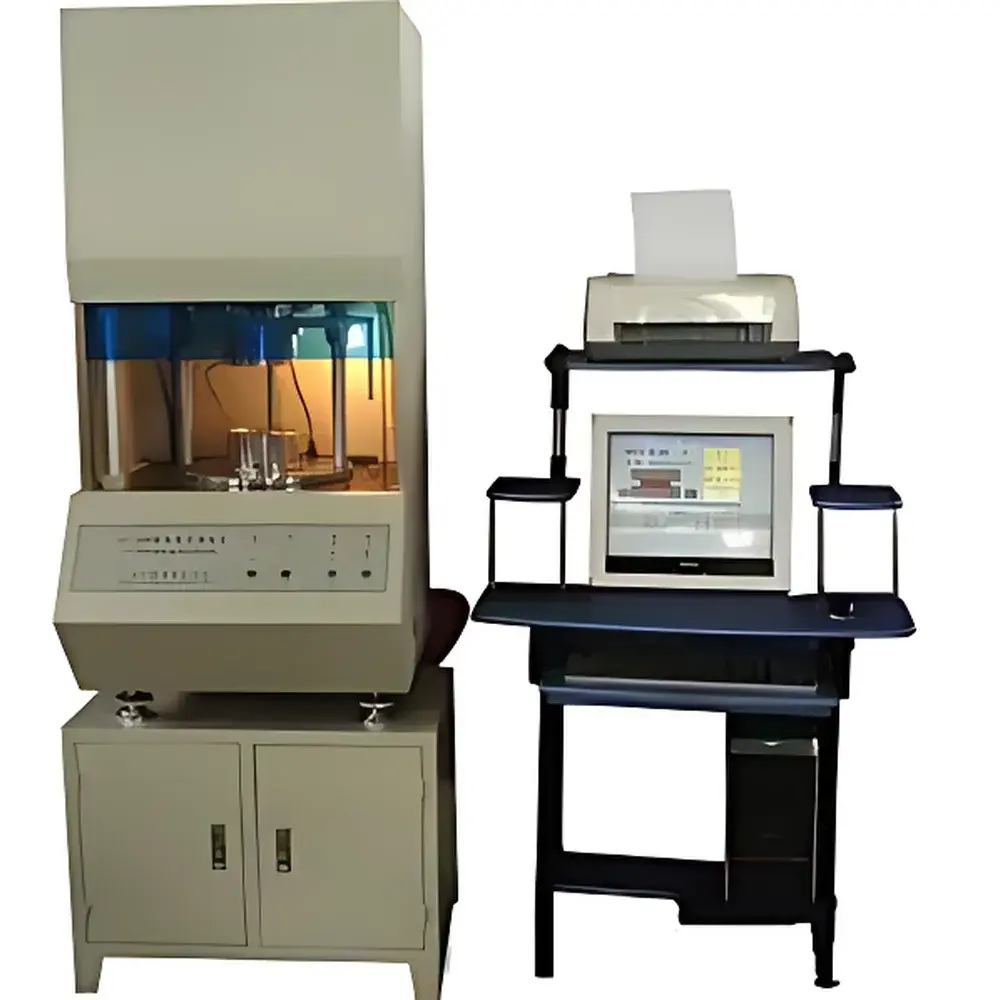
Alpha MV2000 Mooney Viscometer
| Origin | USA |
|---|---|
| Manufacturer Type | Authorized Distributor |
| Origin Category | Imported Instrument |
| Model | MV2000 |
| Pricing | Available Upon Request |
Overview
The Alpha MV2000 Mooney Viscometer is a precision-engineered, microprocessor-controlled instrument designed for the standardized determination of Mooney viscosity and stress relaxation behavior of raw and compounded rubber materials. Based on the fundamental principle of rotational viscometry under constrained shear flow—specifically, the measurement of torque required to rotate a standardized rotor (typically a 38.1 mm diameter, slotted disk) within a heated, closed cavity filled with uncured rubber compound—the MV2000 delivers traceable, reproducible results in strict compliance with ASTM D1646, ISO 289, and GB/T 1232.1. Its thermally stabilized cavity system maintains sample temperature within ±0.1 °C across the standard operating range of 100 °C to 140 °C, ensuring high fidelity to the Mooney test protocol. Unlike legacy analog instruments, the MV2000 integrates real-time digital torque sensing, automatic thermal equilibrium detection, and self-verifying calibration routines—enabling consistent data acquisition even under variable ambient conditions or extended production shifts.
Key Features
- High-precision torque transduction system with <0.2% full-scale linearity and long-term stability, supporting repeatable Mooney unit (MU) reporting per ASTM D1646 Section 7.3.
- Integrated stress relaxation mode: post-Mooney viscosity measurement, the instrument automatically executes a controlled rotor stop sequence and monitors torque decay over time (typically 0–300 s), yielding quantitative indicators of elastic recovery (e.g., ML1+4 vs. ML1+8) and viscoelastic relaxation kinetics.
- Automated cavity temperature control with dual-zone PID regulation and embedded Pt100 RTD sensors, certified to meet ISO 289 Annex A thermal uniformity requirements.
- Self-balancing and auto-calibration architecture: internal reference weights and zero-torque verification routines execute at power-on and user-initiated intervals, eliminating manual mechanical adjustments and reducing operator dependency.
- Durable, chemically resistant elastomeric seal design rated for >50,000 test cycles, significantly extending mean time between maintenance (MTBM) and lowering total cost of ownership.
- Modular I/O interface supporting optional analog output (4–20 mA), RS-232/RS-485 serial communication, and Ethernet connectivity for integration into centralized LIMS or MES environments.
Sample Compatibility & Compliance
The MV2000 accommodates standard ASTM/ISO-compliant test specimens (approximately 11.5 g of uncured rubber compound) in both natural rubber (NR), synthetic polyisoprene (IR), styrene-butadiene rubber (SBR), ethylene-propylene-diene monomer (EPDM), nitrile rubber (NBR), and thermoplastic elastomers (TPEs). Cavity geometry and rotor profile conform precisely to ASTM D1646 Figure 1 and ISO 289-1:2010 Figure 2 specifications. All firmware and data handling protocols are architected to support GLP and GMP-aligned workflows, including optional 21 CFR Part 11-compliant audit trail logging (when paired with validated software modules), electronic signature capability, and secure user role management (Administrator, Technician, Reviewer).
Software & Data Management
The instrument operates with Alpha’s proprietary ViscoLink™ v4.x control software (Windows 10/11 compatible), which provides real-time graphing of torque vs. time, automated Mooney viscosity calculation (ML1+4, ML1+8, etc.), stress relaxation curve fitting (exponential decay models), and customizable report generation per internal QA templates or customer-specific formats (PDF, CSV, XML). Raw data files include timestamped metadata (operator ID, sample ID, cavity temperature history, calibration status), enabling full traceability. Data export supports direct import into statistical process control (SPC) platforms such as Minitab or JMP. Optional IQ/OQ documentation packages are available for regulated laboratory validation.
Applications
- Raw material acceptance testing of polymer batches prior to compounding.
- Quality assurance of masterbatch consistency and filler dispersion homogeneity.
- Correlation of Mooney viscosity with extrusion pressure, calendering roll separation force, and injection molding cycle time.
- Development of cure package optimization studies—particularly where scorch safety (t5, t35) must be balanced against compound processability.
- Root cause analysis of batch-to-batch variability in green strength and die swell behavior.
- Supporting ISO/IEC 17025-accredited testing laboratories requiring documented measurement uncertainty budgets for Mooney viscosity.
FAQ
What standards does the MV2000 comply with?
ASTM D1646, ISO 289-1:2010, GB/T 1232.1, and JIS K6300-1.
Does the MV2000 require external calibration services?
No—its built-in auto-calibration routine, traceable to NIST-certified torque references, satisfies routine verification requirements; annual third-party verification is recommended for ISO/IEC 17025 compliance.
Can stress relaxation data be exported separately from Mooney viscosity results?
Yes—ViscoLink™ allows independent export of relaxation curves (torque vs. time) and derived parameters (e.g., relaxation half-life τ1/2) in CSV or MATLAB-compatible formats.
Is the rotor geometry interchangeable for different polymer types?
No—the MV2000 uses a single, fixed ASTM-standard rotor; alternative rotors (e.g., large-disk or low-shear variants) are not supported, preserving method equivalence across global labs.
What is the typical warm-up time to reach thermal equilibrium at 120 °C?
Approximately 12 minutes from ambient (23 °C), verified by integrated cavity temperature stabilization logic before test initiation.





