
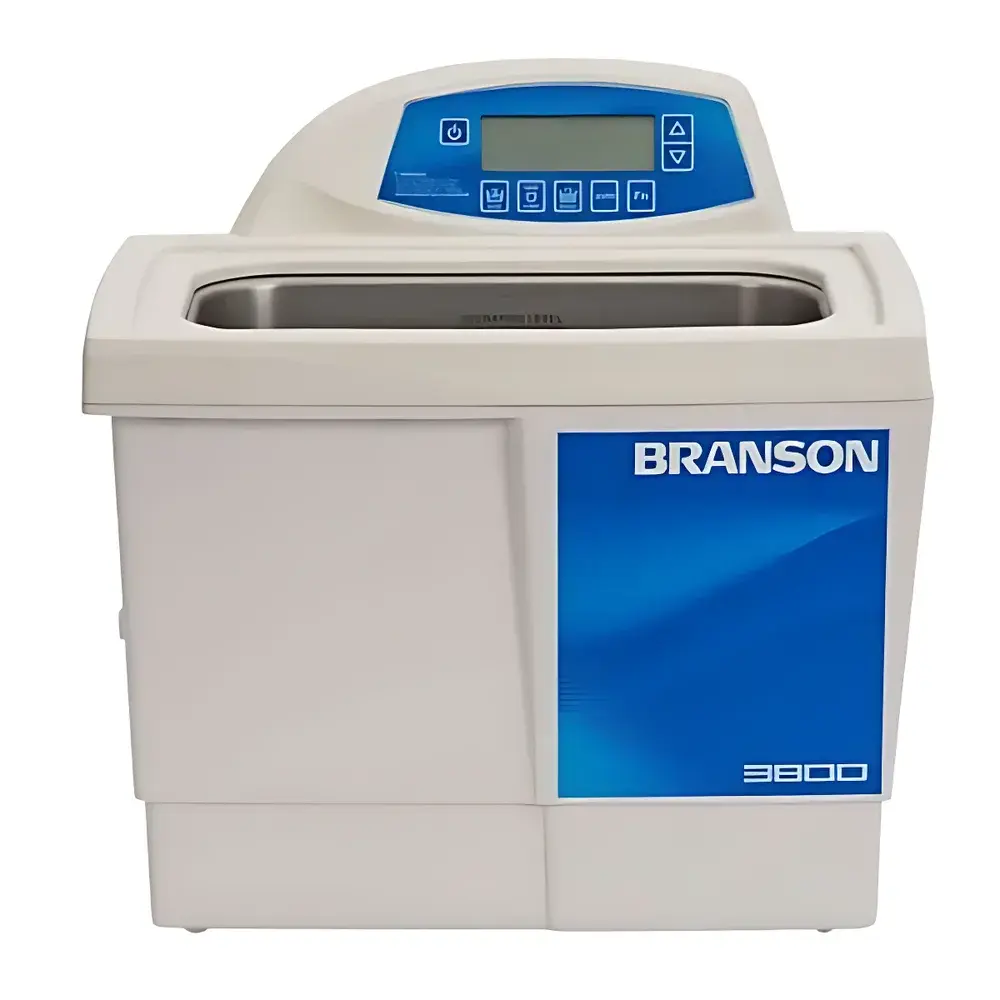
Branson M3800H-C Ultrasonic Cleaner
| Brand | Branson |
|---|---|
| Origin | USA |
| Model | M3800H-C |
| Capacity | 5.7 L |
| Ultrasonic Frequency | 40 kHz |
| Ultrasonic Power Output | 130 W |
| Adjustable Power | Yes |
| Adjustable Temperature | Yes (up to 69 °C) |
| Adjustable Timer | Yes (mechanical, 0–60 min) |
| Sound-Dampening Lid | Included |
| Drain Valve | Manual |
| Construction Material | Polypropylene (PP) tank and housing |
| Transducer Type | Langevin-type metal/ceramic |
| Transducer Mounting | Adhesive-bonded |
| Circuit Design | Auto-power tracking + frequency sweeping |
| Control Panel Location | Top-mounted for moisture protection |
| Internal PCB Orientation | Vertical mounting |
Overview
The Branson M3800H-C Ultrasonic Cleaner is a benchtop, general-purpose cleaning system engineered for precision, repeatability, and long-term reliability in regulated laboratory environments. It operates on the principle of cavitation—generating high-frequency acoustic energy (40 kHz) within a liquid medium to produce microbubbles that implode with localized energy, effectively dislodging particulate contaminants, organic residues, and biofilms from delicate instrumentation, glassware, surgical tools, and precision components. Unlike fixed-frequency systems, the M3800H-C integrates real-time power tracking and frequency sweeping technology, dynamically adjusting output to maintain consistent cavitation intensity across varying load conditions, solution composition, or temperature fluctuations—ensuring process robustness essential for QC/QA workflows and GLP-compliant operations.
Key Features
- Auto-power tracking circuitry continuously monitors and stabilizes ultrasonic energy delivery, preserving cleaning efficacy regardless of transducer aging, solution viscosity changes, or partial tank loading.
- Integrated frequency sweep (±1 kHz around 40 kHz) eliminates standing wave nodes and promotes uniform energy distribution throughout the 5.7 L polypropylene (PP) tank—critical for reproducible cleaning of irregularly shaped or nested samples.
- Langevin-type piezoelectric transducers—constructed with nickel-plated steel front mass and high-curie-point ceramic elements—are bonded directly to the tank bottom using aerospace-grade epoxy, delivering mechanical durability and thermal stability over extended duty cycles.
- Top-mounted control interface isolates electronics from ambient humidity and accidental splashes; all circuit boards are vertically oriented to minimize condensation-related corrosion and improve thermal dissipation.
- Heating function supports temperature-controlled cleaning up to 69 °C, enabling enhanced solubilization of waxy, lipid-rich, or polymer-based soils—compatible with aqueous alkaline, neutral, and mild acidic solutions.
- Mechanical timer provides precise 0–60 minute operation; optional continuous mode permits unattended extended-cycle processing for heavy-soil applications.
Sample Compatibility & Compliance
The M3800H-C accommodates a broad range of laboratory substrates—including borosilicate glass, stainless steel, anodized aluminum, ceramic, and select polymers—without risk of surface pitting or etching when operated within recommended parameters. Its PP construction resists corrosion from common cleaning chemistries (e.g., sodium hydroxide, citric acid, ethanol/water mixtures), supporting routine decontamination per ISO 15883-1 and ASTM F3123-18 guidelines. While not certified as a medical device sterilizer, it meets functional requirements for pre-sterilization cleaning validation under AAMI ST79 and FDA guidance for reprocessed devices. The unit complies with IEC 61000-6-3 (EMC emission) and IEC 61010-1 (safety for laboratory equipment).
Software & Data Management
As a stand-alone analog-controlled instrument, the M3800H-C does not incorporate digital firmware, network connectivity, or audit-trail functionality. Its mechanical timer and analog temperature dial provide deterministic, non-volatile operation suitable for environments where electromagnetic interference must be minimized or where regulatory frameworks require minimal software validation burden (e.g., certain ISO 17025-accredited testing labs). For users requiring electronic data capture, external time/temperature loggers compliant with 21 CFR Part 11 may be deployed in parallel to document cleaning cycle parameters during qualification and routine monitoring.
Applications
- Cleaning of HPLC vials, GC autosampler trays, and spectrophotometer cuvettes prior to trace-level analysis.
- Removal of solder flux, machining oils, and metal fines from microfluidic chips and MEMS devices.
- Preparation of electron microscopy grids and TEM sample holders to eliminate carbon contamination.
- Routine decontamination of pipette tips, forceps, and reusable biopsy instruments in pathology and histology labs.
- Supporting ASTM D2621 (cleaning verification for automotive parts) and USP (cleaning validation for pharmaceutical manufacturing equipment) through documented parameter control.
FAQ
Is the M3800H-C suitable for cleaning delicate optical lenses or coated surfaces?
Yes—when used with low-surface-tension, non-ionic detergents and controlled exposure times (typically ≤5 min at 30–40 °C), it effectively removes fingerprints and dust without damaging anti-reflective or hydrophobic coatings.
Does this model support degassing of solvents prior to use?
No—degas functionality is exclusive to the CPX-series models. The M3800H-C relies on standard fill-and-run operation; manual degassing via vacuum or gentle sonication is recommended for volatile or viscous solutions.
Can the unit be integrated into a cleanroom environment?
Yes—the PP housing generates no particulate shedding, and its sealed top-panel design minimizes ingress pathways; however, installation must comply with ISO 14644-1 Class 7 or lower airflow requirements.
What maintenance intervals are recommended for sustained performance?
Transducer adhesion integrity and tank integrity should be visually inspected quarterly; ultrasonic output verification (using aluminum foil test per ASTM E1729) is advised before each new validation protocol or after 500 operational hours.



