
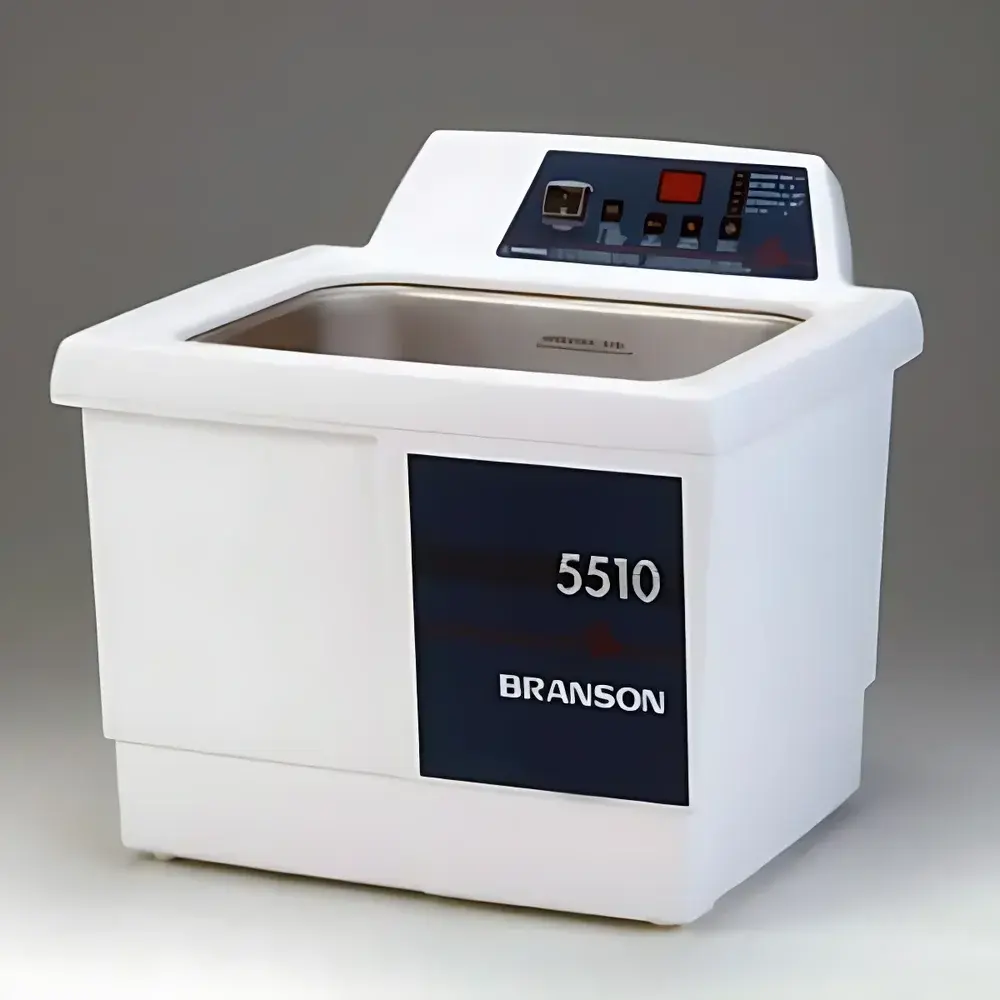
Branson B5510E-MT Ultrasonic Cleaner
| Brand | Branson |
|---|---|
| Origin | USA |
| Model | B5510E-MT |
| Capacity | 9.46 L |
| Ultrasonic Frequency | 40 kHz |
| Ultrasonic Power | 200 W |
| Adjustable Power | Yes |
| Adjustable Temperature | Yes |
| Adjustable Timer | Yes |
| Sound-Dampening Lid | Included |
| Drain/Inlet | Manual Control |
Overview
The Branson B5510E-MT Ultrasonic Cleaner is a precision-engineered, benchtop ultrasonic cleaning system designed for consistent, repeatable removal of particulate, organic, and ionic contaminants from delicate and complex surfaces. It operates on the principle of cavitation—where high-frequency acoustic energy (40 kHz) induces controlled microbubble formation and collapse within a liquid medium—generating localized shear forces sufficient to dislodge sub-micron residues without mechanical abrasion. Engineered for laboratory, analytical, pharmaceutical QC, medical device reprocessing, and precision manufacturing environments, this unit delivers uniform energy distribution across its stainless-steel tank via Branson’s proprietary spherical wave transducer architecture. Unlike linear or planar transducer arrays, the spherically radiating Langevin-type transducers ensure minimal standing-wave interference and eliminate cleaning “dead zones,” supporting reproducible results across heterogeneous sample geometries—including narrow lumens, threaded components, and microfluidic substrates.
Key Features
- Spherical wave transduction technology: Optimized transducer geometry ensures isotropic energy propagation and uniform cavitation intensity throughout the 9.46 L tank volume (292 × 241 × 152 mm internal dimensions).
- Frequency sweep mode: Automatically modulates output within ±1 kHz around 40 kHz to prevent node formation and maintain consistent cleaning efficacy across varying load conditions and solution compositions.
- High-efficiency piezoelectric conversion: Utilizes high-purity, high-curie-point ceramic elements bonded to titanium-alloy sonotrodes using aerospace-grade epoxy; achieves >90% electroacoustic energy transfer efficiency and stable performance under sustained thermal cycling.
- Full parameter control: Independent digital adjustment of ultrasonic power (0–100%), heating setpoint (ambient to 80 °C), and timer duration (0–60 minutes) with real-time display and non-volatile memory retention.
- Ergonomic, low-maintenance construction: Top-mounted control panel conforms to ISO 14738 ergonomic guidelines; tank fabricated from seamless, electropolished 316L stainless steel with no weld seams or crevices; exterior housing molded from chemical-resistant polypropylene (PP) with integrated acoustic damping.
- Integrated safety and usability features: Automatic shutdown on lid open, overtemperature protection, dry-run detection, and removable sound-dampening lid with integrated condensate channeling.
Sample Compatibility & Compliance
The B5510E-MT accommodates a broad range of substrates—including glassware, metal instrumentation, ceramic filters, silicon wafers, surgical tools, optical lenses, and printed circuit boards—without risk of surface pitting or coating delamination when operated within validated parameters. Its design supports compatibility with aqueous, mild alkaline, acidic, and low-surface-tension solvent-based cleaning chemistries. The system meets CE marking requirements for electromagnetic compatibility (EN 61326-1) and electrical safety (EN 61010-1). While not certified as a medical device per FDA 21 CFR Part 820, it is routinely deployed in ISO 13485-certified facilities for pre-sterilization cleaning and complies with ASTM D2603 (Standard Test Method for Sonic Shear Stability of Lubricants) and USP guidance for cleaning validation support. Its closed-loop thermal management and programmable dwell times facilitate alignment with GLP/GMP documentation workflows.
Software & Data Management
The B5510E-MT operates via an embedded microcontroller with no external PC dependency; all operational parameters are stored in EEPROM with timestamped event logging (e.g., cycle start/end, temperature deviation alerts, lid-open events). While the unit does not feature Ethernet or USB connectivity, its deterministic behavior and repeatable setpoint execution enable full traceability when integrated into facility-wide data acquisition systems via optional analog voltage outputs (0–10 V) for temperature and power monitoring. Audit trails comply with ALCOA+ principles when paired with laboratory information management systems (LIMS) that record user ID, method name, and execution timestamp per run—supporting adherence to FDA 21 CFR Part 11 requirements for electronic records where local validation protocols are implemented.
Applications
- Pre-analytical sample preparation: Cleaning HPLC vials, autosampler needles, and ICP-MS nebulizers to eliminate carryover and background contamination.
- Pharmaceutical manufacturing: Removal of milling residues from tablet punches and granulation equipment prior to sterilization.
- Medical device reprocessing: Decontamination of endoscopic accessories, biopsy forceps, and laparoscopic instruments per AAMI ST91 recommendations.
- Microelectronics: Particle removal from MEMS sensors, photomasks, and wafer carriers prior to thin-film deposition.
- Research laboratories: Degassing solvents, dispersing nanomaterials, and accelerating enzymatic digestion protocols.
- Jewelry and optics restoration: Non-abrasive removal of polishing compounds, flux residues, and fingerprint oils from precious metals and coated lenses.
FAQ
What is the maximum operating temperature of the B5510E-MT?
The heater is rated for continuous operation up to 80 °C, with ±1 °C stability under steady-state conditions.
Does the unit include a drain valve or only manual drainage?
Drainage is performed manually via a rear-mounted quick-connect fitting; no integrated solenoid valve or foot pedal is included.
Can the B5510E-MT be used with flammable solvents?
No—this model is not explosion-proof and must only be operated with non-flammable, water-based, or flash-point–verified cleaning solutions.
Is the stainless-steel tank passivated?
Yes—the 316L tank undergoes electropolishing followed by nitric acid passivation per ASTM A967, ensuring optimal corrosion resistance and minimal metallic ion leaching.
What maintenance is required for long-term reliability?
Transducer integrity should be verified annually via impedance spectroscopy; tank interior requires periodic inspection for pitting or scale buildup, especially when used with hard water or high-conductivity solutions.



