
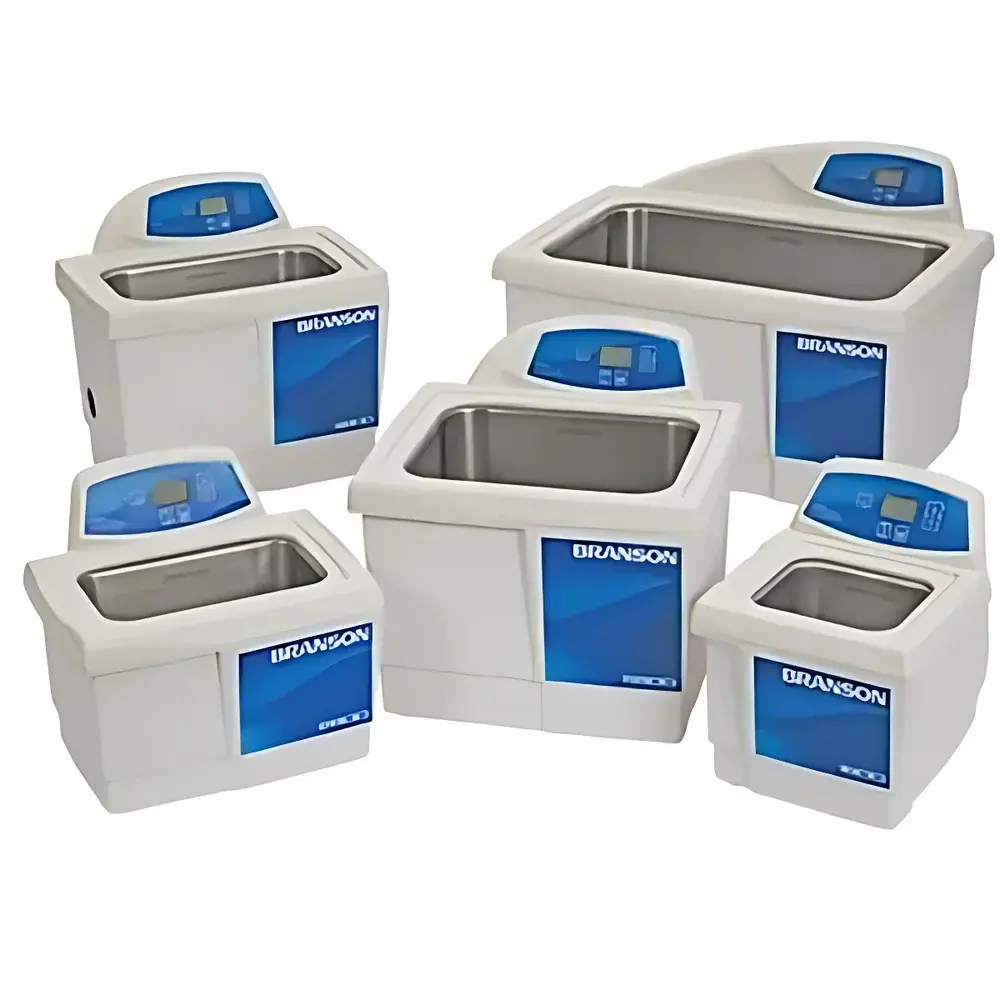
Branson CPXH/CPX/MH/M Series Ultrasonic Cell Disruptor
| Brand | Branson |
|---|---|
| Origin | USA |
| Manufacturer Type | Authorized Distributor |
| Origin Category | Imported |
| Model | CPXH/CPX/MH/M |
| Instrument Type | Ultrasonic Cell Disruptor |
| Temperature Range | 5°C to 50°C |
| Operating Frequency | 40 kHz |
| Ultrasonic Power Output | 200 W |
| Sample Volume Capacity | 200 µL – 1000 mL |
| Sample Throughput | Single-sample processing per cycle |
Overview
The Branson CPXH/CPX/MH/M Series Ultrasonic Cell Disruptor is a benchtop ultrasonic processor engineered for controlled, reproducible cell lysis, homogenization, and sample preparation in life science laboratories. It operates on the principle of acoustic cavitation: high-frequency (40 kHz) ultrasonic energy induces rapid formation and violent collapse of microscopic vapor cavities in liquid media, generating localized shockwaves, microstreaming, and intense shear forces. These physical effects efficiently disrupt cellular membranes, disperse emulsions, accelerate solvent extraction, and degas solutions—without thermal degradation or chemical additives. Unlike general-purpose ultrasonic cleaners, the CPXH/CPX/MH/M systems are specifically configured with optimized transducer coupling, temperature-controlled baths, and programmable duty cycles to meet the stringent demands of molecular biology, pharmaceutical development, and analytical sample prep workflows.
Key Features
- Real-time frequency tracking circuitry maintains resonance stability across varying load conditions and bath levels, ensuring consistent energy delivery and minimizing transducer stress.
- Low-noise enclosure constructed from polypropylene (PP) housing reduces operational sound pressure level (SPL) to ≤45 dB(A) at 1 m—critical for shared lab environments and GLP-compliant facilities.
- Intuitive digital interface supports one-touch program recall: users store up to 10 customizable protocols (time, power, temperature, degas duration) and initiate repeatable runs with a single press.
- Auto-start functionality (CPXH models only): integrated temperature sensor triggers ultrasonic activation upon reaching user-defined setpoint, followed by pre-programmed degassing and sonication phases.
- Dual-power mode (CPXH & CPX): selectable 100% (200 W) or 70% (140 W) output enables precise energy modulation—ideal for fragile samples such as primary neurons, exosomes, or protein complexes where excessive cavitation may cause denaturation.
- Energy-efficient sleep mode activates after 15 minutes of inactivity, reducing standby power consumption by >85%; full system wake-up occurs instantly upon button press.
Sample Compatibility & Compliance
The CPXH/CPX/MH/M platforms accommodate a broad range of biological and chemical matrices—including mammalian cell suspensions, bacterial cultures, tissue homogenates, lipid emulsions, and botanical extracts—within standard laboratory vessels (e.g., microcentrifuge tubes, beakers, and jacketed reactors). All models comply with IEC 61000-6-3 (EMC emissions) and IEC 61010-1 (safety requirements for electrical equipment for measurement, control, and laboratory use). The CPXH series further supports temperature-controlled applications aligned with USP environmental monitoring and ASTM D2603 (ultrasonic degradation testing of polymers). Optional calibration certificates traceable to NIST standards are available for audit-ready documentation under ISO/IEC 17025 and FDA 21 CFR Part 11–enabled software configurations.
Software & Data Management
While the base units operate via embedded firmware, optional PC connectivity (RS-232 or USB) enables integration with Branson’s proprietary SonicsSuite™ software. This platform provides real-time logging of temperature, power output, elapsed time, and cycle status—supporting electronic signatures, audit trails, and PDF report generation. Data export formats include CSV and XML for LIMS compatibility. For regulated environments, the software package meets ALCOA+ principles (Attributable, Legible, Contemporaneous, Original, Accurate) and facilitates 21 CFR Part 11 compliance when deployed with validated user access controls and electronic signature modules.
Applications
- Cell disruption for nucleic acid and protein isolation (e.g., plasmid prep, ChIP-seq lysates, recombinant protein release).
- Pre-HPLC and LC-MS solvent degassing to eliminate baseline noise and improve chromatographic reproducibility.
- Extraction of bioactive compounds from plant tissues, marine organisms, and fungal mycelia under mild, non-thermal conditions.
- Homogenization of liposomes, nanosuspensions, and microemulsions for drug delivery formulation development.
- Cleaning and decontamination of reusable labware (pipette tips, glass vials, stainless-steel probes) per ISO 15883-1 guidelines.
- Accelerated aging studies of medical device materials using controlled ultrasonic erosion protocols.
FAQ
What is the difference between the CPXH, CPX, MH, and M models?
The CPXH series includes integrated heating and auto-start functionality; CPX offers identical ultrasonic performance without heating; MH/M models are non-programmable variants with manual controls and fixed timing.
Can this system be used for sonication in sealed tubes to prevent aerosol generation?
Yes—when paired with appropriate tube holders and cooling jackets, the system supports closed-vessel sonication compatible with BSL-2 containment practices.
Is calibration required before first use?
No factory calibration is needed; however, users should perform initial verification using a calibrated thermometer and power meter per SOP-ULTR-01 (available in Branson Technical Documentation Library).
Does the unit support continuous operation beyond 30 minutes?
Yes—duty cycle management is user-configurable; extended runs require periodic pauses to maintain transducer thermal stability and ensure long-term reliability.
How does the 40 kHz frequency compare to higher-frequency probes used in focused sonicators?
40 kHz delivers deeper penetration and broader cavitation distribution—suited for bulk sample processing—whereas >200 kHz systems prioritize localized, high-intensity energy delivery for micro-volume applications.




