
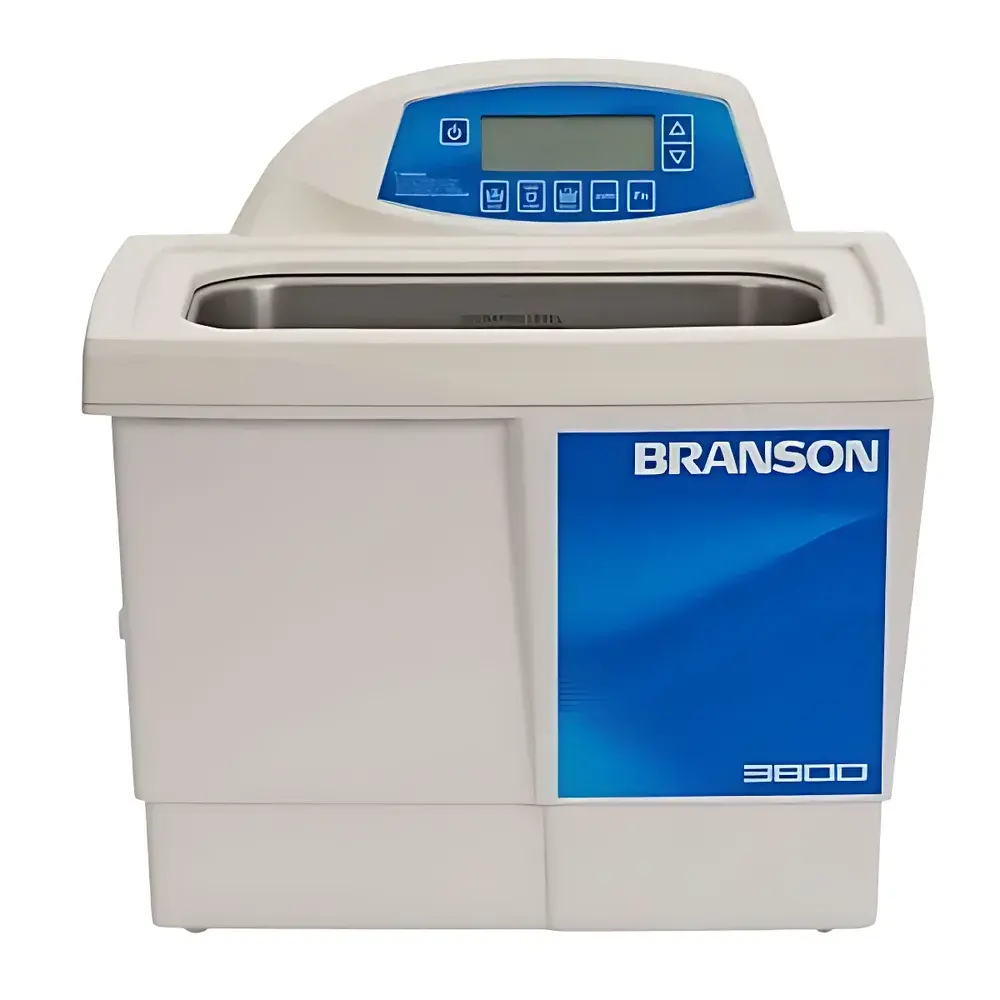
Branson CPX3800-C Digital Ultrasonic Cleaner
| Brand | Branson |
|---|---|
| Origin | USA |
| Model | CPX3800-C |
| Capacity | 5.7 L |
| Ultrasonic Frequency | 40 kHz |
| Ultrasonic Power | 130 W |
| Adjustable Power | Yes |
| Adjustable Temperature | Yes (Room Temp to 69 °C) |
| Adjustable Timer | Yes (1–99 min or Continuous Mode) |
| Sound-Dampening Lid | Included |
| Drainage | Manual Bottom Drain with Valve and Hose |
| Tank Material | 304L Stainless Steel |
| Housing Material | Polypropylene (PP) |
| Heating Power | 205 W |
| Transducers | 2 |
| Dimensions (Tank) | 292 × 152 × 152 mm |
| Overall Dimensions | 406 × 305 × 368 mm |
| Input | 220 V, 50/60 Hz |
| Sweep Frequency Function | Yes |
| Degassing Mode | Yes |
| Display | LED, Real-Time & Set-Point Monitoring |
| Safety Features | Over-Temperature Alarm, Auto Temperature Calibration, Sleep Mode, Programmable Cleaning Cycles |
Overview
The Branson CPX3800-C Digital Ultrasonic Cleaner is a precision-engineered benchtop cleaning system designed for reproducible, non-destructive removal of particulate, organic, and ionic contaminants from laboratory components, analytical hardware, medical instruments, and microfabricated parts. Operating on the principle of cavitation—where high-frequency acoustic energy (40 kHz) induces controlled formation and collapse of microscopic bubbles in liquid media—the CPX3800-C delivers uniform energy distribution across its 5.7 L stainless steel tank via dual transducers and Branson’s proprietary Sweep Frequency technology. This eliminates standing-wave nodes and ensures consistent cleaning efficacy without ultrasonic “dead zones,” critical for validation-sensitive applications in QC labs, pharmaceutical R&D, and semiconductor fabrication support environments.
Key Features
- Dual-transducer architecture with real-time power tracking and automatic impedance compensation ensures stable acoustic output across varying load conditions and solution compositions.
- Digitally programmable sweep frequency modulation (±1 kHz around 40 kHz center) enhances spatial uniformity of cavitation intensity, improving repeatability in multi-sample or irregular-part cleaning protocols.
- Integrated heating system (205 W) enables precise temperature control from ambient to 69 °C, supporting solvent-based cleaning, enzymatic decontamination, and accelerated degassing of HPLC-grade mobile phases.
- Full-featured digital interface with LED display shows real-time temperature, elapsed time, setpoint values, and operational status—including active mode (cleaning, degas, or continuous), power level (70% low / 100% high), and alarm indicators.
- Manual bottom-drain assembly—including valve, drain hose, and quick-connect fittings—allows rapid, spill-free fluid exchange between cycles, minimizing cross-contamination risk and complying with GLP-aligned lab hygiene practices.
- Sound-dampening lid reduces ambient noise to <55 dB(A) at 1 m distance and prevents aerosol dispersion during operation, supporting ISO 14644-compliant cleanroom-adjacent workflows.
Sample Compatibility & Compliance
The CPX3800-C accommodates a broad range of sample geometries and materials, including glassware (vials, cuvettes, chromatography columns), metal tools (tweezers, forceps, surgical instruments), ceramic substrates, and polymer-based microfluidic devices. Its 304L stainless steel tank resists corrosion from aqueous, mild alkaline, and alcohol-based cleaning solutions. The unit meets IEC 61000-6-3 (EMC emissions) and IEC 61000-6-2 (immunity) standards. While not certified as medical device sterilizers, it supports preparation steps compliant with ASTM D4299 (standard guide for ultrasonic cleaning of laboratory apparatus) and USP (Cleaning and Sanitization of Laboratory Equipment). Optional accessories—including perforated baskets, beaker holders, and rack-mounted fixtures—are constructed from inert, autoclavable materials to maintain traceability and avoid leachables.
Software & Data Management
The CPX3800-C operates as a standalone instrument with no external software dependency. All parameters—including time (1–99 min or continuous), temperature, power level, and degas cycle—are stored in non-volatile memory and recalled after power cycling. The controller logs up to 10 user-defined cleaning programs with name-tagged identifiers (e.g., “HPLC-Column-Rinse”, “Glassware-Decontam”). Though lacking network connectivity or FDA 21 CFR Part 11-compliant electronic signatures, its deterministic behavior, thermal and temporal stability (±0.5 °C, ±1 s), and built-in over-temperature cutoff provide audit-ready operational integrity for GMP-aligned documentation packages.
Applications
- Routine cleaning of HPLC/GC autosampler vials, syringes, and injection ports prior to trace-level analysis.
- Pre-analytical sample preparation: removal of residual solvents, oils, or polishing compounds from SEM/TEM specimens and wafer carriers.
- Pharmaceutical manufacturing: cleaning of stainless-steel contact parts per SOPs aligned with Annex 11 data integrity expectations.
- Academic research labs: degassing of LC mobile phases to prevent pump cavitation and baseline drift; gentle biofilm disruption from cell culture flasks without surface abrasion.
- Quality control environments: standardized cleaning validation using calibrated test soils (e.g., ISO 15797 soiling agents) and gravimetric residue assessment.
FAQ
Is the CPX3800-C suitable for cleaning delicate optical components or MEMS devices?
Yes—when operated in low-power mode (70%) with low-surface-tension, non-ionic detergents and controlled temperature (≤40 °C), the unit provides sufficient cavitation intensity for contaminant removal while minimizing mechanical stress on fragile coatings or suspended structures.
Can the unit be integrated into automated lab workflows?
No native Ethernet, USB, or RS-232 interface is provided; however, external relay-based start/stop triggering is possible via the dry-contact terminal block (optional accessory kit required).
Does the CPX3800-C support validation documentation per ISO 13485 or FDA QSR requirements?
It provides stable, repeatable performance and configurable parameters but lacks electronic audit trail generation. Users must implement manual logbooks or third-party data acquisition systems for full regulatory traceability.
What maintenance is required for long-term reliability?
Transducer coupling integrity should be verified annually via ultrasonic output mapping (per Branson Technical Bulletin TB-UL-002); tank interior inspection for pitting or weld seam degradation is recommended every 6 months in aggressive solvent environments.
Is the bottom drain compatible with waste solvent recovery systems?
Yes—the standard 1/2″ NPT drain port accepts standard laboratory vacuum or gravity-fed recovery lines; compatibility with closed-loop distillation units depends on solvent vapor pressure and material compatibility of downstream tubing.



