
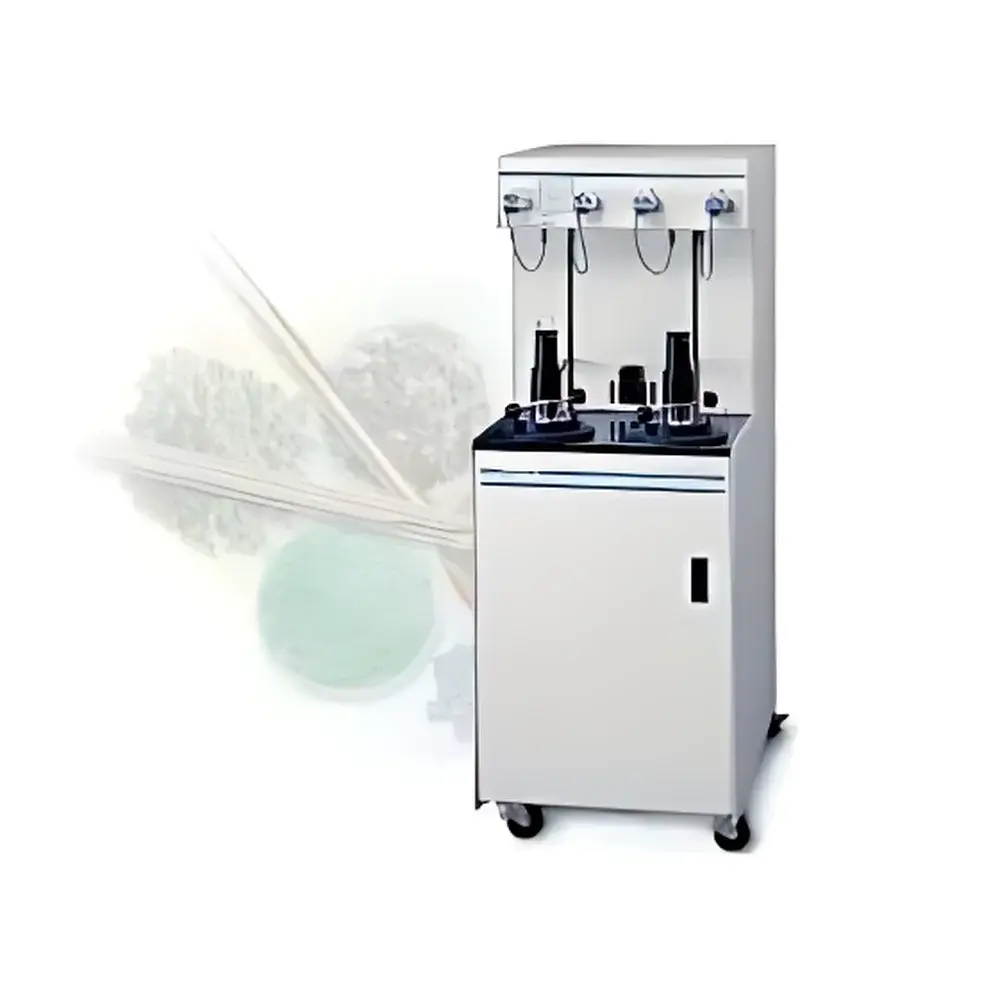
Micromeritics AutoPore IV Series High-Performance Automated Mercury Intrusion Porosimeter
| Brand | Micromeritics |
|---|---|
| Origin | USA |
| Model | AutoPore IV |
| Pressure Range | 0.2–50 psi (low-pressure), optional high-pressure up to 33,000 psi or 60,000 psi |
| Pore Diameter Range | 0.003–1100 µm |
| Pressure Increment Resolution | 0.05 psi |
| Volume Resolution | < 0.1 µL |
| Stations | 4 low-pressure + 2 high-pressure |
| Safety | Enhanced mercury containment, linear high-pressure chamber closure, reduced operator exposure |
| Software | MicroActive™ interactive analysis platform with Reverberi method, automatic baseline correction (auto/differential/manual), temperature-compensated mercury density calculation, multi-sample & gas adsorption data overlay |
Overview
The Micromeritics AutoPore IV Series is an automated mercury intrusion porosimeter engineered for high-precision characterization of porous solids across a broad pore size distribution—from ultramicropores (3 nm) to macropores (1100 µm). Based on the fundamental principle of mercury intrusion porosimetry (MIP), the instrument applies controlled incremental pressure to force non-wetting mercury into interconnected pore networks. The volume intruded at each pressure step is recorded and converted to pore diameter using the Washburn equation, assuming cylindrical pore geometry and a contact angle of 130° and surface tension of 485 mN/m for mercury. This technique provides quantitative access to total pore volume, differential and cumulative pore size distribution, median pore diameter, bulk and skeletal density, and compressibility-corrected porosity—critical parameters for catalysts, ceramics, pharmaceutical excipients, battery electrodes, and geological samples.
Key Features
- Wide operational pressure range: standard low-pressure module (0.2–50 psi) enables high-resolution measurement of pores from 0.003 µm to 1100 µm; optional high-pressure modules support up to 33,000 psi or 60,000 psi for sub-3 nm pore analysis in rigid materials.
- Ultra-fine pressure control: 0.05 psi minimum pressure increment ensures dense data acquisition in macro- and mesopore regions, improving resolution of bimodal or complex pore structures.
- Sub-microliter volumetric precision: < 0.1 µL resolution in both intrusion and extrusion steps supports rigorous QC/QA protocols and R&D-grade reproducibility (RSD < 1.5% for repeated analyses).
- Dual-mode operation: rapid-scan mode for preliminary screening and equilibrium-based mode for thermodynamically stable, high-accuracy measurements—user-selectable based on analytical objectives.
- Integrated thermal compensation: built-in mercury temperature sensor enables real-time density correction per ASTM D4404 and ISO 15901-1, eliminating manual lookup tables and reducing systematic error in pore volume calculation.
- Enhanced safety architecture: linear actuated high-pressure chamber closure minimizes risk of mercury spillage; fully enclosed mercury handling path; OSHA-compliant shielding and leak-detection diagnostics.
- High-throughput configuration: four independent low-pressure stations and two high-pressure stations allow concurrent analysis of heterogeneous sample sets without cross-contamination.
Sample Compatibility & Compliance
The AutoPore IV accommodates solid powders, monoliths, granules, and pressed pellets with minimal preparation—requiring only degassing prior to analysis (typically at 100–150 °C under vacuum). It complies with international standards including ASTM D4404 (Standard Test Method for Determining Pore Size Distribution of Catalysts and Catalyst Carriers), ISO 15901-1 (Porous materials — Mercury porosimetry and gas adsorption), and USP (Pore Size Distribution). Its audit-trail-enabled software supports 21 CFR Part 11 compliance when configured with appropriate user access controls and electronic signature modules—making it suitable for regulated environments in pharmaceutical development and quality control laboratories operating under GLP or GMP frameworks.
Software & Data Management
MicroActive™ software provides a unified interface for instrument control, real-time diagnostics, and advanced post-processing. It supports customizable report generation (PDF, CSV, XML), overlay of multiple MIP datasets, and co-analysis with complementary gas adsorption results (e.g., BET surface area). The Reverberi method implementation extracts throat-to-pore size correlations and generates 3D volumetric distributions of pore vs. constriction diameter—enabling geometric modeling of transport-limiting features. Baseline correction options (automatic, differential, manual) accommodate artifacts from system expansion or thermal drift. All raw pressure-volume-temperature data are stored with metadata tags—including operator ID, calibration history, and environmental conditions—for full traceability.
Applications
- Catalyst and support characterization: quantifying pore accessibility, diffusion limitations, and sintering-induced structural changes.
- Pharmaceutical solid dosage forms: evaluating tablet porosity, binder distribution effects, and dissolution rate correlation.
- Energy materials: assessing electrode compaction, separator tortuosity, and pore network connectivity in Li-ion battery components.
- Geological core analysis: determining permeability predictors (e.g., threshold pressure, pore-throat ratio) for reservoir evaluation.
- Ceramics and refractories: monitoring green-body densification, firing shrinkage, and microcrack formation.
- Quality assurance in additive manufacturing: verifying powder bed uniformity and post-sinter porosity in metal and polymer parts.
FAQ
What pore size range can the AutoPore IV measure?
It measures pores from 0.003 µm (3 nm) to 1100 µm using combined low- and high-pressure modules—fully aligned with ISO 15901-1 classification.
How does the system correct for mercury compression and thermal expansion?
Real-time mercury temperature sensing enables dynamic density calculation; optional mechanical compliance calibration accounts for system deformation under high pressure.
Can MIP data be directly compared with nitrogen physisorption results?
Yes—MicroActive™ supports synchronized import, unit normalization (cm³/g vs. cm³/cm³), and overlay visualization; however, geometric assumptions differ (cylindrical vs. slit-shaped pores), requiring careful interpretation.
Is the instrument compliant with FDA 21 CFR Part 11?
When deployed with role-based authentication, electronic signatures, and audit-trail logging enabled, it meets Part 11 requirements for electronic records and signatures in regulated labs.
What maintenance is required for long-term accuracy?
Annual calibration of pressure transducers and volumetric cells is recommended; mercury purity verification (ASTM E2913) and system leak testing should be performed quarterly.




