
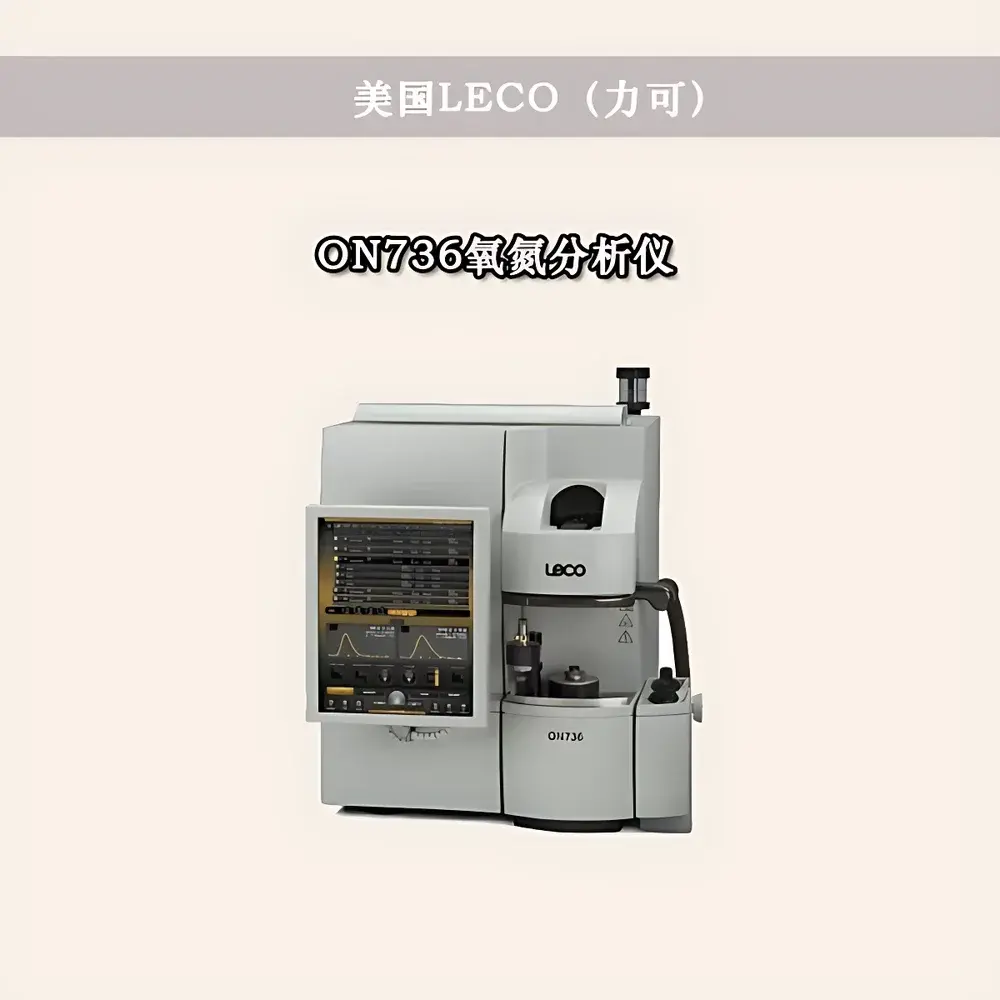
ON736 Oxygen-Nitrogen Analyzer by LECO (Imported, USA)
| (在此处输出精准翻译� | �纯英文产品名称。极其重要:仅输出一行名称,严禁输出备选名、严禁换行重复、严禁包含任何中文字符) |
|---|---|
| [Origin | USA |
| Manufacturer Type | Authorized Distributor |
| Origin Category | Imported |
| Model | ON736 |
| Price Range | USD 28,000 – 70,000 |
| Instrument Type | Oxygen-Nitrogen Analyzer |
| Analytical Range | Full-scale concentration measurement for O and N in solid materials |
| Analysis Time | ≤20 seconds per sample |
| Compliance | Designed to support ASTM E1019, ISO 14284, and GB/T 11261 methodologies] |
Overview
The ON736 Oxygen-Nitrogen Analyzer is a high-performance inert gas fusion (IGF) elemental analyzer engineered for the simultaneous quantitative determination of oxygen and nitrogen in refractory metals, ferrous and non-ferrous alloys, ceramics, carbides, and inorganic solids. It operates on the principle of high-temperature pulse fusion (up to 3000 °C) under ultra-pure helium or argon carrier gas, followed by selective detection using dual-channel non-dispersive infrared (NDIR) absorption for oxygen and thermal conductivity detection (TCD) for nitrogen. This architecture ensures robust separation of gaseous reaction products—CO, CO₂, and N₂—generated from sample decomposition in the graphite crucible. The system is calibrated against certified reference materials traceable to NIST and complies with internationally recognized test methods including ASTM E1019 (Standard Test Methods for Determining Carbon, Sulfur, Nitrogen, and Oxygen in Steel, Iron, Nickel, and Cobalt Alloys) and ISO 14284 (Steel and Iron — Determination of Total Nitrogen Content — Inert Gas Fusion–Thermal Conductivity Method).
Key Features
- Result-oriented design: Integrated hardware-software synchronization minimizes manual intervention and reduces operator-induced variability.
- Dual detection architecture: High-stability NDIR cell for oxygen (measuring CO/CO₂ at 4.26 µm and 4.67 µm bands) and precision TCD for nitrogen, both featuring no moving parts and zero mechanical recalibration requirements.
- Thermally isolated detector housing: Active temperature stabilization eliminates ambient drift, ensuring baseline stability over extended operation cycles.
- Long-life IR source and drift-compensated electronics: Engineered for >5 years of continuous operation without signal degradation or gain adjustment.
- OMI-2 bypass filtration module: A two-stage, chemically selective gas purification system that removes halogens, moisture, and particulates upstream of detectors—enhancing signal-to-noise ratio and extending detector service life.
- Hermetically sealed electrode chamber: Sample loading occurs within a fully enclosed furnace head, preventing atmospheric contamination (e.g., ambient O₂/N₂ ingress) during crucible insertion.
- Modular furnace head assembly: Simplified mechanical layout reduces routine maintenance intervals for electrodes, crucibles, and gas seals—supporting >10,000 analyses before major service.
Sample Compatibility & Compliance
The ON736 accommodates solid samples up to 1.0 g (standard graphite crucibles) or 2.0 g (high-capacity variants), including sintered tungsten carbide, titanium alloys, silicon nitride, stainless steels, and rare-earth magnets. Optional universal lower electrode supports multiple crucible geometries (cup, boat, rod). All analytical protocols are structured to meet GLP and GMP documentation requirements. Data integrity is enforced via audit-trail-enabled software compliant with FDA 21 CFR Part 11 (electronic records and signatures), supporting full traceability of method parameters, calibration history, user actions, and raw detector outputs.
Software & Data Management
Control and analysis are executed through a native Windows-based application optimized for capacitive multi-touch displays. The interface provides real-time visualization of fusion curves, peak deconvolution, baseline correction, and automatic integration. Calibration management includes multi-point linear/non-linear curve fitting with residual error reporting. Cornerstone® Mobile extends functionality to iOS and Android devices, enabling remote monitoring of instrument status, live chromatograms, alarm logs, and report generation. SmartLine® Remote Diagnostic allows secure, encrypted technician access for predictive maintenance alerts and firmware updates—reducing downtime and eliminating unplanned service visits. All data exports comply with ASTM E1382-compliant CSV and XML formats for LIMS integration.
Applications
- Quality control of aerospace-grade superalloys (Inconel®, Waspaloy®) where interstitial O/N content directly affects hot tensile strength and creep resistance.
- Process validation in powder metallurgy lines producing Ti-6Al-4V components, ensuring oxygen levels remain below 0.15 wt% to prevent embrittlement.
- Research laboratories quantifying nitrogen solubility limits in Fe–N phase diagrams using controlled atmosphere fusion experiments.
- Failure analysis labs identifying oxygen-induced porosity in ceramic matrix composites (CMCs) used in turbine shrouds.
- Recycling facilities verifying nitrogen retention in scrap stainless steel prior to electric arc furnace charging.
FAQ
What sample forms are compatible with the ON736?
Solid metallic, ceramic, or intermetallic specimens in chip, turnings, or pellet form—no liquids or gases. Minimum mass: 20 mg; maximum: 2.0 g depending on crucible type.
Does the system support automated calibration verification?
Yes—integrated check standards (e.g., Cu–O, Ta–N) can be scheduled as part of daily startup routines with auto-flagging of calibration drift beyond ±0.5% RSD.
Is helium the only acceptable carrier gas?
Helium is standard for optimal NTD sensitivity and CO₂ resolution; argon may be substituted for cost-sensitive applications where nitrogen detection is secondary.
How is data security maintained during remote access?
Cornerstone® Mobile and SmartLine® Remote use TLS 1.3 encryption, role-based user permissions, and session timeouts—fully aligned with ISO/IEC 27001 information security frameworks.
Can the ON736 quantify hydrogen simultaneously?
No—the ON736 is dedicated to O/N only. For combined O/N/H analysis, LECO’s ONH-836 platform is recommended.





