
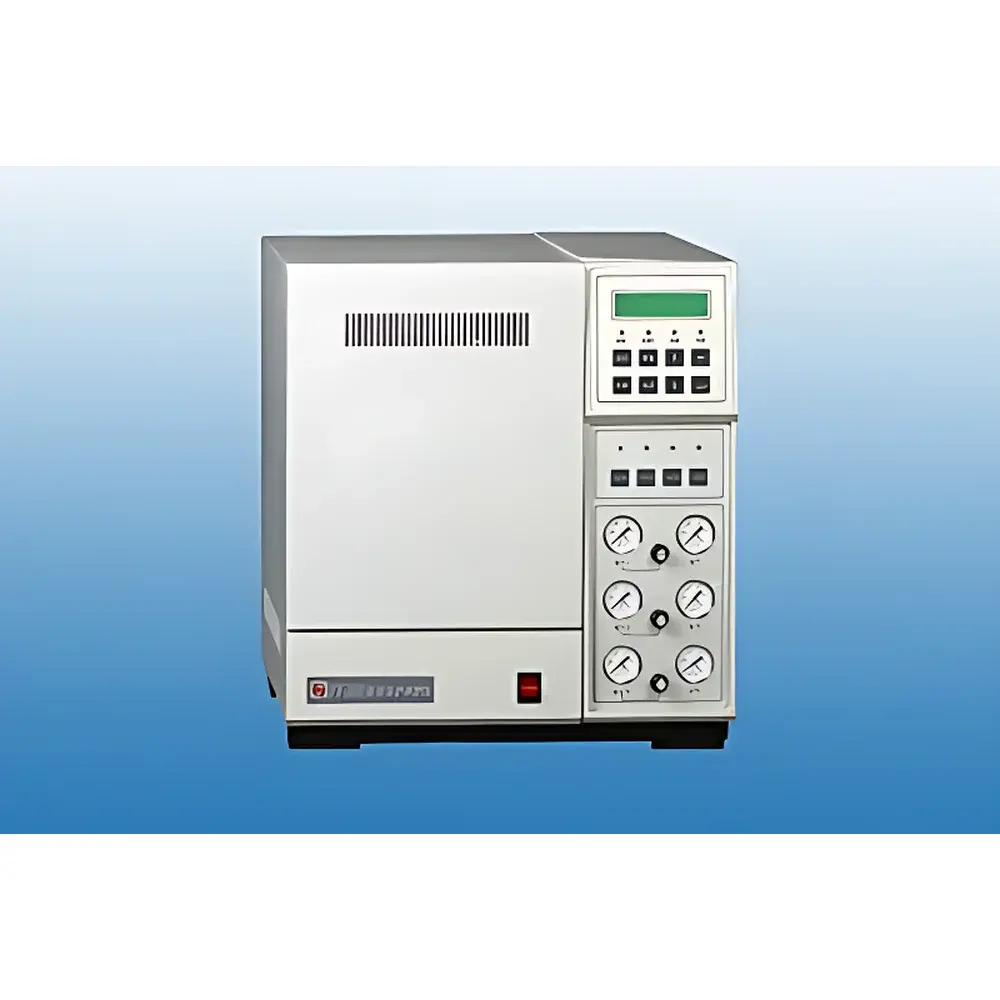
YY-980 Geochemical Logging Analyzer with Dual FID Detectors
| Origin | Imported |
|---|---|
| Manufacturer Type | Authorized Distributor |
| Model | YY-980 |
| Application Field | Petroleum & Petrochemical Industry |
| Detection Principle | Pyrolysis-Gas Chromatography with Flame Ionization Detection (FID) |
| Minimum Hydrocarbon Detection | 0.001 mg hydrocarbon/g rock |
| Baseline Drift | <0.1 mV/30 min |
| Linear Dynamic Range | 10⁵ |
| FID Temperature Control | 380 ± 2 °C |
| Pyrolysis Furnace Control | ±1 °C |
| Sample Probe Temperature Control | 90 ± 3 °C |
| Oxidation Furnace Control | 600 ± 1 °C |
| Programmed Temperature Ramp Linearity Deviation | <1 °C/min |
| Detector Configuration | Dual Synchronized FID |
| Valve System | Integrated 9-port, 3-port, and 2-position 5-way solenoid valve manifold for fully automated pyrolysis-residual carbon sequence |
| Signal Amplification | Four-step electronic-switched microcurrent amplifier with high-input-impedance, low-noise op-amp architecture |
Overview
The YY-980 Geochemical Logging Analyzer is a field-deployable, integrated pyrolysis-gas chromatographic system engineered for real-time geochemical evaluation of source and reservoir rocks in petroleum exploration. It implements a sequential thermal desorption–pyrolysis–oxidation workflow coupled with dual hydrogen flame ionization detection (FID), enabling quantitative determination of free hydrocarbons (S1), thermally cracked hydrocarbons (S2), residual carbon (S3), and total organic carbon (TOC)-derived CO₂. The instrument operates on the Rock-Eval principle adapted for on-site logging environments, delivering reproducible kerogen typing, maturity assessment (Tmax), and hydrocarbon generative potential (PI, OI, HI) without laboratory transfer. Its compact chassis, ruggedized thermal management, and sealed detector housing meet IP54 requirements for operation in drilling rig cabins, mud logging units, and mobile geochemistry labs under ambient temperature fluctuations from −10 °C to +45 °C.
Key Features
- Dual synchronized FID detectors with independent microcurrent amplifiers, each supporting four electronically switched sensitivity ranges (10⁻¹² to 10⁻⁹ A full scale), ensuring optimal signal-to-noise ratio across trace and bulk hydrocarbon concentrations.
- Precision thermal control subsystem: pyrolysis furnace stabilized at ±1 °C, oxidation furnace at 600 ± 1 °C, sample probe at 90 ± 3 °C, and dual FID jets maintained at 380 ± 2 °C — all regulated via PID algorithms with real-time thermocouple feedback and auto-compensated drift correction.
- Automated valving architecture comprising a mechanically interlocked 9-port rotary valve, 3-port injection valve, and 2-position 5-way solenoid manifold, executing standardized Rock-Eval III-style protocols (S1–S2–S3–CO₂) without manual intervention or gas switching.
- Low-drift microcurrent amplifier design featuring ultra-high-input-impedance (>10¹³ Ω), sub-picoampere noise floor (<50 fA RMS), monolithic op-amp topology, and thermal-shielded signal path — eliminating need for external Faraday cages or chilled preamps.
- Embedded firmware compliant with ASTM D7260-22 (Standard Practice for Calibration of Geochemical Analyzers) and aligned with ISO 10303-21 (STEP AP242) data exchange conventions for raw chromatogram export.
Sample Compatibility & Compliance
The YY-980 accepts solid rock powders (20–60 mesh), cuttings, and core chips weighing 50–100 mg per analysis. No solvent extraction or derivatization is required. All thermal zones are inert-coated (SilcoNert® 2000) to prevent catalytic cracking artifacts. The system meets IEC 61000-6-2/6-4 for electromagnetic compatibility and carries CE marking per Directive 2014/30/EU (EMC) and 2014/35/EU (LVD). Data acquisition logs include time-stamped audit trails satisfying GLP/GMP documentation requirements per 21 CFR Part 11 Annex 11 when paired with validated LIMS integration.
Software & Data Management
Acquisition and processing are managed via GeoLogPro v4.2 software, supporting real-time chromatogram visualization, peak deconvolution using constrained Gaussian fitting, Tmax calculation per ASTM D5307, and automated S1/S2/S3 integration with baseline correction algorithms (Asymmetric Least Squares). Raw data exports as .CDF (NetCDF 4.0) and .ASC formats; processed reports comply with POSC Caesar XML schema for upstream E&P data interoperability. Remote diagnostics and firmware updates are performed over TLS 1.2-secured Ethernet or optional 4G LTE modem.
Applications
- On-the-fly source rock evaluation during vertical/horizontal drilling — generating continuous TOC, HI, and OI profiles at 1–3 m resolution.
- Reservoir quality screening via S1/S2 ratio mapping and free hydrocarbon saturation estimation in sandstone and carbonate intervals.
- Thermal maturity zonation using Tmax gradients to identify oil vs. gas windows and assess secondary migration history.
- Quality control of core-derived geochemical datasets prior to basin modeling input.
- Field validation of laboratory Rock-Eval results under time-constrained exploration campaigns.
FAQ
What standards does the YY-980 comply with for field-deployed geochemical analysis?
ASTM D7260-22, ASTM D5307, ISO 10303-21, and IEC 61000-6-2/6-4 — with full traceability documentation available upon request.
Can the YY-980 be integrated into existing mud logging units?
Yes — it supports RS-485 Modbus RTU and Ethernet/IP protocols for seamless interface with Halliburton LogMan, Baker Hughes Geolog, and Schlumberger LogPlot systems.
Is calibration verification required before each run?
No — the dual-FID architecture enables internal reference gas normalization; daily verification using n-decane standard (10 ng/µL) satisfies QA/QC per API RP 13B-2.
Does the system support residual carbon (RC) quantification independent of S3?
Yes — dedicated oxidation furnace and CO₂-selective FID channel enable direct RC measurement with <2% RSD at 0.1 wt% level.
What maintenance intervals are recommended for field operation?
FID jet cleaning every 200 runs; ceramic furnace insulation inspection every 6 months; valving manifold seal replacement annually — all procedures documented in the Field Service Manual (Rev. 4.1).




