
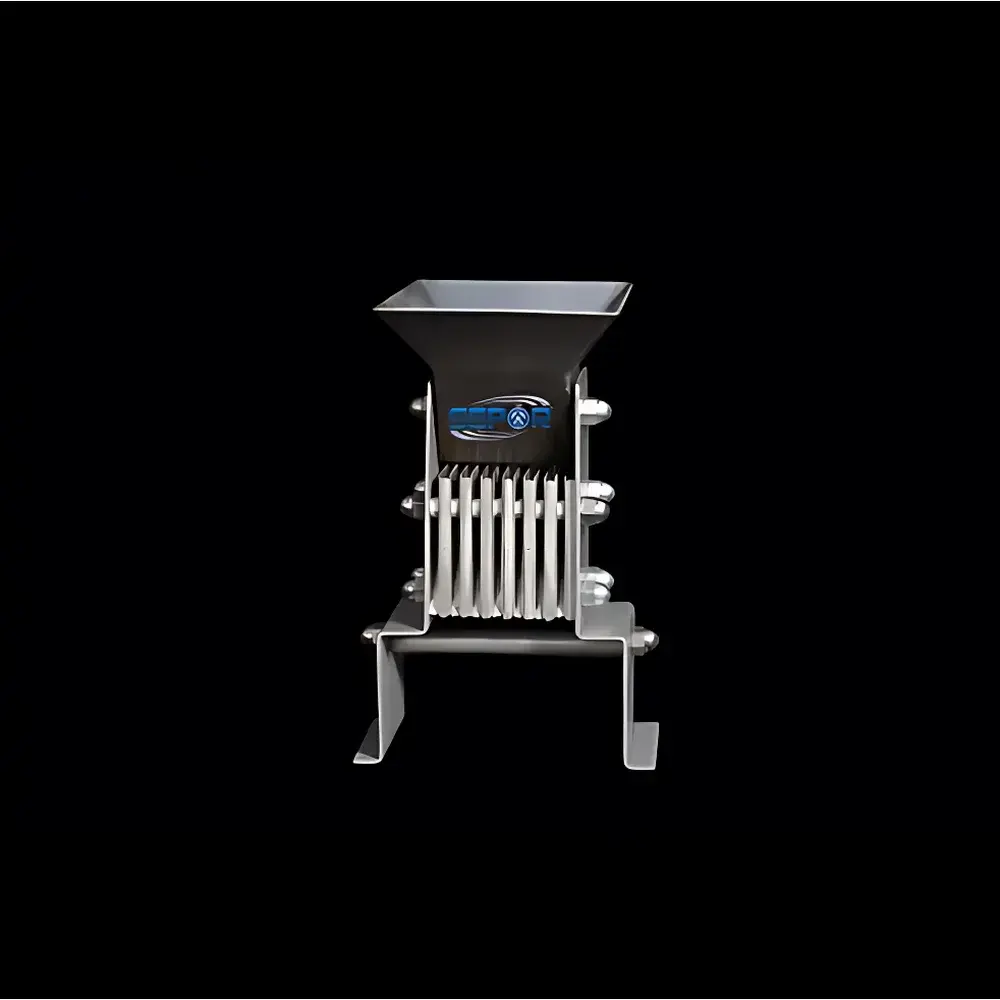
Sepor Jones-Type Micro Riffle Splitter
| Origin | USA |
|---|---|
| Manufacturer Type | Authorized Distributor |
| Origin Category | Imported |
| Model | Jones |
| Pricing | Available Upon Request |
Overview
The Sepor Jones-Type Micro Riffle Splitter is a precision mechanical sample divider engineered for high-fidelity reduction of fine particulate solids in analytical and metallurgical laboratories. Based on the proven riffle splitting principle—governed by gravitational flow and symmetrical channel distribution—it ensures statistically representative subsampling of dry, free-flowing powders and granular materials. Unlike rotary or cone splitters, the Jones-type design relies on fixed, parallel, evenly spaced riffles (chutes) to bifurcate the feed stream with minimal bias and negligible particle segregation. This method complies with ASTM E1444 (Standard Practice for Sampling of Metals and Alloys) and ISO 13320 (Particle size analysis — Laser diffraction methods), where representative sub-sampling is a prerequisite for downstream characterization. Designed for batch sizes ranging from 25 g to 1,000 g, the device delivers consistent 1:2 mass division without operator-induced variability—critical for assay preparation, geochemical analysis, mineral processing QC, and regulatory-compliant sample archiving.
Key Features
- Stainless steel (AISI 304) construction for corrosion resistance and long-term dimensional stability; anodized hard-alloy aluminum used selectively in chute assemblies for weight optimization and wear resistance.
- Two standard riffle configurations: 1/16″ (1.6 mm) and 1/8″ (3.2 mm) chute widths—optimized for fine powders (<75 µm) and coarse granules (up to 2 mm), respectively.
- Modular, tool-free disassembly: all components—including hopper, riffle tray, and collection pans—are fully accessible for rapid cleaning and residue inspection—essential for cross-contamination control in multi-element or high-purity workflows.
- Fixed 14-chute geometry ensuring precise 50:50 mass split ratio; each chute is laser-aligned and CNC-machined to ±0.05 mm tolerance for hydraulic symmetry and flow uniformity.
- Integrated stainless steel frame with adjustable leveling feet for stable operation on laboratory benches; no external power or calibration required.
Sample Compatibility & Compliance
The Sepor Micro Riffle Splitter accommodates dry, non-cohesive, and moderately cohesive powders including crushed ores, cement clinker, pharmaceutical excipients, ceramic precursors, and soil aggregates. It is not suitable for wet, sticky, fibrous, or highly electrostatic materials. All models meet general requirements for GLP (Good Laboratory Practice) sample handling per OECD Series on Principles of Good Laboratory Practice and support audit-ready documentation when integrated into validated sampling SOPs. While the splitter itself does not require formal certification, its use is referenced in USP (Sampling and Testing of Pharmaceutical Products) and ASTM D75 (Standard Practice for Sampling Aggregates) as a primary mechanical subdivision method.
Software & Data Management
This is a purely mechanical, analog sample divider with no embedded electronics, firmware, or connectivity interfaces. As such, it requires no software installation, driver configuration, or data logging integration. However, its deterministic physical behavior enables full traceability within LIMS or ELN environments: users record splitter model (e.g., 040G-000), chute width, total feed mass, and collection pan identifiers directly into sample metadata fields. For FDA 21 CFR Part 11 compliance, handwritten or digitally signed split logs—paired with photographic evidence of clean assembly pre-use—constitute acceptable audit trails. No password protection, user roles, or electronic signatures are implemented or necessary.
Applications
- Preparation of representative sub-samples for XRF, ICP-OES, and fire assay in exploration geochemistry and mining QA/QC labs.
- Reduction of bulk powder batches prior to sieve analysis (ASTM E11), loss-on-ignition (LOI), or moisture content determination (ASTM D2234).
- Homogenization and division of reference material blends during CRM (Certified Reference Material) production and verification.
- Splitting of catalyst powders, battery electrode slurries (after drying), and additive manufacturing feedstocks for particle size distribution validation.
- Regulatory sample archiving under ISO/IEC 17025-accredited testing protocols where mechanical splitting is mandated over manual quartering.
FAQ
What is the minimum recommended sample mass for accurate splitting?
For optimal statistical fidelity, a minimum of 25 g is specified; however, reproducibility improves significantly above 100 g, particularly for heterogeneous materials with wide particle size distributions.
Can this splitter be used for wet or damp samples?
No—moisture content exceeding 1% w/w may cause channel bridging, uneven flow, and mass bias; samples must be air-dried or oven-dried (≤105°C) prior to splitting.
Is calibration required before use?
No periodic calibration is needed; however, visual inspection for chute debris, surface pitting, or misalignment is recommended before each use per laboratory SOP.
Are replacement parts available separately?
Yes—individual riffle trays, hoppers, and stainless steel collection pans (P/N 040G-002) are stocked and shipped globally with lead times under 5 business days.
Does Sepor provide validation documentation for GMP environments?
Sepor supplies a Certificate of Conformance (CoC) with each unit, listing material certifications (304 SS mill test reports) and dimensional verification data; full IQ/OQ documentation packages are available upon request for regulated facilities.





