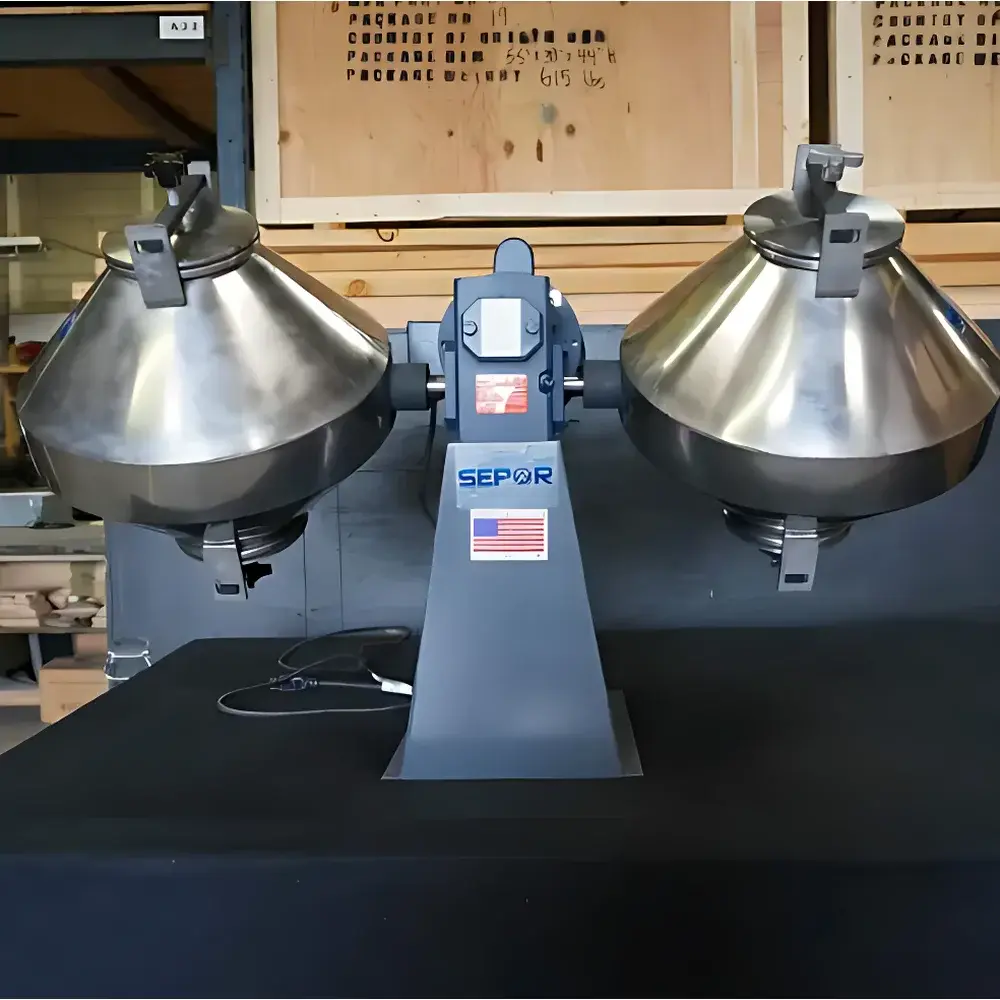
Sepor 080D-005 15″ Rotary Cone Blender
| Origin | USA |
|---|---|
| Manufacturer Type | Authorized Distributor |
| Origin Category | Imported |
| Model | 080D-005 |
| Pricing | Available Upon Request |
Overview
The Sepor 080D-005 15″ Rotary Cone Blender is a precision-engineered, batch-type powder and granular material mixer designed for laboratory, pilot-scale, and small-batch industrial applications. It operates on the principle of gravitational convection mixing: as the dual-cone vessel rotates about its central horizontal axis, materials undergo continuous reorientation, cascading, and axial displacement—enabling uniform distribution without mechanical shear or high-energy impact. This low-shear, tumbling action preserves particle integrity, prevents over-mixing, and ensures high reproducibility across batches. The unit is optimized for dry and semi-dry solid-phase blending, including free-flowing powders, agglomerated granules, fibrous blends, and heterogeneous formulations common in pharmaceutical excipient preparation, mineral processing R&D, ceramic raw material homogenization, and nutraceutical formulation development.
Key Features
- Stainless steel 304 construction throughout all product-contact surfaces—including cone shell, center band, discharge ports, and internal welds—ensuring corrosion resistance, cleanability, and compliance with cGMP-relevant surface finish standards (Ra ≤ 0.8 µm achievable via optional electropolishing).
- Optimized geometry: 45° cone angle and precisely balanced dual-cone + cylindrical center band design facilitate predictable material trajectory and consistent fill-level-dependent mixing efficiency between 35% and 75% volumetric loading.
- Drive system comprises a ½ HP TEFC motor coupled to a 40:1 double-reduction gearmotor, delivering stable 43 RPM rotational speed with low vibration and minimal thermal drift—critical for extended mixing cycles and operator safety.
- Standard configuration includes a rigid bench-mounted frame, integrated motor-mounting base, and one 15″ cone assembly; total usable volume per cone is 0.80 ft³ (22.7 L), with nominal total vessel capacity of ~1.15 ft³ (32.6 L) at 75% fill.
- Large-diameter feed and discharge openings (standard 8″ top port; optional dual-bottom discharge per model 080D-006) support rapid loading/unloading and compatibility with standard lab funnels, pneumatic transfer lines, or manual scooping tools.
- Low power consumption (< 0.4 kW operational load) and silent operation enable integration into shared laboratory environments without HVAC or structural reinforcement requirements.
Sample Compatibility & Compliance
The 080D-005 is validated for use with non-hazardous, non-explosive dry solids having bulk densities between 0.2–2.0 g/cm³ and particle sizes ranging from sub-10 µm fines to 8 mm granules. It is unsuitable for highly cohesive, hygroscopic, or temperature-sensitive materials requiring inert atmosphere or jacketed temperature control. While not intrinsically rated for Class I Div 1 hazardous locations, optional ATEX-compliant motor upgrades and grounding kits are available upon request. The unit meets general electrical safety requirements per UL 508A and CSA C22.2 No. 14, and its stainless steel construction supports cleaning validation protocols aligned with FDA 21 CFR Part 211 (Subpart F) and ISO 14644-1 Class 8 cleanroom-compatible handling when used with appropriate gowning and environmental controls.
Software & Data Management
This mechanical blender operates without embedded firmware or digital controls; all operation is manually initiated and monitored. Timer-based mixing duration (typically 5–20 minutes depending on material cohesiveness) is tracked externally using calibrated laboratory timers or integrated LIMS timestamps. Batch records—including lot numbers, operator ID, start/stop times, fill volume, and visual homogeneity assessment—can be logged in electronic notebooks compliant with 21 CFR Part 11 when paired with validated signature capture systems. Sepor provides a standardized Equipment Qualification Package (EQP) template supporting IQ/OQ documentation for GxP-regulated environments.
Applications
- Pharmaceutical: Blending of API-excipient mixtures prior to tableting or capsule filling; verification of content uniformity per USP .
- Materials Science: Homogenization of metal oxide precursors, battery cathode slurries (pre-slurry stage), and refractory compound batches.
- Mining & Metallurgy: Pilot-scale blending of ore concentrates, flotation reagent carriers, and leaching adsorbent media.
- Food & Feed: Dry premix formulation for vitamins, enzymes, probiotics, and mineral fortificants—validated for non-GMO and allergen segregation protocols.
- Academic Research: Teaching tool for powder flow behavior, mixing kinetics modeling, and scale-up correlation studies from lab to continuous twin-screw extrusion.
FAQ
What is the recommended fill level range for optimal mixing performance?
The unit achieves maximum efficiency when loaded between 35% and 75% of total vessel volume. Below 35%, insufficient material cascade reduces convective turnover; above 75%, restricted movement diminishes axial dispersion and increases cycle time.
Can this blender handle abrasive or corrosive materials?
Yes—provided they do not exceed the chemical resistance limits of 304 stainless steel (e.g., avoid prolonged contact with chlorides >50 ppm or strong alkalis >10% w/w). For aggressive chemistries, 316 SS upgrade kits are available.
Is validation documentation included with purchase?
Sepor supplies a Factory Acceptance Test (FAT) report and mechanical certification. Full GxP qualification support—including URS, DQ/IQ/OQ templates and on-site commissioning assistance—is offered as a value-added service.
How is cleaning verified between batches?
Visual inspection through the top port is standard. Swab sampling per ASTM E1847-21 may be performed using the optional gasketed lid (model 080D-007/008) to ensure residue limits meet internal SOP thresholds.
What maintenance is required?
Biannual inspection of gearmotor oil level, ear shaft bearing preload, and fastener torque; no scheduled lubrication of the cone pivot points due to sealed-for-life construction.