
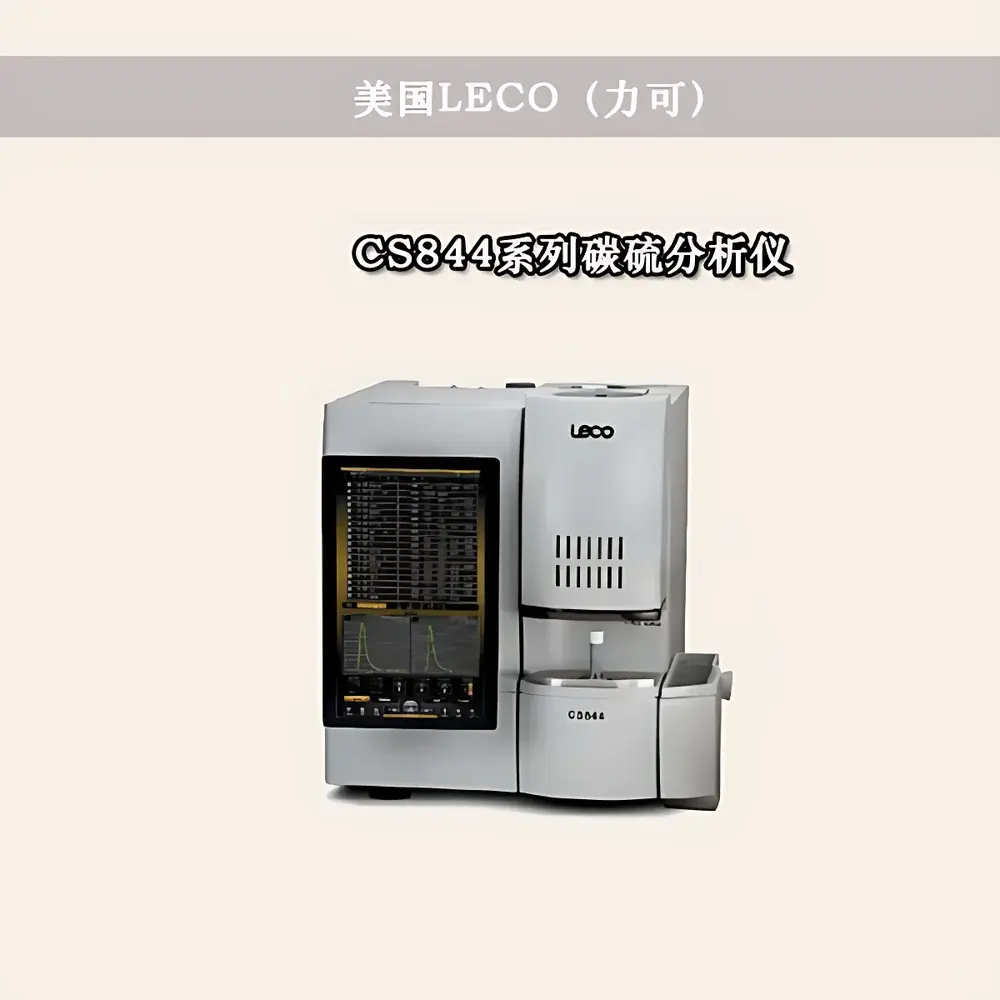
LECO CS844 Series Carbon-Sulfur Analyzer
| Origin | USA |
|---|---|
| Manufacturer Type | Authorized Distributor |
| Origin Category | Imported |
| Model | CS844 |
| Price Range | USD 6,800 – 13,600 (FOB) |
| Measurement Principle | Gas Volumetric Method |
| Heating System | High-Frequency Induction Furnace |
Overview
The LECO CS844 Series Carbon-Sulfur Analyzer is a high-precision elemental combustion analyzer engineered for quantitative determination of total carbon (C) and total sulfur (S) in ferrous and non-ferrous metals, ores, alloys, ceramics, and other inorganic solid materials. It operates on the gas volumetric principle—where sample combustion in a high-purity oxygen atmosphere within a high-frequency induction furnace quantitatively converts carbon to CO₂ and sulfur to SO₂; these gases are then separated, measured volumetrically via precision gas displacement cells, and reported as mass percentages. Unlike infrared absorption-based systems, the volumetric method delivers inherent linearity across wide concentration ranges (typically 0.0005–6.0 wt% C and 0.0002–0.5 wt% S), with minimal matrix interference and no calibration drift due to detector saturation or optical degradation. Designed for routine QC/QA laboratories in metallurgical plants, foundries, third-party testing facilities, and ISO/IEC 17025-accredited labs, the CS844 integrates robust hardware architecture with deterministic gas handling and closed-loop environmental compensation to ensure long-term measurement stability under variable ambient conditions.
Key Features
- High-frequency induction furnace (2.5 kW, 20 kHz) optimized for rapid, complete combustion of refractory metals, stainless steels, and high-carbon cast irons without manual flux adjustment
- Dual independent gas volumetric detection cells—one for CO₂ (carbon), one for SO₂ (sulfur)—each featuring temperature-stabilized piston chambers, pressure-compensated transducers, and zero-drift calibration reference volumes
- Automated crucible handling system with optional 10-position or 60-position robotic autosampler, enabling unattended sequential analysis with pre-weighed samples
- Self-cleaning dual-brush combustion chamber cleaning mechanism activated between runs, minimizing residue carryover and extending furnace liner service life
- Integrated vacuum dust extraction system that captures particulate ash during combustion, reducing maintenance frequency and protecting downstream gas pathways
- Motor-driven automatic combustion tube loading/unloading module with positional feedback—eliminates manual tube insertion and ensures repeatable thermal alignment
- Redesigned gas manifold with welded stainless-steel tubing and metal-sealed fittings to minimize permeation, leakage, and adsorption artifacts
- Onboard environmental monitoring: real-time compensation for ambient temperature (±0.1 °C resolution) and barometric pressure (±0.1 kPa resolution) applied to volumetric calculations
Sample Compatibility & Compliance
The CS844 accommodates solid samples weighing 0.2–1.0 g in standard graphite or ceramic crucibles, including low-alloy steels, tool steels, nickel-based superalloys, titanium alloys, slag, sintered oxides, and geological matrices. It complies with ASTM E1019 (Standard Test Methods for Determination of Carbon, Sulfur, Nitrogen, and Oxygen in Steel, Iron, Nickel, and Cobalt Alloys), ISO 4935 (Steel — Determination of carbon content — Combustion-gas volumetric method), and JIS G 1211 (Methods of test for carbon and sulfur in steel). Its hardware architecture supports GLP/GMP audit readiness: all critical parameters (furnace current, O₂ flow rate, cell pressure/temperature, run timestamp) are logged with immutable timestamps and user ID attribution. The system meets FDA 21 CFR Part 11 requirements when deployed with LECO’s SmartLine® software suite configured for electronic signatures and audit trail retention.
Software & Data Management
Controlled via a Windows-based SmartLine® platform, the CS844 software provides full instrument configuration, method development, real-time gas signal visualization, and automated report generation in PDF/XLS formats. It supports multi-level user access control (administrator, analyst, viewer), method locking, and electronic signature workflows. Data integrity is enforced through encrypted local database storage (SQL Server Express), automatic daily backup scheduling, and configurable retention policies. Remote diagnostics via SmartLine® Connect enable secure, encrypted technician access for troubleshooting—without exposing lab network infrastructure. All raw volumetric traces, calibration curves, and system logs are exportable in vendor-neutral CSV format for external statistical process control (SPC) integration or regulatory submission.
Applications
- Quality control of incoming raw materials (scrap, pig iron, ferroalloys) in integrated steel mills
- Final product certification for ASTM A615/A706 rebar, API 5L pipe, and aerospace-grade Inconel 718
- Sulfur segregation mapping in continuous casting billets via rapid batch analysis
- Process validation of desulfurization efficiency in ladle metallurgy operations
- Research-grade carbon equivalency (CE) calculation for weldability assessment of HSLA steels
- Third-party verification of material declarations per RoHS, REACH, and IATF 16949 traceability requirements
FAQ
What sample types require flux addition—and how is flux optimization managed?
Flux is required only for highly refractory or low-oxygen-affinity matrices (e.g., tungsten carbide, silicon metal). SmartLine® includes a flux recommendation engine based on sample type, weight, and historical combustion efficiency metrics.
Is helium carrier gas required for volumetric detection?
No. The CS844 uses ambient air or compressed dry air as the displacement medium; helium is neither consumed nor required.
How often does the volumetric cell require recalibration?
Factory calibration remains stable for ≥12 months under normal operation; annual verification against NIST-traceable gas standards is recommended per ISO/IEC 17025 Clause 6.5.
Can the CS844 be integrated into a LIMS environment?
Yes—via ASTM E1482-compliant ASCII output or ODBC connectivity to major LIMS platforms (e.g., LabVantage, Thermo Fisher SampleManager).
What is the typical analysis cycle time for a steel sample?
Average total cycle time—including combustion, gas measurement, and cleaning—is 65–85 seconds, depending on carbon/sulfur content and selected sensitivity mode.





