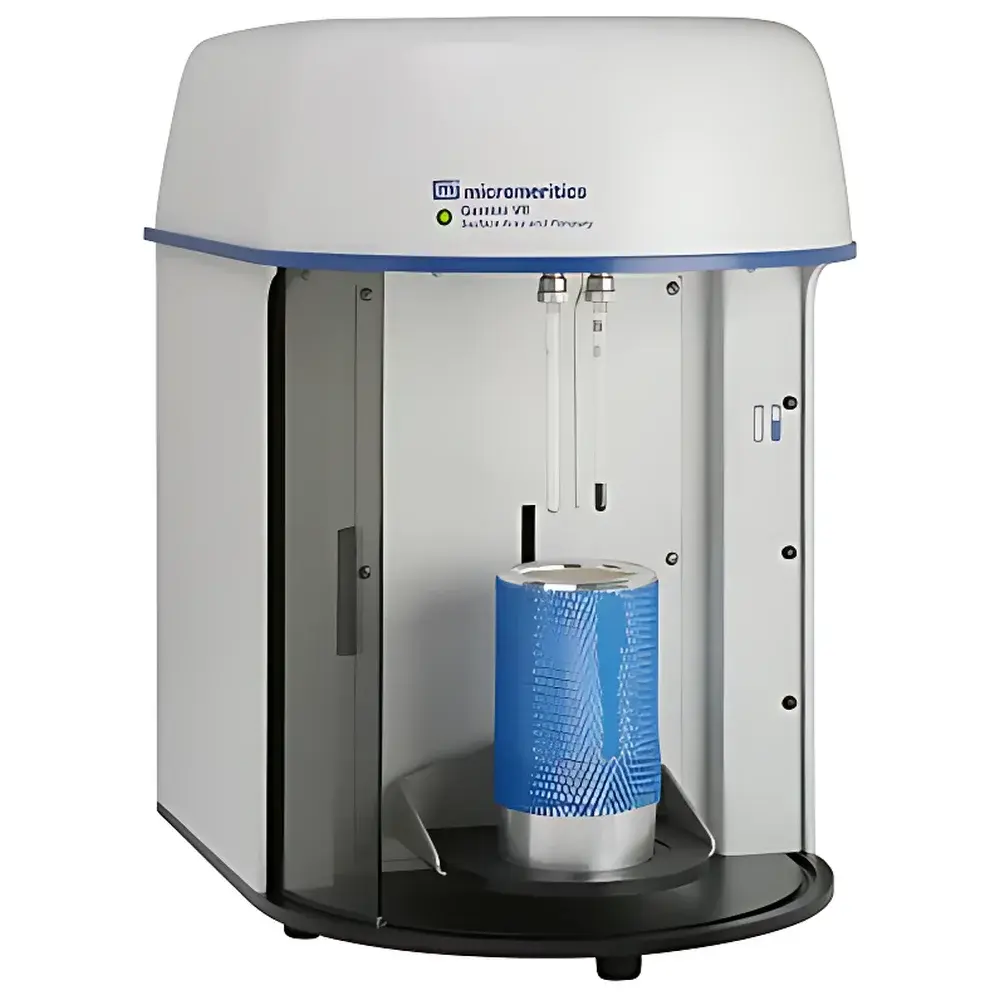
Gemini VII 2390 Series Automated Rapid Surface Area and Porosimetry Analyzer
| Origin | China |
|---|---|
| Manufacturer Type | Authorized Distributor |
| Model | Gemini VII 2390 Series |
| Pricing | Upon Request |
| Gas Compatibility | N₂, Ar, Kr, CO₂, or other adsorptive gases (He-free dead volume calibration supported) |
| Measurement Principle | Static Volumetric Gas Adsorption (N₂ at 77 K, Ar at 87 K) |
| Software | Micromeritics Gemini VII Windows® Application with ASTM/ISO-compliant data reduction modules |
| Compliance Options | FDA 21 CFR Part 11–compliant Confirm™ software available |
| Qualification | IQ/OQ documentation and execution services provided |
Overview
The Gemini VII 2390 Series Automated Rapid Surface Area and Porosimetry Analyzer is an engineered solution for high-precision, static volumetric gas adsorption analysis at cryogenic temperatures. Based on the fundamental principle of physical adsorption—primarily nitrogen at 77 K or argon at 87 K—the instrument quantifies surface area via BET and Langmuir theory, total pore volume via t-plot and αs-plot methods, and pore size distribution across micropores (50 nm) using BJH, DFT (including NLDFT), and MP models. Its patented dual-tube reference equilibrium design eliminates systematic drift caused by liquid nitrogen level variation during long-duration isotherm acquisition—ensuring stable free-space calibration without reliance on helium. This architecture delivers exceptional reproducibility (<1% RSD for repeated SA measurements on certified reference materials) and enables full automation without manual panel controls.
Key Features
- Dual-tube equilibrium system with integrated reference tube for real-time compensation of liquid nitrogen evaporation effects
- Helium-free dead volume determination—eliminates dependency on He supply and associated calibration uncertainty
- Optional P0 monitoring tube for dynamic saturation pressure tracking during isotherm measurement, enabling accurate near-P0 data collection critical for mesopore distribution modeling
- Expandable configuration: supports up to 2000 data points per isotherm; compatible with large-capacity Dewar flasks and extended sample tubes for full adsorption-desorption hysteresis loop acquisition
- Gas-flexible operation: validated for N₂, Ar, Kr, CO₂, and other non-corrosive adsorptives—no specialized carrier gas required for routine surface area screening
- Fully automated workflow: all valve sequencing, temperature stabilization, pressure equilibration, and data logging controlled exclusively via PC interface
Sample Compatibility & Compliance
The Gemini VII 2390 accommodates diverse solid-phase materials—including zeolites, activated carbons, MOFs, silica gels, alumina catalysts, clays, soils, and metal oxides—across powder, pellet, and granular forms (sample mass range: 0.05–2.0 g, depending on density and expected surface area). All analytical protocols align with internationally recognized standards: ASTM D3037 (BET surface area), ASTM D6556 and D3765 (carbon black STSA), ISO 9277 (BET), ISO 15901-2 (pore size distribution by gas adsorption), and ISO 18852.2 / ISO 4652-2/3 (t-plot methodology). Optional Confirm™ software provides audit-trail-enabled operation compliant with FDA 21 CFR Part 11 requirements for regulated environments. Factory-provided IQ/OQ documentation packages support GLP and GMP laboratory validation frameworks.
Software & Data Management
The Gemini VII Windows® software suite implements a comprehensive, standards-based data reduction engine. It includes native support for single- and multi-point BET, Langmuir, Temkin, and Freundlich isotherm fitting; t-plot, αs-plot, and DFT/NLDFT kernel libraries; BJH desorption branch analysis; and user-defined pore volume integration over custom diameter ranges. Reports are exportable in CSV, PDF, and XML formats—with metadata embedding for traceability. The software maintains full version control, electronic signature capability (when paired with Confirm™), and time-stamped audit logs for every parameter change, run initiation, and result export—meeting ALCOA+ data integrity principles.
Applications
This analyzer serves as a core characterization tool in catalysis R&D (e.g., active site density mapping of supported metals), battery material development (anode/cathode porosity optimization), pharmaceutical excipient qualification (surface-dependent dissolution kinetics), environmental sorbent evaluation (activated carbon regeneration efficiency), and quality control of industrial adsorbents (zeolite batch consistency). Its speed (<15 min per BET point), low operational cost (no He consumption), and robustness make it especially suitable for teaching laboratories, contract testing facilities, and high-throughput QC labs requiring ISO/IEC 17025–aligned workflows.
FAQ
Does the Gemini VII 2390 require helium for calibration?
No—its proprietary equilibrium method enables accurate free-volume determination without helium, reducing operating costs and supply-chain dependencies.
Can it measure microporous materials like MOFs or activated carbon?
Yes—using t-plot, αs-plot, and DFT/NLDFT models, it delivers quantitative micropore volume and PSD down to ~0.35 nm.
Is full adsorption-desorption hysteresis analysis supported?
Yes—optional extended Dewar and long sample tubes allow full isotherm acquisition up to 2000 points, including low-pressure micropore filling and capillary condensation regions.
How is instrument performance verified over time?
Micromeritics provides IQ/OQ service packages—including certified reference material runs, pressure transducer linearity checks, and temperature stability validation—to ensure ongoing metrological confidence.
Can data be exported for LIMS integration?
Yes—CSV and XML exports include raw pressure readings, equilibrium times, calculated surface areas, pore volumes, and full isotherm coordinates with embedded metadata tags.
Related Products