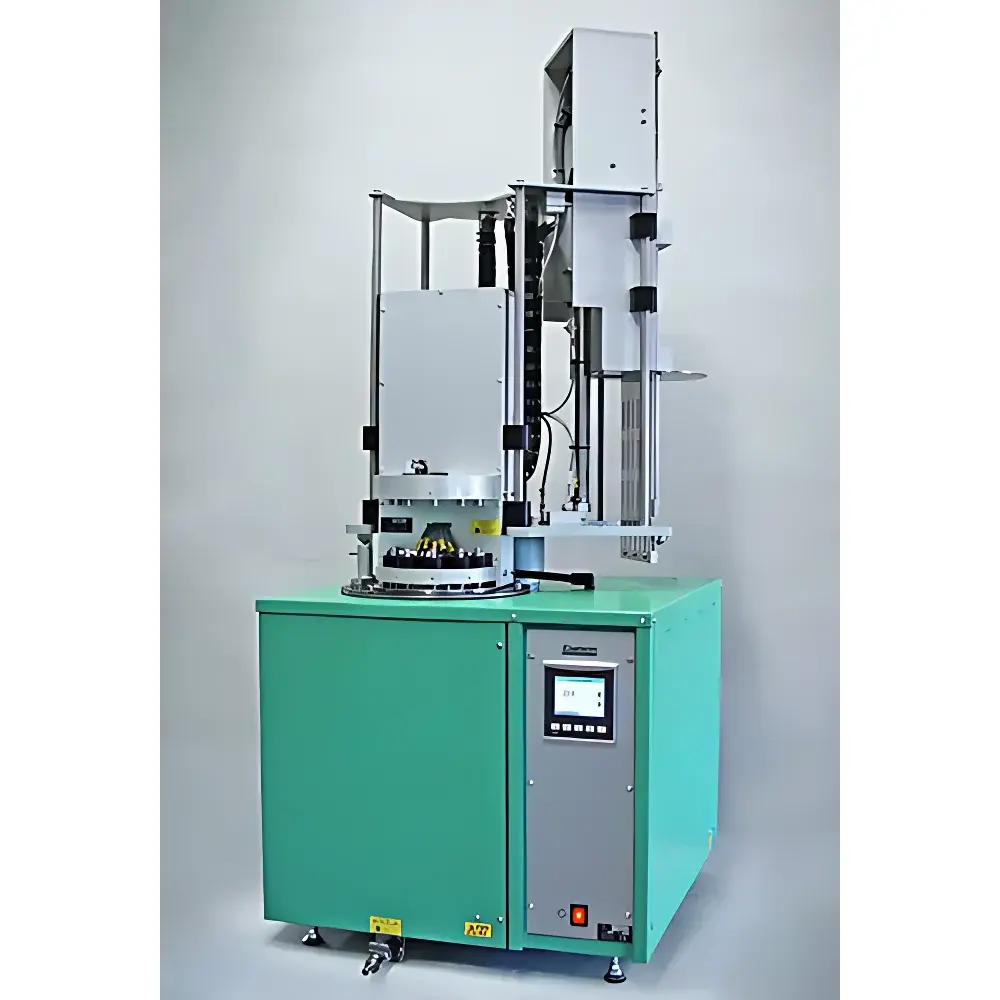
Elastocon Gehman Tester ET 02-II Rotational Stiffness Analyzer
| Brand | ELASTOCON |
|---|---|
| Origin | Sweden |
| Model | Gehman Tester ET 02-II |
| Standards Compliance | ISO 1432, ASTM D1053 |
| Temperature Range | −80 °C to +30 °C |
| Temperature Sensor | PT100 (1/3 DIN accuracy) |
| Cooling Fluid Volume | ~8 L |
| Number of Test Stations | 6 |
| Angular Measurement Range | 0–182° |
| Encoder Resolution | Digital optical encoder |
| Sample Dimensions (L×W×T) | 40 ±2.5 × 3 ±0.2 × 2 ±0.2 mm |
| Test Fixture Material | Stainless steel and anodized aluminum |
| Output Parameters | RM₂, RM₅, RM₁₀, RM₁₀₀, apparent modulus, glass transition temperature (Tg) |
Overview
The Elastocon Gehman Tester ET 02-II is a precision-engineered rotational stiffness analyzer designed for the standardized determination of low-temperature flexural rigidity in vulcanized and thermoplastic elastomers. Based on the fundamental principles of torsional oscillation under controlled thermal conditions, the instrument implements the Gehman test method — a widely accepted empirical procedure for evaluating polymer chain mobility as a function of temperature. The test subjects a rectangular strip specimen to a defined torsional moment while gradually cooling it across a calibrated temperature gradient. As the material transitions from a rubbery to a glassy state, its resistance to twist increases nonlinearly; this behavior is quantified through angular deflection measurements at fixed torque, enabling derivation of key viscoelastic transition indicators. The ET 02-II is not a generic mechanical tester but a purpose-built system optimized for reproducible, multi-station compliance with ISO 1432 and ASTM D1053 — two internationally harmonized standards governing rubber low-temperature characterization.
Key Features
- Six independent, synchronized test stations enable high-throughput comparative analysis without cross-contamination or thermal crosstalk.
- Integrated cryogenic cooling system with precise PT100 (1/3 DIN) temperature sensing ensures traceable thermal control from −80 °C to +30 °C, meeting stringent calibration requirements for Tg determination.
- Digital optical encoders deliver high-resolution angular displacement measurement (0–182°) with sub-degree repeatability, critical for accurate RM-value computation.
- Automated test sequencing — including temperature ramping, dwell timing, torque application, and data capture — eliminates operator-dependent variability and supports unattended operation.
- Stainless steel and anodized aluminum test fixtures provide dimensional stability, corrosion resistance, and long-term mechanical integrity under repeated thermal cycling.
- Modular design facilitates routine maintenance, calibration verification, and optional integration with external environmental chambers or data acquisition networks.
Sample Compatibility & Compliance
The ET 02-II accommodates standard test specimens conforming to ISO 1432 and ASTM D1053 geometry specifications: 40 ±2.5 mm length, 3 ±0.2 mm width, and 2 ±0.2 mm thickness. It is validated for use with sulfur-cured natural rubber (NR), styrene-butadiene rubber (SBR), nitrile rubber (NBR), ethylene propylene diene monomer (EPDM), thermoplastic elastomers (TPEs), and other elastomeric compounds exhibiting measurable glass transition behavior. All mechanical and thermal subsystems are designed to meet ISO/IEC 17025 metrological traceability requirements when operated within specified environmental conditions. The system supports audit-ready documentation workflows aligned with GLP and GMP quality systems, including timestamped raw angular and thermal data logs suitable for FDA 21 CFR Part 11-compliant electronic record retention when paired with validated software configurations.
Software & Data Management
Control and analysis are performed via Elastocon’s proprietary Windows-based software suite, which provides real-time monitoring of all six stations, configurable test protocols, and automated calculation of RM₂, RM₅, RM₁₀, and RM₁₀₀ values — defined as the reciprocal of angular deflection (in degrees) at respective torque levels. The software generates exportable CSV and PDF reports containing full time-temperature-deflection curves, derivative plots for Tg estimation (e.g., inflection point of dθ/dT), apparent modulus profiles, and statistical summaries across replicates. Raw encoder and PT100 data streams are stored with millisecond timestamp resolution, supporting retrospective reprocessing and uncertainty budgeting per GUM (Guide to the Expression of Uncertainty in Measurement). Optional API interfaces allow integration into laboratory information management systems (LIMS) or enterprise quality management software (QMS).
Applications
- Quality control of incoming elastomer batches against specification limits for low-temperature flexibility.
- Formulation development for winter-grade tires, seals, gaskets, and cold-resistant medical tubing.
- Accelerated aging studies assessing embrittlement mechanisms after thermal, UV, or ozone exposure.
- Comparative evaluation of plasticizer efficiency and polymer blend compatibility.
- Supporting regulatory submissions requiring standardized Tg and stiffness data per ISO, ASTM, or OEM technical specifications (e.g., SAE J2236, VDA 262).
- Research into structure–property relationships in novel bio-based elastomers and dynamic vulcanizates.
FAQ
What does “RM” stand for in Gehman testing?
RM denotes “Relative Modulus” — a dimensionless ratio derived from angular deflection under constant torque; RM₂, RM₅, etc., correspond to measurements taken at specific torque values (e.g., 2 × 10⁻⁴ N·m), used to interpolate the glass transition temperature.
Can the ET 02-II be calibrated independently of Elastocon service?
Yes — the system includes user-accessible calibration routines for angular zero-point and thermal offset verification using NIST-traceable reference standards; full metrological calibration requires certified tools and documented procedures per ISO 17025.
Is the cooling fluid system closed-loop or open-bath?
It employs a recirculating chiller-compatible closed-loop jacketed bath with integrated temperature stabilization, eliminating evaporative loss and ensuring consistent thermal mass across extended test cycles.
How is sample alignment verified prior to testing?
Each station incorporates mechanical alignment guides and a visual inspection window; optional digital microscope integration is available for pre-test dimensional validation per ISO 23529 Annex A.
Does the software support multi-language UI and report generation?
The interface and report templates are English-only by default; localized language packs require prior agreement with Elastocon and validation per regional regulatory requirements (e.g., EU Annex 11, JPAL guidelines).