
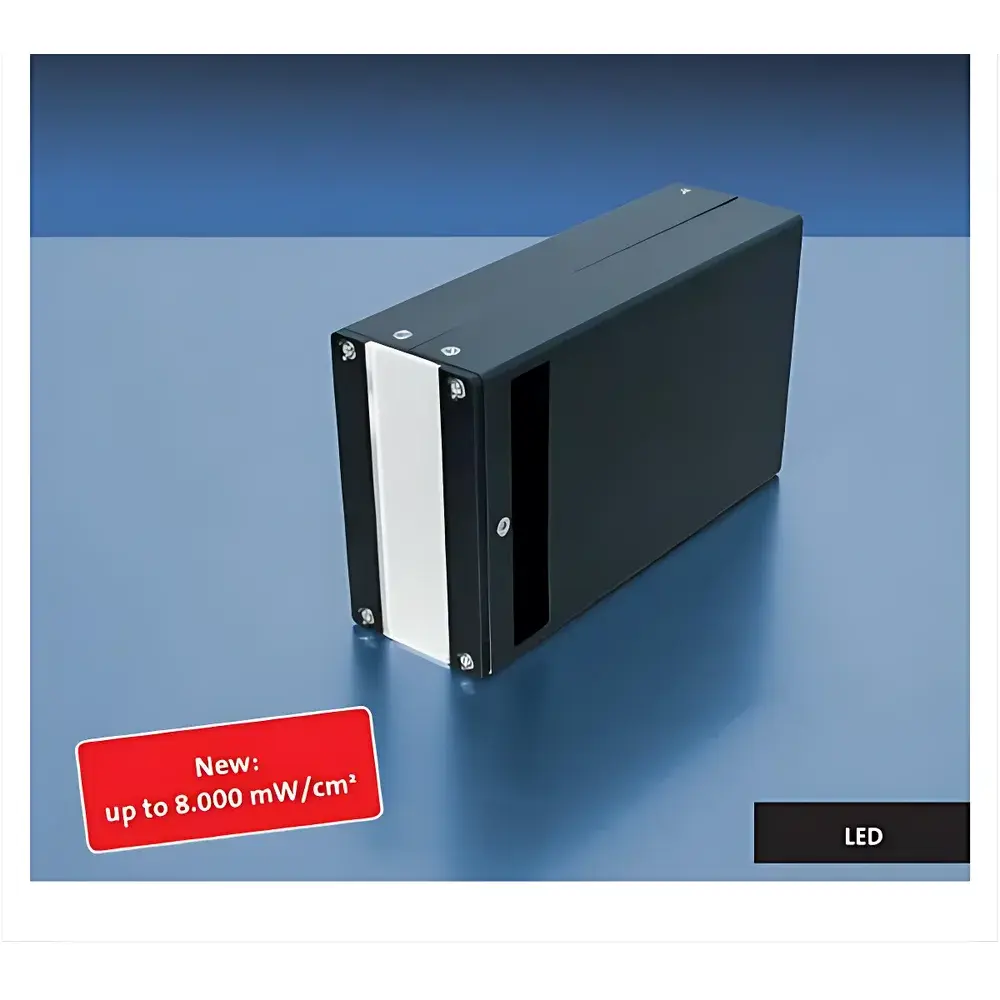
Hoenle LED Powerline AC/IC 410 Air-Cooled High-Performance UV LED Array
| Brand | Hoenle |
|---|---|
| Origin | Germany |
| Model | LED Powerline AC/IC 410 Air-Cooled High-Performance |
| Wavelength Options | 365 nm / 385 nm / 395 nm / 405 nm (±10 nm) |
| Cooling | Integrated forced-air cooling system |
| Power per Segment | Up to 120 W |
| Control Interface | 0–10 V analog dimming |
| Monitoring Functions | Short-circuit, open-circuit, and overtemperature detection per LED segment |
| Modular Scalability | Seamless side-by-side stacking for extended irradiation width |
| Controller Type | Integrated Controller (IC) |
Overview
The Hoenle LED Powerline AC/IC 410 is an industrial-grade, air-cooled UV LED array engineered for precision photopolymerization in demanding manufacturing environments. Unlike conventional mercury arc lamps or water-cooled LED systems, this series leverages solid-state semiconductor technology operating on the principle of electroluminescence within gallium nitride (GaN)-based diodes. It delivers stable, narrow-band ultraviolet irradiance across four standard peak wavelengths—365 nm, 385 nm, 395 nm, and 405 nm—with a spectral tolerance of ±10 nm—enabling selective activation of photoinitiators used in acrylate, epoxy, and cationic formulations. Designed for inline process integration, the AC/IC 410 supports both intermediate “tack-free” curing (pinning) and full-depth final cure in applications such as digital inkjet printing, conformal coating, adhesive bonding, and encapsulation of electronic components. Its air-cooled architecture eliminates dependency on external chillers or facility water loops, reducing infrastructure complexity while maintaining thermal stability under continuous duty cycles.
Key Features
- Integrated forced-air thermal management system ensures consistent LED junction temperature control across ambient conditions from 15 °C to 40 °C—no external heat exchangers or recirculated coolant required.
- Modular mechanical design allows seamless lateral stacking of multiple units to achieve uniform irradiation profiles over widths exceeding 1 meter without dead zones or intensity drop-offs.
- Integrated Controller (IC) provides real-time monitoring and independent regulation of up to 120 W per LED segment, supporting precise irradiance control via 0–10 V analog input.
- Per-segment fault diagnostics detect short circuits, open circuits, and thermal excursions—triggering automatic shutdown and logging events for traceability in regulated production environments.
- Wavelength-selectable configuration enables alignment with photoinitiator absorption maxima, improving energy efficiency and minimizing substrate thermal load compared to broadband sources.
Sample Compatibility & Compliance
The LED Powerline AC/IC 410 is compatible with a broad range of UV-curable chemistries—including free-radical acrylates, cationic epoxies, and hybrid formulations—as validated by industry-standard adhesion, hardness, and crosslink density testing per ASTM D3359, ISO 15184, and ISO 2813. Its stable spectral output and intensity repeatability (±3% over 1,000 hours at rated power) support compliance with ISO 9001 quality management systems and facilitate validation protocols required under ISO 13485 for medical device manufacturing. While not intrinsically rated for hazardous locations, the unit meets CE marking requirements (EMC Directive 2014/30/EU, Low Voltage Directive 2014/35/EU) and conforms to RoHS 2011/65/EU restrictions on hazardous substances.
Software & Data Management
The integrated controller supports deterministic analog control and does not require proprietary software for basic operation. However, when interfaced with programmable logic controllers (PLCs) or supervisory control and data acquisition (SCADA) systems, it enables full audit trail generation—including timestamped power-on duration, segment-level thermal logs, and fault event records. For facilities operating under FDA 21 CFR Part 11 or EU Annex 11 requirements, third-party SCADA platforms may be configured to enforce electronic signatures, role-based access control, and immutable data archiving—ensuring regulatory readiness during GMP or GLP audits.
Applications
- Digital inkjet printing: Pinning of aqueous and solvent-based UV inks prior to transport; full cure post-printing on flexible substrates including PET, PVC, and coated paperboard.
- Electronics assembly: Curing of underfill adhesives, conformal coatings (e.g., silicone-acrylate hybrids), and edge-bonding sealants on PCBs and SMT components.
- Optical component manufacturing: Bonding of lenses, prisms, and sensor housings using low-shrinkage, high-clarity UV adhesives with minimal outgassing.
- Automotive trim finishing: Localized curing of clearcoats and decorative laminates on interior panels, where thermal sensitivity prohibits IR or convection heating.
- Medical device packaging: Sealing of peelable lidding films and sterilization barrier materials requiring consistent, low-ozone UV exposure.
FAQ
What is the expected lifetime of the LED emitters at rated power?
Based on accelerated life testing per IES LM-80 and TM-21 methodologies, the LEDs maintain ≥70% of initial radiant flux after 15,000 hours of continuous operation at 25 °C ambient and nominal drive current.
Can the system be synchronized with conveyor speed or print trigger signals?
Yes—the 0–10 V analog interface supports TTL-compatible start/stop triggering and proportional intensity modulation synchronized to encoder-based line speed feedback.
Is ozone generation a concern during operation?
No—emission below 240 nm is negligible; the 365–405 nm spectral range produces no measurable ozone under normal ventilation conditions.
Does the unit support Ethernet or fieldbus communication protocols?
The base IC controller does not include native Ethernet, CANopen, or EtherCAT interfaces—but optional OEM modules are available for Modbus RTU/TCP integration.
What safety certifications apply to operator exposure?
The system complies with IEC 62471:2006 (Photobiological Safety of Lamps) and is classified as Risk Group 2 (RG2) for UV-A exposure—requiring appropriate engineering controls and PPE per ANSI Z136.1 when direct viewing or skin exposure exceeds permissible exposure limits (PELs).






