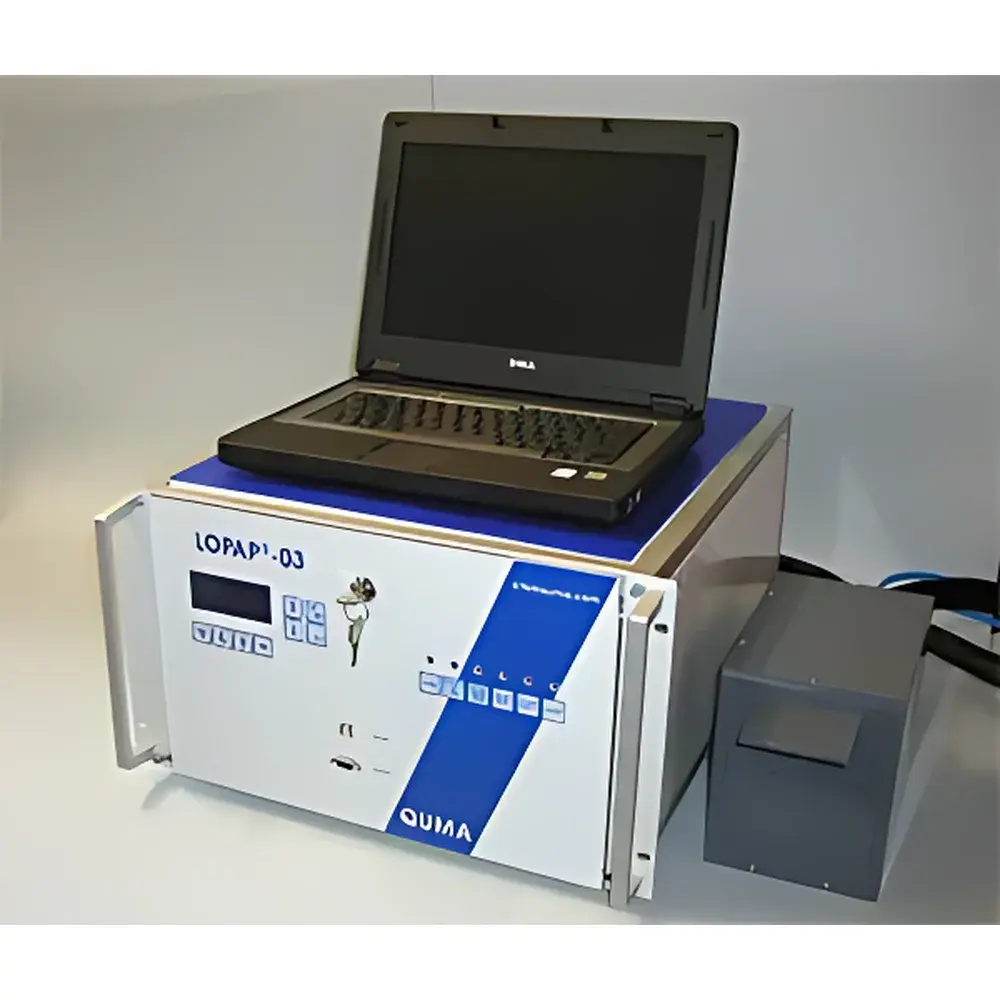
LOPAP HONO Analyzer by QUMA (Germany)
| Origin | Germany |
|---|---|
| Manufacturer Type | Authorized Distributor |
| Origin Category | Imported Instrument |
| Model | LOPAP |
| Pricing | Available Upon Request |
Overview
The LOPAP HONO Analyzer by QUMA (Germany) is a high-sensitivity, field-deployable instrument engineered for the quantitative, in-situ, and continuous measurement of gaseous nitrous acid (HONO) in ambient air, indoor environments, polar boundary layers, and industrial emission streams. It employs a hybrid analytical principle combining wet-chemical derivatization with long-path differential optical absorption photometry (LOPAP — Long Path Absorption Photometer). In this method, sampled air is drawn into an external reaction cell where HONO is selectively trapped and converted into a stable, light-absorbing azo dye via sulfanilamide and N-(1-naphthyl)ethylenediamine dihydrochloride (NED) under acidic conditions. The resulting colored compound is quantified using a dual-beam UV-Vis photometric system with an effective optical path length exceeding 10 meters—achieved through multiple internal reflections—enabling sub-ppt detection capability. This principle ensures selectivity against common interferents (e.g., NO₂, O₃, HNO₃, PAN, formaldehyde), making LOPAP uniquely suited for atmospheric chemistry research where HONO serves as a critical precursor to hydroxyl (OH) radical formation—particularly during early morning hours and in snowpack photochemistry.
Key Features
- Dual-channel optical design eliminates cross-talk between sample and reference beams, ensuring baseline stability and drift compensation over extended unattended operation.
- External sampling unit decouples gas-phase interaction from the optical core—eliminating contamination risk and enabling true in-situ measurement without heated or catalytic sampling lines.
- Dynamic measurement range spans five orders of magnitude: 5 ppt to 2 ppm (v/v), configurable via integration time and reagent flow rate.
- Measurement cycle programmable from 60 to 300 seconds, optimized for temporal resolution versus sensitivity trade-offs in field campaigns.
- Integrated temperature- and humidity-stabilized reaction chamber maintains >95% derivatization efficiency across ambient conditions (−10 °C to +40 °C, 20–90% RH).
- Compliant with ISO/IEC 17025 traceability requirements when operated with certified HONO permeation tubes or gravimetrically prepared standards.
Sample Compatibility & Compliance
The LOPAP analyzer demonstrates robust performance in complex matrices: ambient air (urban, rural, marine, polar), indoor air (residential, occupational, museum environments), flue gas (post-SCR, combustion exhaust), and aqueous extracts (detection limit ~1 nM for NO₂⁻ in water following extraction and dilution). It has been validated in intercomparison studies coordinated by ACTRIS and EUSAAR. The system meets functional requirements outlined in EPA Method TO-15 (for reactive nitrogen speciation support), ASTM D5196 (for low-concentration gas analysis), and supports GLP-compliant data acquisition when paired with audit-trail-enabled software. All fluidic components are chemically inert (PTFE, PFA, borosilicate glass); no metal surfaces contact reagents or samples.
Software & Data Management
Data acquisition and instrument control are managed via QUMA’s LOPAP Control Suite (v4.x), a Windows-based application supporting real-time visualization, automated calibration scheduling, and event-triggered logging. Raw absorbance signals, temperature/pressure/humidity metadata, and diagnostic flags (e.g., pump status, reagent level, lamp intensity) are timestamped with millisecond precision and stored in HDF5 format. Export options include CSV, NetCDF, and XML for compatibility with atmospheric modeling frameworks (e.g., CMAQ, WRF-Chem). Software adheres to FDA 21 CFR Part 11 principles: electronic signatures, role-based access control, and immutable audit trails for all configuration changes and calibration events.
Applications
- Atmospheric science: Quantifying HONO fluxes and photolysis rates in field campaigns (e.g., HOPE, NITROX, POLARCAT).
- Indoor air quality assessment: Monitoring HONO emissions from gas stoves, tobacco smoke, and NO₂–surface reactions on building materials.
- Environmental toxicology: Supporting exposure assessments for epidemiological studies linking HONO to respiratory morbidity.
- Industrial compliance: Verifying abatement efficiency of HONO-forming processes in nitric acid production, fertilizer manufacturing, and diesel aftertreatment systems.
- Aqueous-phase analysis: Measuring dissolved nitrite in meltwater, fogwater, and cloudwater samples collected in situ.
FAQ
What is the primary measurement principle used by the LOPAP HONO Analyzer?
It combines selective wet-chemical derivatization of HONO with long-path UV-Vis photometry—achieving detection limits of 1–2 ppt via enhanced optical pathlength and signal averaging.
Can the instrument operate unattended for extended periods?
Yes—typical maintenance intervals exceed 72 hours; reagent reservoirs support >10 days of continuous operation at 3-minute cycle time.
Is calibration traceable to international standards?
Calibration is performed using NIST-traceable HONO permeation devices or gravimetrically prepared aqueous nitrite standards, documented per ISO Guide 34 and ISO/IEC 17025.
Does the system require external gas cylinders or zero-air generators?
No—zeroing is achieved via reagent blank subtraction and periodic valve-switched bypass; no auxiliary gases are needed for routine operation.
How is data security and regulatory compliance ensured?
The control software implements full 21 CFR Part 11 functionality: user authentication, electronic signatures, change history logging, and encrypted data storage.