
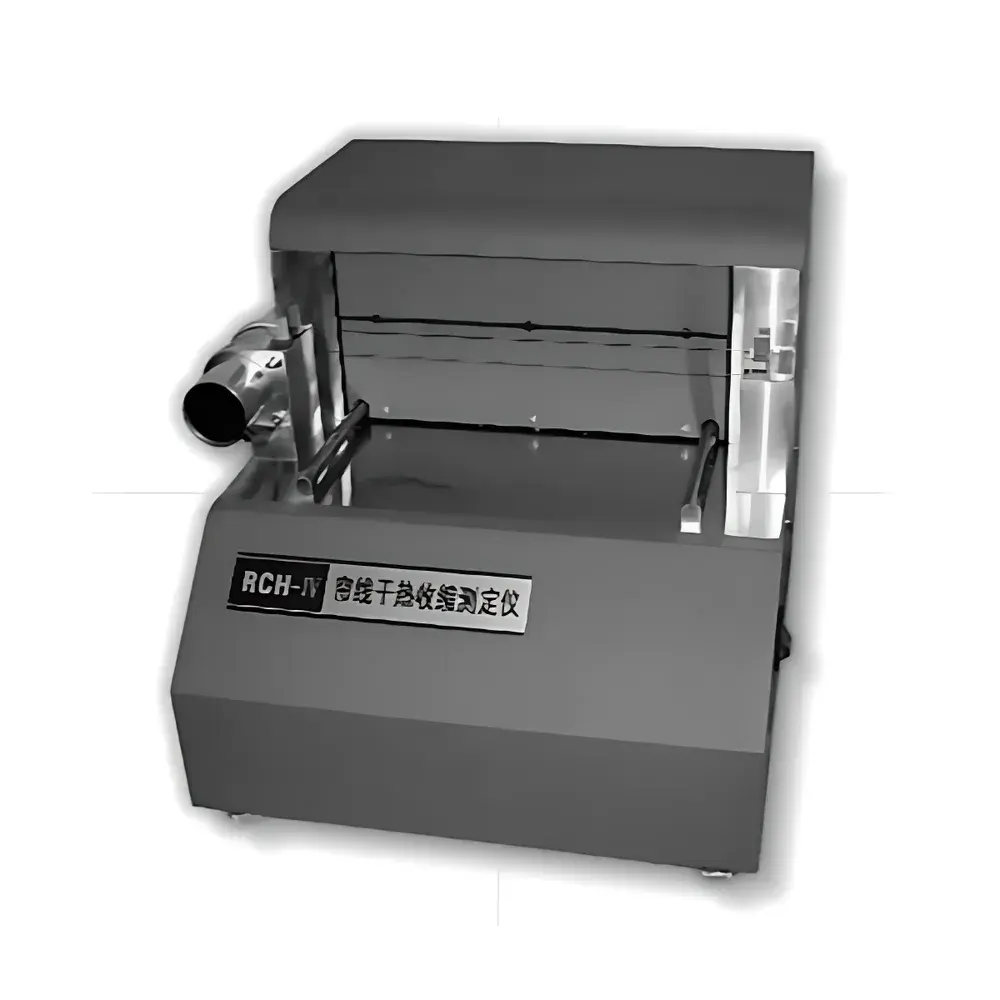
SUERC RCH-IV Dry Heat Shrinkage Tester for Cord and Textile Yarns
| Brand | SUERC |
|---|---|
| Origin | USA |
| Manufacturer Type | Authorized Distributor |
| Origin Category | Imported |
| Model | RCH-IV |
| Compliance | ASTM D4974, GB/T 9101–2002, GB/T 9102–2003, GB/T 19390–2003 |
| Temperature Range | Ambient to 250 °C |
| Shrinkage Measurement Range | –5% to +40% |
| Shrinkage Force Range | 0–25 N |
| Test Stations | 3 (Shrinkage ×2, Shrinkage Force ×1) |
| Power Supply | 220 V / 50 Hz |
Overview
The SUERC RCH-IV Dry Heat Shrinkage Tester is a precision-engineered instrument designed for quantitative thermal dimensional stability assessment of high-tenacity cords, tire reinforcement yarns (e.g., polyester, nylon, aramid), and technical textile filaments. It operates on the principle of controlled dry-heat exposure under defined mechanical constraint—applying standardized pre-tension while subjecting specimens to elevated temperatures in a calibrated forced-air oven chamber. The system measures two distinct yet interrelated physical responses: (1) percentage length change (shrinkage rate) after thermal treatment and cooling to standard atmospheric conditions, and (2) real-time tensile force developed during heating (shrinkage force), both critical parameters for predicting performance in end-use applications such as radial tire carcass construction, industrial belting, and architectural fabric tensioning systems. Its design adheres strictly to ASTM D4974 and Chinese national standards GB/T 9101–2002, GB/T 9102–2003, and GB/T 19390–2003, ensuring traceable, inter-laboratory comparable results required for QC release, supplier qualification, and regulatory documentation.
Key Features
- Triple-station modular test configuration: two independent shrinkage measurement channels and one dedicated shrinkage force channel—enabling concurrent evaluation of dimensional change and thermomechanical response under identical thermal profiles.
- Precisely regulated forced-air convection oven with ±0.5 °C temperature uniformity across the test zone (ambient to 250 °C), verified per ASTM E2203 calibration protocols.
- Microprocessor-controlled thermal ramping and dwell timing, supporting programmable multi-step temperature profiles with user-defined hold durations and ramp rates.
- High-resolution linear displacement transducers (resolution ≤0.01 mm) and digital load cells (accuracy ±0.5% FS) integrated into each station for synchronized acquisition of length and force data.
- Real-time graphical display of shrinkage % vs. time and shrinkage force (N) vs. temperature curves during active testing—no post-processing required for trend visualization.
- Robust mechanical architecture featuring low-thermal-expansion alloy sample holders, non-contact specimen alignment guides, and vibration-damped base assembly to minimize measurement drift.
Sample Compatibility & Compliance
The RCH-IV accommodates standard cord specimens per ASTM D4974 (typically 500 mm gauge length, conditioned at 21 °C / 65% RH per ISO 139). It supports single-filament, twisted, and cabled structures up to 3 mm diameter. All hardware and firmware comply with ISO/IEC 17025:2017 requirements for test equipment metrological traceability. Data integrity conforms to FDA 21 CFR Part 11 principles through secure user authentication, electronic audit trails, and immutable result archiving—including raw time-series datasets, final calculated values (shrinkage %, residual shrinkage %, peak shrinkage force), and annotated test reports. Calibration certificates are supplied with NIST-traceable references for temperature, displacement, and load sensors.
Software & Data Management
The embedded Windows-based control software provides full GLP-compliant operation: user role management (administrator/operator), password-protected method templates, automatic metadata stamping (operator ID, date/time, environmental logs), and encrypted local database storage. Export functions support CSV, PDF, and XML formats for LIMS integration. Statistical analysis tools include batch averaging, outlier detection (Dixon’s Q-test), and comparative reporting across material lots or process conditions. All test sequences are fully reproducible via saved method files—including temperature setpoints, tension application protocol, sampling interval (100 ms default), and pass/fail criteria thresholds.
Applications
- Tire cord manufacturers verifying thermal stability of polyester and nylon cords prior to calendering and rubber adhesion processing.
- Automotive OEMs qualifying replacement cord specifications against original equipment benchmarks for sidewall durability and rolling resistance optimization.
- Textile R&D labs investigating heat-setting parameters for high-modulus synthetic fibers used in geotextiles and safety harnesses.
- Third-party testing laboratories performing accredited conformance testing to ASTM, ISO, and GB standards for export certification.
- Quality assurance departments conducting incoming inspection of raw materials where shrinkage behavior directly impacts downstream weaving tension control and dimensional consistency.
FAQ
What standards does the RCH-IV validate against?
ASTM D4974, GB/T 9101–2002 (cord shrinkage rate), GB/T 9102–2003 (residual shrinkage), and GB/T 19390–2003 (shrinkage force)—with optional validation packages available for ISO 2078 and JIS L1096.
Can the instrument measure both shrinkage and shrinkage force simultaneously?
Yes—the three-station architecture allows two specimens to be evaluated for dimensional change while a third specimen undergoes concurrent force measurement under identical thermal conditions.
Is calibration documentation included with shipment?
Yes: factory calibration certificate with uncertainty budgets for temperature, displacement, and load subsystems, plus instructions for user-performed verification checks using certified reference materials.
How is data security ensured during long-term deployment?
All stored data are encrypted at rest; software enforces session timeouts, prohibits unauthorized USB exports, and maintains tamper-evident audit logs compliant with ISO 17025 clause 7.7 and FDA 21 CFR Part 11 Subpart B.
What maintenance intervals are recommended?
Biannual verification of oven temperature uniformity and sensor linearity; annual full recalibration by SUERC-certified service engineers using traceable standards.






