
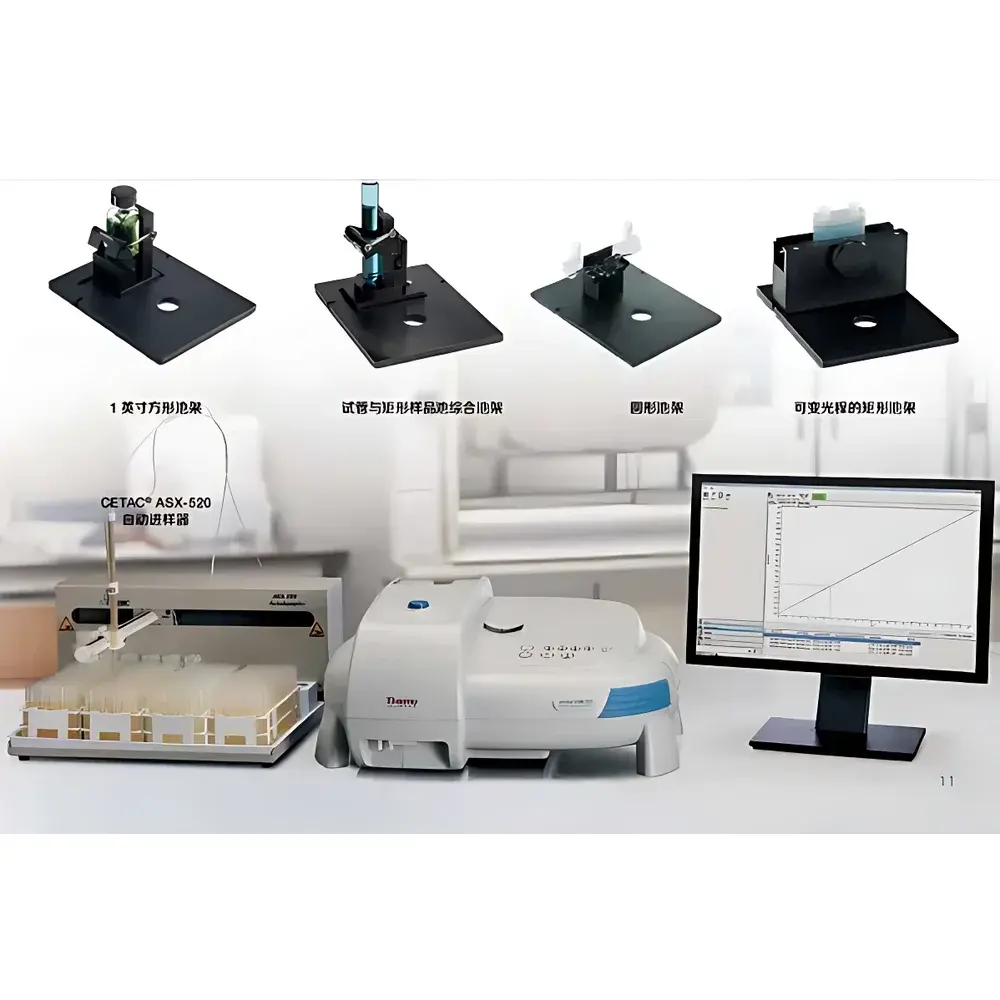
Thermo Scientific Evolution 200 UV-Vis Spectrophotometer
| Origin | USA |
|---|---|
| Manufacturer Type | Authorized Distributor |
| Origin Category | Imported |
| Model | Evolution 200 |
| Instrument Architecture | Double-Beam |
| Detector Type | Photodiode Array (PDA) |
| Wavelength Range | 190–1100 nm |
| Automation Level | Motorized Wavelength Scanning |
| Spectral Bandwidth | Variable, 1.0 nm and 2.0 nm nominal |
| Wavelength Accuracy | ±0.5 nm |
| Stray Light | <0.05% T at 220 nm (NaI), <0.02% T at 340 nm (NaNO₂) |
Overview
The Thermo Scientific Evolution 200 UV-Vis Spectrophotometer is a high-performance, double-beam scanning spectrophotometer engineered for precision quantitative and qualitative analysis across research laboratories, quality control environments, and regulated pharmaceutical and chemical manufacturing facilities. Based on monochromator-driven optical architecture with a xenon flash lamp light source and photodiode array detection, the instrument delivers rapid spectral acquisition, exceptional photometric stability, and long-term wavelength fidelity without lamp warm-up delays or degradation-related recalibration cycles. Its optical design incorporates beam-focusing optics and an actively shielded sample detector to minimize stray light influence and environmental interference—enabling reproducible absorbance measurements even during open-cuvette operation. The Evolution 200 complies with core performance expectations outlined in ASTM E275, ISO 6223, and USP <857> for ultraviolet-visible spectrophotometry, supporting method validation under GLP and GMP frameworks.
Key Features
- Double-beam optical path with real-time reference compensation ensures high baseline stability and minimizes drift from source intensity fluctuations or detector sensitivity variations.
- Xenon flash lamp source provides intense, broadband output from 190 nm to 1100 nm—eliminating warm-up time, reducing ozone generation, and delivering >3 years of stable operation without replacement.
- Motorized, high-resolution monochromator enables scan speeds from <1 nm/min up to 6,000 nm/min, supporting both high-resolution spectral profiling and rapid kinetic monitoring.
- Photodiode array detector offers simultaneous multi-wavelength acquisition with 1.0 nm nominal resolution and selectable 2.0 nm bandwidth for optimized signal-to-noise ratio in routine assays.
- Integrated touchscreen computer enables fully standalone operation—including method execution, data visualization, and report export—without external PC dependency.
- Modular accessory interface supports temperature-controlled cuvette holders (±0.1 °C), automated 8- or 12-position sample changers, integrating spheres for diffuse transmittance/reflectance, fiber-optic probes, and solid-sample reflectance stages.
- Dedicated mercury lamp port enables traceable wavelength calibration across the full spectral range, satisfying internal audit requirements for wavelength accuracy verification per ISO/IEC 17025.
Sample Compatibility & Compliance
The Evolution 200 accommodates standard 10 mm square quartz or UV-grade glass cuvettes, micro-volume cells (down to 50 µL), flow cells, and solid samples via optional integrating sphere or specular reflectance accessories. Its sample compartment features a motorized sliding door with tactile activation and ambient-light shielding—allowing safe, interruption-free insertion or removal of samples during measurement sequences. All firmware and software modules are designed to support 21 CFR Part 11-compliant workflows when deployed with Thermo Scientific INSIGHT software configured for electronic signatures, audit trails, and user-access controls. Instrument performance verification protocols align with ASTM E169, E387, and pharmacopeial standards (USP <857>, EP 2.2.25), facilitating regulatory submissions and laboratory accreditation.
Software & Data Management
Two complementary software platforms are supported: INSIGHT (PC-based) and CUE (method-centric, embedded or PC-deployed). INSIGHT provides comprehensive instrument control, spectral processing (baseline correction, peak identification, derivative analysis), quantitative modeling (single/multi-point calibration, Beer’s law fitting), kinetics module with time-resolved plotting, and customizable reporting templates exportable to PDF, CSV, or XML. CUE enables creation of guided, step-by-step analytical workflows—ideal for routine QC labs where operator training consistency and procedural adherence are critical. Both applications maintain full audit trail functionality, including timestamped parameter changes, measurement history, and user attribution. Data files adhere to ASTM E1388-compliant metadata structures, ensuring interoperability with LIMS and ELN systems.
Applications
- Pharmaceutical assay development and release testing (e.g., active ingredient quantification, dissolution profile analysis)
- Environmental water quality monitoring (nitrate, phosphate, COD estimation)
- Protein and nucleic acid quantification (A260/A280, A260/A230) using validated extinction coefficients
- Polymer characterization (additive concentration, degradation kinetics)
- Colorimetric enzyme assays and cell viability studies (MTT, XTT)
- Thin-film thickness and optical bandgap determination via transmission/reflectance spectroscopy
- Method transfer between R&D and production labs due to consistent photometric linearity (0–3.5 AU) and repeatability (RSD <0.2% at 1.0 AU)
FAQ
Does the Evolution 200 support GLP-compliant data integrity requirements?
Yes—when used with INSIGHT software configured for 21 CFR Part 11 compliance, it provides electronic signatures, immutable audit trails, role-based access control, and secure data archiving.
Can I perform kinetic measurements without connecting to an external PC?
Yes—the built-in touchscreen computer supports full kinetic method definition, real-time plotting, and data export via USB or network interface.
What is the typical lifetime of the xenon flash lamp?
Rated for ≥1 × 10⁹ flashes, equivalent to >3 years of continuous daily use under standard operating conditions.
Is wavelength calibration traceable to NIST standards?
Yes—using the integrated mercury lamp port and certified Hg emission lines at 253.7, 365.0, 404.7, 435.8, and 546.1 nm, users can verify and adjust wavelength accuracy against internationally recognized references.
How does the double-beam architecture improve measurement robustness?
It continuously compares sample and reference beam intensities at each wavelength point, compensating for source drift, solvent absorption shifts, and minor environmental fluctuations—yielding superior photometric reproducibility in variable lab conditions.





