
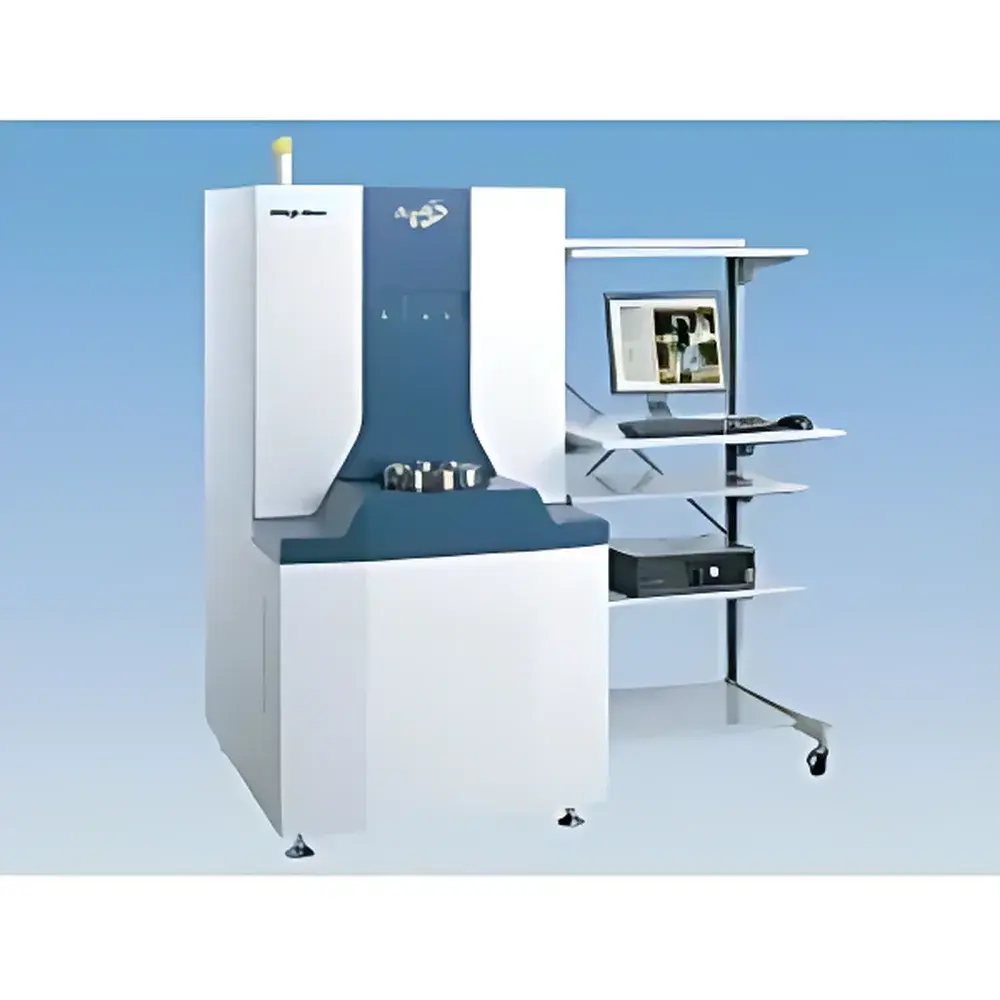
Rigaku ZSX Primus IV Multi-Channel Simultaneous Wavelength Dispersive X-Ray Fluorescence Spectrometer
| Brand | Rigaku |
|---|---|
| Origin | Japan |
| Configuration | Benchtop or Floor-Standing |
| Element Range | Na (11) to U (92) |
| Simultaneous Channels | Standard 16, Upgradable to 30 or 40 |
| X-ray Tube | 3 kW (Optional 4 kW), 60 kV / 80 mA |
| Stability | ±0.005% against ±10% mains voltage fluctuation |
| Sample Changer | Standard 8-position, Optional 20/50/100-position (4 s load time) |
| Vacuum System | Dual-speed pumping with Automatic Pressure Control (APC) |
| Detector | Flow-proportional counters + Scintillation counter |
| Background Correction | Patented Fixed-Channel Background Subtraction |
| Software | Multi-tasking, multi-window, fully localized Chinese interface with FP (Fundamental Parameters) quantification engine |
| Compliance | Designed for ISO 8597, ASTM E1361, and JIS Z 3212 |
Overview
The Rigaku ZSX Primus IV is a high-performance, multi-channel simultaneous wavelength dispersive X-ray fluorescence (WDXRF) spectrometer engineered for precision elemental analysis across industrial QC, geological surveying, metallurgical R&D, and regulatory compliance laboratories. Unlike energy-dispersive (EDXRF) systems, the ZSX Primus IV employs Bragg diffraction from precisely aligned analyzing crystals to isolate characteristic X-ray lines—enabling superior spectral resolution, minimal peak overlap, and sub-ppm detection limits for major, minor, and trace elements. Its fixed-channel architecture allows true simultaneous measurement of up to 40 elements without sequential scanning delays, delivering high throughput while maintaining long-term intensity stability critical for certified reference material (CRM) validation and routine batch certification.
Key Features
- High-power X-ray source: 3 kW sealed-tube generator (optional 4 kW upgrade), operating at 60 kV and 80 mA, optimized for excitation of light elements (Na–F) through heavy metals (Pb, U) with consistent photon flux.
- Exceptional power supply stability: ±0.005% intensity drift under ±10% AC line variation—ensuring reproducible count rates across shifts and facilities with variable grid quality.
- Modular multi-channel detection: Standard configuration includes 16 fixed analytical channels; expandable to 30 or 40 channels via crystal/detector retrofit—each channel independently optimized for specific element lines (e.g., LiF(200) for Si Kα, PET for S Kα, TAP for Al Kα).
- Patented fixed-channel background subtraction: Real-time background estimation at adjacent 2θ positions eliminates matrix-induced continuum interference without sacrificing acquisition time—critical for accurate low-concentration analysis in complex matrices such as slag, catalysts, or soil extracts.
- Dual-mode vacuum system: Fast-roughing and high-vacuum stages operate in tandem; integrated Automatic Pressure Control (APC) maintains stable <1 Pa pressure during analysis of light elements (B–F), minimizing absorption losses and enhancing signal-to-noise ratio.
- Automated sample handling: 8-position carousel standard; optional 20/50/100-position robotic changers enable unattended operation with ≤4 s sample loading cycle—supporting high-volume QA/QC workflows compliant with ISO/IEC 17025.
Sample Compatibility & Compliance
The ZSX Primus IV accepts solid discs (up to 50 mm Ø), fused beads, pressed pellets, and thin-film standards. It accommodates both air-path (for Mg–U) and vacuum-path (for Na–F) analysis modes within a single run sequence. All hardware and software modules conform to IEC 61000-4 electromagnetic compatibility standards and meet Japanese JIS Z 3212 and international ISO 8597 guidelines for WDXRF performance verification. The system supports full audit trail logging—including user actions, method changes, calibration events, and raw spectrum metadata—in alignment with FDA 21 CFR Part 11 and EU Annex 11 requirements for regulated environments.
Software & Data Management
Rigaku’s proprietary ZSX software provides a fully localized Chinese GUI with multi-tasking capability: users may acquire spectra, calibrate curves, process FP-based quantitation, and generate PDF reports concurrently across multiple windows. The Fundamental Parameters (FP) algorithm incorporates matrix correction models validated against NIST SRMs and CRMs from BAM, IRMM, and USGS. Raw data are stored in vendor-neutral .rxf format; export options include CSV, ASTM E1361-compliant XML, and LIMS-ready ASCII tables. Data integrity safeguards include electronic signatures, role-based access control, and immutable audit logs archived with timestamped hash verification.
Applications
- Metallurgy: Rapid grade identification and inclusion analysis in stainless steels, aluminum alloys, and superalloys per ASTM E1086 and ISO 11575.
- Cement & construction materials: Quantitative determination of SiO₂, Al₂O₃, Fe₂O₃, CaO, MgO, SO₃, and alkalis per ASTM C114 and EN 196-2.
- Environmental testing: Screening of RoHS-restricted elements (Pb, Cd, Hg, Cr⁶⁺, Br) in polymers and electronics per IEC 62321-5.
- Geosciences: Major oxide and trace element profiling in igneous rocks, sediments, and exploration drill cores using fused-disk preparation.
- Pharmaceutical excipients: Verification of catalyst residues (e.g., Pd, Pt, Ni) and elemental impurities per ICH Q3D and USP /.
FAQ
Does the ZSX Primus IV support light element analysis below sodium?
No—the instrument is optimized for Na (Z=11) through U (Z=92); analysis of Be, B, C, N, and O requires dedicated vacuum-path EDXRF or secondary fluorescence setups.
Can FP calibration be performed without certified standards?
Yes—the Fundamental Parameters engine enables semi-quantitative screening using only pure-element sensitivities and basic matrix composition; however, quantitative accuracy requires at least three CRM-based calibrants per element group.
Is remote monitoring supported?
Yes—via Rigaku’s optional WebLink module, enabling real-time status viewing, alarm notifications, and limited method execution through HTTPS-secured browser access.
What maintenance intervals are recommended for the X-ray tube and vacuum pumps?
The sealed X-ray tube has a rated lifetime of ≥20,000 hours; oil-free scroll pumps require biannual inspection and filter replacement, while turbomolecular pump bearings are rated for 30,000 hours under continuous vacuum operation.
How does the fixed-channel background subtraction differ from traditional Compton normalization?
It uses empirically derived background intensities measured at fixed angular offsets adjacent to each analyte peak—not interpolated from scattered radiation—and is updated dynamically during calibration to accommodate crystal aging and detector gain drift.
Related Products




