
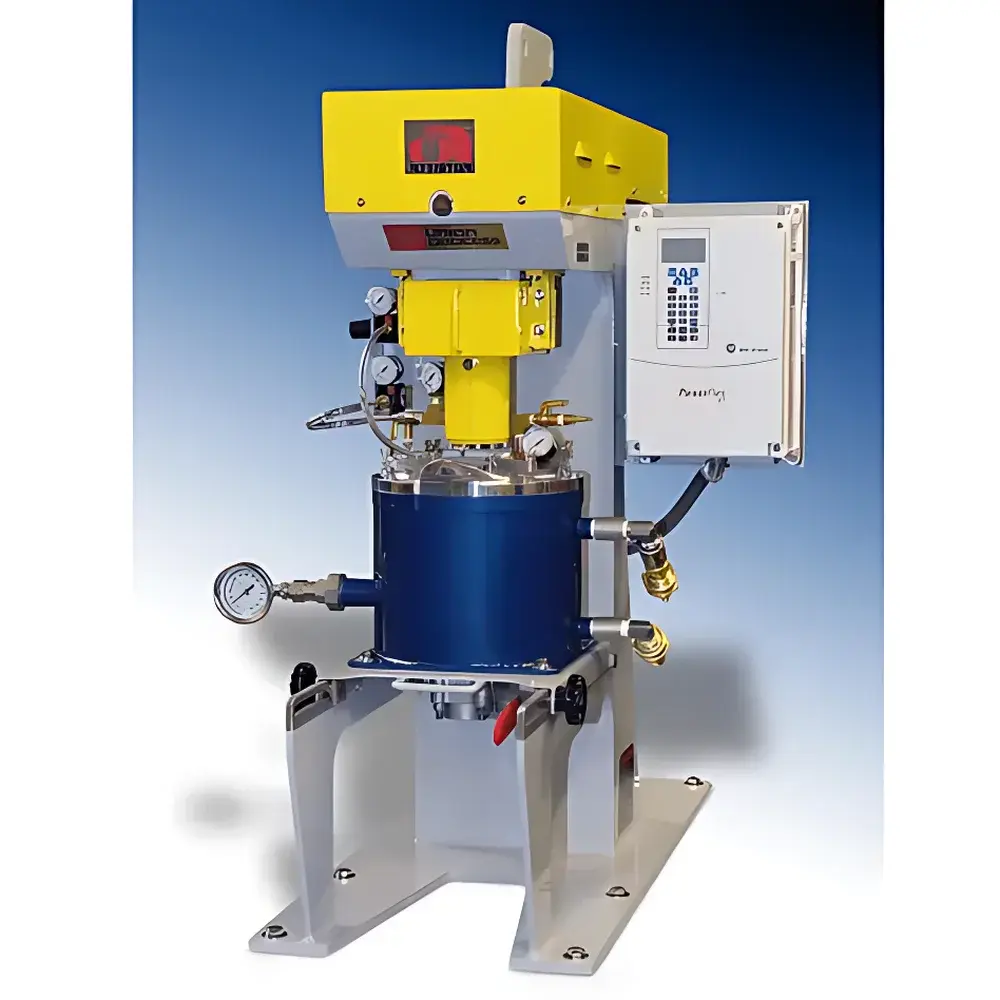
Union Process Attritor 010E-500 / 010E-510 Stirred Ball Mill
| Origin | USA |
|---|---|
| Supplier Type | Authorized Distributor |
| Origin Category | Imported |
| Model | 010E-500 / 010E-510 |
| Tank Capacity | 1.5 gal (5.7 L) / 2.5 gal (9.5 L) |
| Working Volume | 0.7 gal (2.7 L) / 1.1 gal (4.2 L) |
| Media Volume | 1.0 gal (3.8 L) / 1.5 gal (5.7 L) |
| Speed Range | 100–500 rpm |
| Power Supply | 230/460 V, Three-Phase |
| Construction | Stainless Steel Tank with Optional Linings |
| Cooling/Heating | Jacketed Vessel with Quick-Disconnect Fittings |
| Drive System | Variable Frequency Drive (VFD) |
| Stirrer Shaft | Height-Adjustable for Media Size Optimization |
| Discharge | Bottom Grid Valve with Integrated Sampling Port |
| Tilt Mechanism | 90° Forward Tilt for Rapid Media Drainage and Cleaning |
Overview
The Union Process Attritor 010E-500 and 010E-510 stirred ball mills are laboratory-scale, high-shear wet or dry grinding systems engineered for reproducible particle size reduction, dispersion, and mechanochemical activation. Unlike conventional tumbling mills, the Attritor operates on the principle of high-speed agitation of grinding media—typically spherical balls ranging from 1/8″ to 3/8″ in diameter—within a stationary tank via a centrally mounted, vertically oriented stirring shaft. This configuration generates intense shear, impact, and attrition forces between particles and media, enabling consistent micron- and sub-micron-level comminution (typically achieving D₅₀ < 5 µm under optimized conditions). The system’s mechanical design ensures minimal heat accumulation during operation, while the jacketed vessel allows precise thermal control—critical for temperature-sensitive formulations, reactive milling, or exothermic mechanochemical synthesis. Its batch-mode architecture supports full process traceability and is widely adopted in R&D, formulation development, QC/QA laboratories, and pilot-scale process validation.
Key Features
- Variable-speed drive (100–500 rpm) with digital VFD control for precise energy input modulation
- Height-adjustable stirrer shaft to accommodate varying media diameters and optimize media-to-material interaction dynamics
- Jacketed grinding tank with quick-disconnect fittings for rapid connection/disconnection of cooling or heating fluid circuits
- Bottom-mounted grid valve with integrated sampling port for non-invasive in-process monitoring and controlled discharge
- 90° forward tilt mechanism enabling complete media drainage and efficient tank cleaning without disassembly
- Robust stainless steel construction; compatible with alternative liner materials (e.g., ceramic, tungsten carbide, polyurethane) for corrosion- or contamination-sensitive applications
- No pre-mixing required—reagents or additives may be introduced incrementally during milling without interrupting operation
Sample Compatibility & Compliance
The Attritor accommodates a broad spectrum of inorganic and organic feedstocks, including but not limited to metal oxides (e.g., ZnO, TiO₂), ferrites, coal derivatives, mineral concentrates, polymer composites, and pharmaceutical intermediates. It supports inert atmosphere processing (N₂, Ar) via sealed tank configurations with gas purge ports, ensuring stability of oxygen- or moisture-sensitive compounds. All models comply with general electrical safety standards (UL 508A, CE marking for industrial equipment) and are designed for integration into GLP- and GMP-aligned workflows. While the unit itself does not include built-in audit trail functionality, its operational parameters (speed, duration, temperature setpoint) are externally loggable via analog/digital I/O interfaces—supporting alignment with FDA 21 CFR Part 11 requirements when paired with compliant data acquisition software.
Software & Data Management
The Attritor 010E series operates as a standalone electromechanical system with no embedded firmware or proprietary HMI. Process parameters—including rotational speed, run time, and external jacket temperature—are manually set or controlled via external PLCs or SCADA systems. For traceable operation, users commonly integrate the unit with third-party data loggers (e.g., Omega iSeries, National Instruments CompactDAQ) that record speed feedback (via tachometer output), jacket inlet/outlet temperatures, and elapsed time. Such configurations enable generation of raw data files compliant with ISO/IEC 17025 documentation requirements and support retrospective review per ASTM E2500-21 (Guide for Specification, Design, and Verification of Pharmaceutical and Biopharmaceutical Manufacturing Systems).
Applications
- Mechanochemical synthesis of functional nanomaterials (e.g., metal–organic frameworks, doped phosphors)
- Dispersion stabilization of pigments, carbon nanotubes, and graphene in polymer matrices
- Particle size engineering of battery cathode precursors (e.g., LiCoO₂, NMC) for improved electrode homogeneity
- Amorphization of crystalline APIs to enhance solubility and bioavailability
- Reactive milling for solid-state synthesis of ceramics and intermetallics
- Quality control testing of raw material grindability and dispersion kinetics in QC laboratories
FAQ
What grinding media sizes are recommended for optimal performance?
The Attritor 010E series is specifically engineered for spherical media between 1/8″ (3.2 mm) and 3/8″ (9.5 mm) in diameter. Smaller media increase surface area contact but require higher rotational energy to maintain effective agitation; larger media deliver greater impact force but reduce shear density. Selection depends on target particle size distribution and material hardness.
Can the unit operate under vacuum or inert gas?
Yes—optional sealed tank configurations with gas purge ports and pressure-rated viewports are available to support operation under nitrogen or argon atmospheres, minimizing oxidation during milling of reactive metals or air-sensitive compounds.
Is the system suitable for Good Manufacturing Practice (GMP) environments?
While the base unit is not GMP-certified out-of-the-box, its modular design, cleanable geometry, and compatibility with validated data logging systems allow seamless integration into GMP-compliant manufacturing and analytical workflows when qualified per ISPE GAMP 5 guidelines.
What maintenance intervals are recommended for long-term reliability?
Routine inspection of stirrer shaft bearings, grid valve seals, and VFD cooling fans is advised every 500 operating hours. Lubrication of mechanical components follows ISO 23468 standards, and periodic verification of speed calibration against a certified tachometer is recommended quarterly.





