
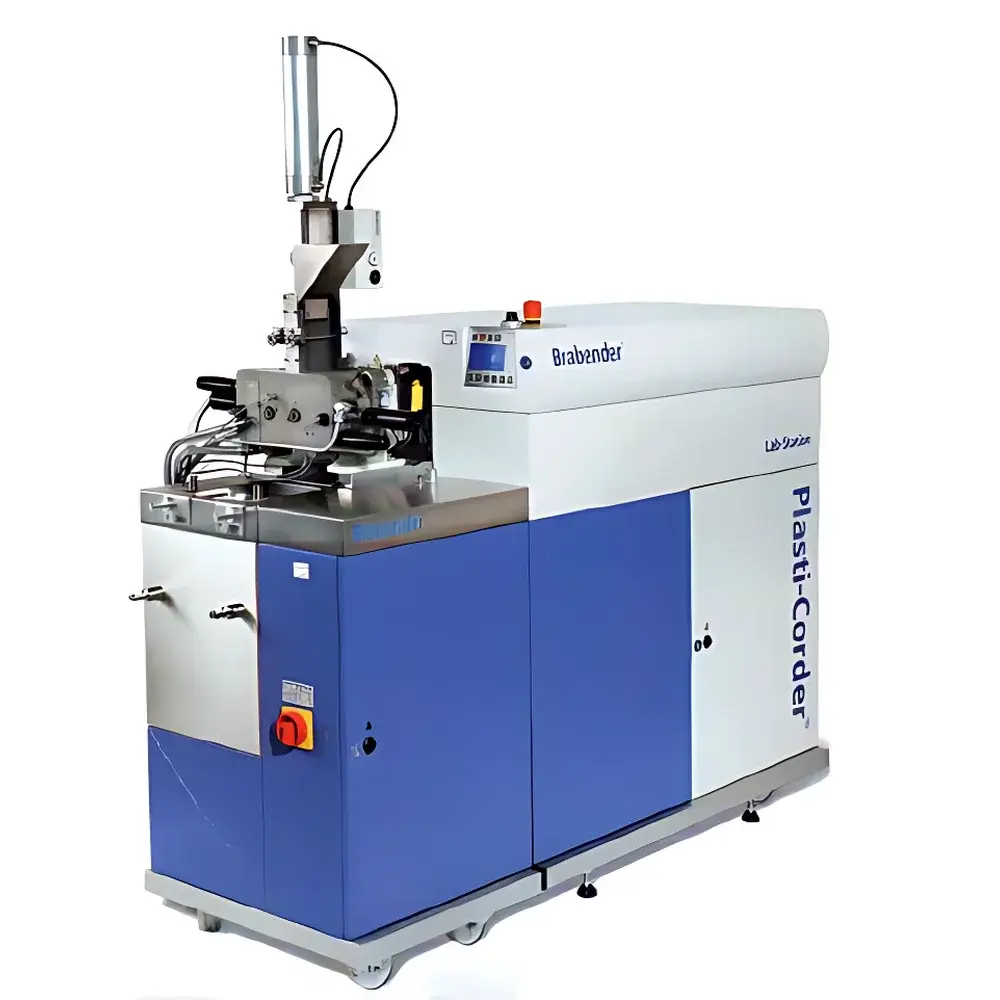
Brabender Plastic-Corder Lab-Station Torque Rheometer
| Origin | Germany |
|---|---|
| Manufacturer Type | Authorized Distributor |
| Origin Category | Imported |
| Model | Plastic-Corder Lab-Station |
| Price Range | USD 135,000–270,000 (approx.) |
| Instrument Type | Torque Rheometer |
| Bearing Type | Mechanical Bearings |
| Minimum Rotational Speed | 0.2 rpm |
| Frequency Range | 10⁻³–628 rad/s |
| Maximum Rotational Speed | 275 rpm |
| Maximum Torque | 400 N·m |
| Torque Resolution | < 100 nN·m |
Overview
The Brabender Plastic-Corder Lab-Station is a high-precision, modular torque rheometer engineered for fundamental and applied research in polymer processing science. Operating on the principle of controlled-shear rheometry under dynamic or steady-state conditions, it measures real-time torque, temperature, pressure, and rotational speed during melt compounding, extrusion, mixing, and kneading processes. Unlike conventional viscometers or capillary rheometers, the Plastic-Corder Lab-Station replicates industrial-scale mechanical energy input while maintaining laboratory-level control and data fidelity—making it indispensable for predictive process development, formulation screening, and material structure–property–process relationships. Its architecture supports both closed-cavity (e.g., batch mixer) and open-channel (e.g., extruder) configurations, enabling direct correlation between lab-scale experiments and pilot or production-line behavior.
Key Features
- Modular platform with plug-and-play integration of Brabender processing units: 30/50/350 cm³ internal mixers, P600 planetary mixers, 19/25D single-screw extruders, TSE20/40D and TSE25 co-rotating twin-screw extruders (including variable-length screw configuration), CTSE conical twin-screw systems, and a full suite of die heads and downstream test modules (e.g., pelletizers, film casters, rheo-die units).
- High-torque drive system with 400 N·m maximum output and sub-100 nN·m resolution, enabling precise quantification of low-viscosity melts and highly filled compounds alike.
- Can-Bus-based real-time bus control architecture ensuring deterministic communication between control unit, transducers, motor drives, thermal zones, and peripheral modules—guaranteeing synchronization accuracy within ±1 ms across all channels.
- Dual-mode operation: fully software-controlled via WinRheo™ interface or local touchscreen panel with hardware-enforced safety interlocks—including mechanical emergency stop, electronic torque limit override, and touch-sensitive panel lockout.
- Self-identifying intelligent modules: each connected unit automatically reports its type, calibration status, firmware version, and operational limits to the host controller—eliminating manual configuration errors and supporting GLP-compliant audit trails.
- Wide dynamic range: 0.2–275 rpm rotational speed and angular frequency coverage from 10⁻³ to 628 rad/s (0.00016–100 Hz), suitable for both slow structural relaxation studies and high-shear processing simulations.
Sample Compatibility & Compliance
The Plastic-Corder Lab-Station accommodates thermoplastics (e.g., PE, PP, PET, PC, PA), thermosets (epoxy, phenolic resins), elastomers (EPDM, TPU, silicone), ceramic feedstocks, powder coatings, masterbatches, filled composites (glass/carbon fiber, mineral fillers), pigmented systems, and reactive formulations. All standard configurations comply with ASTM D2538 (torque rheometry of thermoplastics), DIN 53736 (plasticizing behavior of PVC), ISO 11443 (determination of melt flow properties), and relevant sections of ISO 20432 (extrusion characterization). The system’s embedded calibration protocols adhere to ISO/IEC 17025 traceability requirements when used with certified reference materials and third-party accredited verification procedures.
Software & Data Management
WinRheo™ v8.x serves as the native control, acquisition, and analysis environment—compatible with Windows 10/11 (64-bit) and validated for FDA 21 CFR Part 11 compliance (electronic signatures, audit trail, user role management, data integrity safeguards). Real-time data streams include torque (N·m), temperature (°C), pressure (bar), screw speed (rpm), mass flow (g/min), and energy consumption (kWh/kg). All datasets are stored in encrypted .brd binary format with embedded metadata (operator ID, timestamp, instrument ID, calibration ID, environmental conditions). Export options include CSV, Excel, HDF5, and direct SQL database push for LIMS integration. Advanced post-processing tools support time–temperature superposition (TTS), Payne effect analysis, yield stress estimation, and melt fracture onset detection.
Applications
- R&D of polymer blends and compatibilizer efficiency
- Thermal stability and degradation kinetics assessment under shear
- Filler dispersion quality evaluation (e.g., carbon black, nanocellulose, graphene)
- Processing window definition for injection molding and extrusion
- Reaction kinetics monitoring in reactive extrusion (e.g., grafting, polycondensation)
- Viscoelastic fingerprinting of biopolymers and recycled resin streams
- Scale-up validation for twin-screw extruder screw design and barrel zoning
- Quality-by-Design (QbD) parameter space mapping per ICH Q5E and Q8(R2)
FAQ
What types of extruders can be directly integrated with the Plastic-Corder Lab-Station?
The system natively supports Brabender TSE20/40D, TSE25 (variable-length), and CTSE conical twin-screw extruders, as well as 19/25D single-screw units—all with synchronized torque, temperature, and throughput control.
Is the Can-Bus interface compatible with third-party sensors or PLCs?
Yes—via optional CANopen gateway modules (e.g., HMS Anybus), enabling integration with external load cells, infrared pyrometers, or industrial PLCs for hybrid automation setups.
Does the system support automated method sequencing for unattended operation?
Yes—WinRheo™ allows creation of multi-step protocols with conditional triggers (e.g., “hold at 180°C until torque stabilizes ±2% for 60 s”), enabling overnight or weekend testing with full data logging and fault recovery.
How is calibration traceability maintained across modules?
Each transducer carries an embedded EEPROM storing factory calibration coefficients, date, and uncertainty budget; recalibration events are logged with operator signature and reference standard IDs in the audit trail.
Can the Plastic-Corder Lab-Station be used for food-grade or pharmaceutical polymer processing studies?
Yes—when equipped with FDA-compliant wetted materials (e.g., AISI 316L stainless steel barrels, PTFE-free seals) and operated under GMP-aligned SOPs, it meets ICH Q5A and USP requirements for excipient characterization.



