
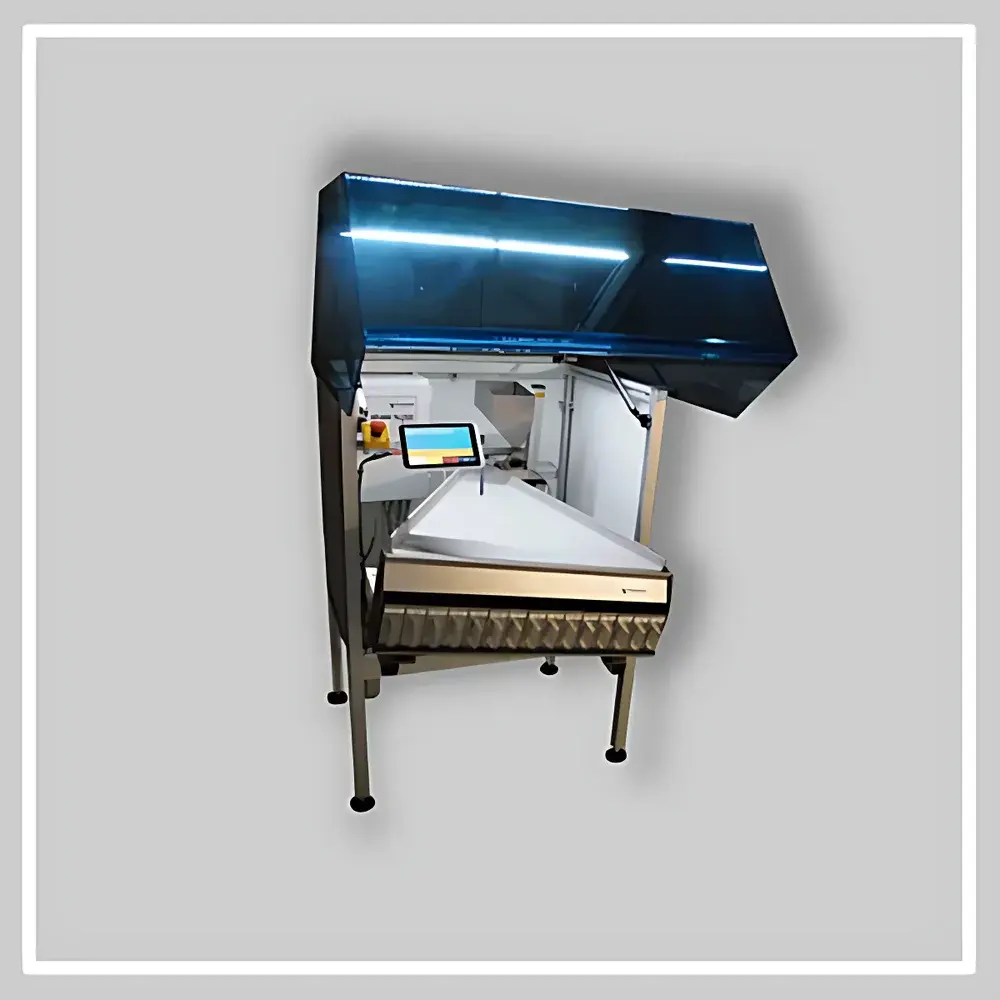
Volstaedt SHAPE SORTER 4.1 Diamond Shape Classifier
| Brand | Volstaedt |
|---|---|
| Origin | Germany |
| Model | SHAPE SORTER 4.1 |
| Power Supply | 230 V, 50/60 Hz, 4 A (optional 100–115 V) |
| Protection Rating | IP 42 |
| Dimensions (L×W×H) | 100 × 97 × 140 cm (closed), 100 × 97 × 210 cm (operational) |
| Weight | ~125 kg |
| Tilt Range | X- and Y-axis: 0–15° |
| Feed Rate Control | 0–200,000 particles/min (closed-loop) |
| Hopper Volume | ~3.5 L (stainless steel) |
| Sorting Trays | 15 × ~500 mL (stainless steel) |
| Throughput | ~800 ct/h (30/40 mesh), ~500 ct/h (40/50 mesh), ~100 ct/h (325/400 mesh) |
| Surface Material | Anodized aluminum |
| Ambient Conditions | 20–25 °C, 45–60 % r.H. |
| Tablet PC | Acer, 8.1″ display, Windows 8.1, ShapeSorter 4.0 software |
Overview
The Volstaedt SHAPE SORTER 4.1 is a precision industrial diamond shape classifier engineered for deterministic separation of natural and synthetic diamond crystals—and other granular materials—based on geometric morphology rather than size alone. Unlike conventional sieve-based or optical sorting systems, the SHAPE SORTER 4.1 employs controlled vibratory motion on a dynamically adjustable dual-axis inclined platform to exploit differential kinematic behavior: spherical or near-spherical particles roll preferentially under gravity and vibration, while angular, irregular, or plate-like particles exhibit higher resistance to downward transport and remain retained at higher positions along the vibrating surface. This principle—rooted in granular dynamics and frictional trajectory differentiation—enables reproducible classification into up to 15 discrete shape categories (e.g., octahedral, cubo-octahedral, crushed, tabular, and spherical fractions) without reliance on imaging algorithms or particle-by-particle detection. Designed for high-integrity industrial diamond grading, synthetic crystal quality control, and advanced powder process development, the system operates independently of mains frequency fluctuations and voltage variations, ensuring metrological stability across global laboratory and production environments.
Key Features
- Motor-driven dual-axis tilt adjustment (0–15° in both X and Y) with real-time angle feedback via integrated sensors and on-tablet digital display
- Electronically regulated vibration frequency and amplitude control, incorporating accelerometer-based closed-loop amplitude stabilization for immunity to supply voltage drift
- Optically gated vibratory feeder with laser light barrier and programmable feed rate (0–200,000 particles/min), enabling precise mass-flow synchronization with sorting dynamics
- Rotating safety cover with interlocked access control compliant with EN ISO 13857 mechanical hazard protection requirements
- Full operational logging—including tilt angles, vibration parameters, feed rates, timestamps, and user actions—for audit-ready traceability
- Touchscreen-driven Acer tablet PC (8.1″, Windows 8.1) running proprietary ShapeSorter 4.0 software with intuitive workflow navigation and parameter preset management
- IP 42-rated enclosure with stainless-steel hopper (3.5 L) and 15 stainless-steel collection trays (500 mL each), optimized for abrasion resistance and chemical compatibility with cleaning agents (e.g., isopropyl alcohol)
- LED interior illumination and status signaling (visual + audible) for operator situational awareness during extended runs
Sample Compatibility & Compliance
The SHAPE SORTER 4.1 is validated for use with industrial-grade diamond grits (D46–D601, per ISO 6344 and FEPA standards), synthetic cubic zirconia, silicon carbide, alumina, and other dense, non-cohesive crystalline powders exhibiting distinct morphological signatures. Its classification logic does not require optical transparency or electrical conductivity, making it suitable for opaque or conductive materials where laser diffraction or electrostatic methods fail. The system supports GLP-compliant operation through full parameter logging, user authentication (role-based access), and electronic signature-capable reporting. While not inherently 21 CFR Part 11 compliant out-of-the-box, its data export architecture (CSV, XML) enables integration with validated LIMS or ELN platforms supporting electronic records and audit trails.
Software & Data Management
ShapeSorter 4.0 software provides a structured environment for defining, storing, and recalling product-specific sorting protocols—including tilt vectors, vibration profiles, feed rates, and tray assignment maps. Each protocol is timestamped and associated with operator ID, enabling version-controlled method management. Real-time monitoring displays live feed rate, tilt angles, and system status; historical logs are exportable in machine-readable formats for statistical process analysis (e.g., Cpk, trend charts). Software updates are delivered via encrypted USB key or secure FTP, with change logs and validation summaries provided per release. No cloud connectivity is embedded—data residency remains fully on-device unless explicitly exported by authorized personnel.
Applications
- Grading of rough and polished industrial diamonds for abrasive tool manufacturing (e.g., grinding wheels, wire saws, core bits)
- Quality assurance of synthetic diamond powders post-HPT synthesis or milling, separating intact crystals from fractured or twinned fractions
- Process optimization in powder metallurgy and ceramic green-body formation, where particle shape directly influences packing density and sintering behavior
- Research into granular flow physics, particularly studies on shape-dependent segregation, avalanching, and angle-of-repose correlations
- Pre-sorting of calibration standards for optical particle analyzers (e.g., dynamic image analysis, SEM-EDS) to reduce morphological heterogeneity in reference sets
FAQ
What morphological distinctions can the SHAPE SORTER 4.1 resolve?
It differentiates particles based on macroscopic rolling resistance and directional mobility on an inclined vibrating plane—effectively separating spheres, cubes, octahedra, cubo-octahedra, plates, and highly irregular fragments. It does not classify sub-micron features or surface texture.
Is the system compatible with non-diamond materials?
Yes—any dry, free-flowing granular material with sufficient density contrast and shape anisotropy (e.g., SiC, Al₂O₃, WC, borosilicate glass beads) can be classified, provided particle size falls within the validated throughput ranges.
How is method reproducibility ensured across operators?
All critical parameters (tilt, vibration, feed rate) are digitally locked per protocol; manual mode requires explicit override confirmation. System calibration checks (tilt sensor zero, feed rate verification) are accessible via maintenance menu and logged.
Can sorting results be correlated to downstream performance metrics?
Yes—throughput-adjusted yield per tray and cumulative distribution data are exportable for correlation with grinding efficiency, thermal conductivity, or compaction density in application-specific validation studies.
What maintenance is required beyond routine cleaning?
Annual verification of tilt sensor linearity, accelerometer sensitivity, and laser gate alignment is recommended. No consumables or recalibration certificates are required between verifications.



