
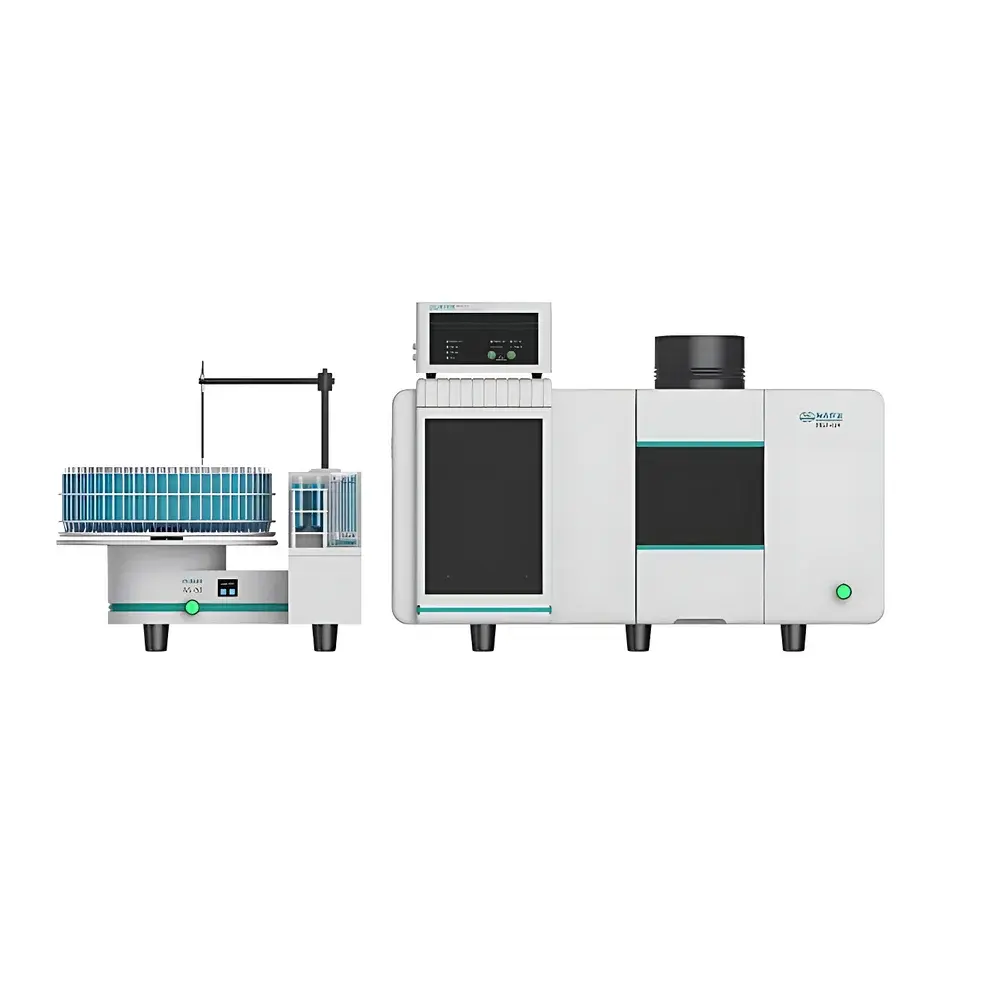
Haiguang HGF-U Series Atomic Fluorescence Spectrometer
| Brand | Haiguang Instrument |
|---|---|
| Origin | Beijing, China |
| Manufacturer Type | Authorized Distributor |
| Product Category | Domestic |
| Model | HGF-U |
| Instrument Type | Multi-channel Atomic Fluorescence Spectrometer |
| Compliance | Fully aligned with 100+ national and industry standards for AFS analysis (e.g., GB, HJ, GBZ/T, SL) |
Overview
The Haiguang HGF-U Series Atomic Fluorescence Spectrometer is a high-performance, multi-channel analytical instrument engineered for trace-level quantification of hydride-forming elements—including arsenic (As), mercury (Hg), selenium (Se), antimony (Sb), bismuth (Bi), and lead (Pb)—in environmental, food, clinical, geological, and industrial matrices. Based on the principle of atomic fluorescence spectroscopy (AFS), the system excites ground-state atoms—generated via hydride vapor generation or cold vapor atomic fluorescence—using element-specific hollow cathode lamps, and measures the intensity of characteristic fluorescent emission at defined wavelengths. The HGF-U builds upon Haiguang’s proven platform architecture, integrating over 40 proprietary core technologies inherited from the HGF-V/S/T series to deliver enhanced sensitivity, long-term stability, and robust interference resistance in routine laboratory workflows.
Key Features
- Advanced sequential injection system incorporating dual precision syringe pumps for reproducible sample introduction and reagent delivery.
- Digital real-time pressure monitoring during hydride generation, enabling dynamic optimization of reaction kinetics and minimizing gas-phase variability.
- Intelligent temperature-controlled sample loop technology with active heating to suppress memory effects—particularly critical for ultra-trace mercury analysis.
- Digital mercury lamp energy stabilization algorithm, compensating for lamp aging and thermal drift to maintain constant excitation intensity across extended operational cycles.
- Hydrogen-assisted combustion design that reduces potassium borohydride (KBH4) consumption by up to 40% without compromising hydride yield or signal stability.
- Fully automated fluidic routing for online dilution of carrier stream and reducing agent, coupled with integrated cleaning protocols between samples.
- Non-contact liquid level sensing system for precise, maintenance-free reagent volume tracking and low-level alarm triggering.
- Human-machine interface designed for high reliability and minimal operator intervention—featuring self-diagnostic routines, status logging, and intuitive touchscreen navigation compliant with GLP documentation requirements.
Sample Compatibility & Compliance
The HGF-U supports direct analysis of aqueous digests and extracts following standardized pretreatment methods including microwave-assisted acid digestion (per HJ 680-2013, HJ 702-2014), alkaline leaching, and UV photo-oxidation. It is validated for use with solid, liquid, and biological matrices—including soil, sediment, drinking water, wastewater, food homogenates, urine, blood, and cosmetic formulations. The instrument meets the performance criteria specified in over 100 Chinese national and sectoral standards, including GB 5009.11–2014 (total and inorganic arsenic in food), GB 5009.17–2021 (total and organic mercury), HJ 694–2014 (water quality), HJ 1133–2020 (ambient particulate matter), and GBZ/T 316.3–2018 (blood lead). All measurement protocols support audit-ready data integrity under GLP and GMP frameworks.
Software & Data Management
The embedded control software provides full method development, instrument calibration (including multi-point standard addition and internal standard correction), spectral background subtraction, and peak integration with configurable dwell time and replicate averaging. Raw data files are stored in vendor-neutral formats compatible with LIMS integration. Audit trails record all user actions, parameter changes, and calibration events with timestamped metadata—ensuring compliance with FDA 21 CFR Part 11 requirements for electronic records and signatures. Optional reporting modules generate PDF-certified reports aligned with ISO/IEC 17025 documentation structures.
Applications
The HGF-U is deployed across regulatory testing laboratories, public health institutes, food safety inspection centers, environmental monitoring stations, pharmaceutical QC units, agricultural research facilities, and university teaching labs. Typical applications include: quantification of inorganic arsenic in rice and infant formula; speciation-independent total mercury screening in fish tissue and drinking water; monitoring of antimony leaching from PET packaging materials; rapid assessment of selenium bioavailability in fortified foods; and routine surveillance of heavy metals in urban wastewater effluents and landfill leachates. Its multi-channel capability enables simultaneous analysis of As/Hg/Se or Sb/Bi/Pb in a single run—significantly improving throughput in high-volume testing environments.
FAQ
What hydride-forming elements can the HGF-U quantify?
The system is optimized for As, Hg, Se, Sb, Bi, and Pb using standard hydride generation or cold vapor techniques.
Is the HGF-U compatible with microwave digestion systems?
Yes—it accepts digested samples prepared per HJ 680-2013, HJ 702-2014, and GB/T 22105-2008 protocols.
Does the software support 21 CFR Part 11 compliance?
Yes—audit trail, electronic signature, and role-based access control modules are fully implemented.
What is the typical detection limit for arsenic in water?
Under standard operating conditions, the instrument achieves sub-ppt (ng/L) detection limits for As, consistent with HJ 694–2014 validation requirements.
Can the HGF-U be integrated into a laboratory information management system (LIMS)?
Yes—data export follows ASTM E1384 and ISO/IEC 17025-compliant structured formats for seamless LIMS ingestion.





