
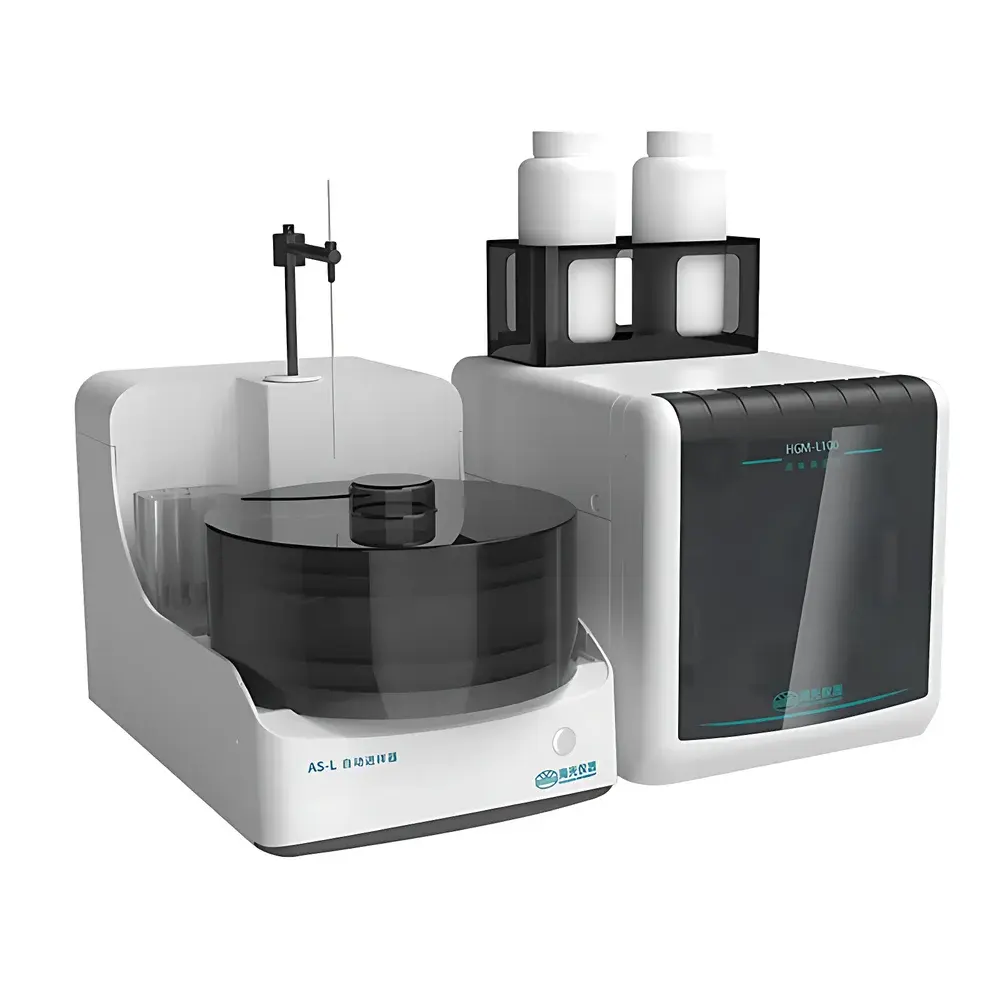
Haiguang HGM-L Series Liquid Mercury Analyzer
| Brand | Haiguang Instrument |
|---|---|
| Origin | Beijing, China |
| Instrument Type | Benchtop Laboratory Analyzer |
| Measurement Principle | Cold Vapor Atomic Absorption Spectrometry (CVAAS) |
| Sample Throughput | 40-position or 120-position Automated Carousel Sampler |
| Integrated Carrier Gas Source | Yes |
| Gold Amalgamation Preconcentration System | Nano-coated Gold Trap |
| Dual-Beam Optical Design | Yes |
| Temperature-Controlled Absorption Cell | Yes |
| Compliance Standards | HJ 597–2011, HJ 543–2009, GB/T 17136–1997, DZ/T 0064.26–2021, USP <232>, ISO 17294-2, ASTM D6722-22 |
Overview
The Haiguang HGM-L Series Liquid Mercury Analyzer is a benchtop cold vapor atomic absorption spectrometer engineered for trace-level mercury quantification in aqueous, digested solid, and gas-washed liquid matrices. It operates on the principle of cold vapor atomic absorption spectrometry (CVAAS), where mercury is chemically reduced to elemental vapor (Hg⁰) in solution—typically via sodium borohydride or stannous chloride reduction—and swept by a controlled carrier gas stream into a temperature-regulated quartz absorption cell. The absorbance of 253.7 nm UV light is measured against a reference beam, enabling highly selective and interference-resistant detection. Designed for regulatory compliance and method robustness, the HGM-L integrates hardware and software features aligned with internationally recognized environmental and industrial testing protocols—including U.S. EPA Method 1631E analogs, ISO 17294-2 for water analysis, and ASTM D6722-22 for coal and solid fuels.
Key Features
- Nano-coated gold amalgamation trap: A high-surface-area, thermally regulated gold trap enables efficient preconcentration of sub-ng/L mercury levels, significantly lowering the method detection limit (MDL) while minimizing carryover and memory effects.
- Dual-beam optical architecture: Real-time compensation for lamp intensity drift and electronic noise ensures long-term signal stability and measurement reproducibility across multi-hour analytical sequences.
- Intelligent dual-path absorption cell system: Automatically selects between short- and long-path cells based on sample concentration, optimizing dynamic range from 0.01 ng/L to 100 µg/L without manual recalibration or dilution.
- Integrated carrier gas generation: Onboard electrolytic hydrogen or compressed air source eliminates dependency on external gas cylinders, reducing operational overhead and improving lab safety and footprint efficiency.
- Controlled bubbling vapor generation: Precise gas-flow-driven in-line bubbling ensures complete redox reaction kinetics and consistent vapor transport—critical for achieving low relative standard deviation (RSD < 2.5% at 10 ng/L).
- High-mercury auto-protection protocol: Software-triggered thermal desorption and purge cycles prevent detector saturation and maintain calibration integrity during high-concentration sample analysis.
Sample Compatibility & Compliance
The HGM-L accommodates a broad spectrum of sample types following standardized pretreatment: filtered natural waters, acid-digested soils and sediments (per GB/T 17136–1997), alkaline leachates from industrial waste (per HJ 543–2009), urine and biological fluids (per WS/T 25–1996), and microwave-digested ores and alloys (per SN/T 3004–2011). Its hardware configuration and firmware logic support full audit trails, electronic signatures, and data integrity safeguards compliant with FDA 21 CFR Part 11 and GLP/GMP documentation requirements. All measurement workflows align with validated methods referenced in Chinese national standards (e.g., HJ 597–2011, DZ/T 0064.26–2021) and harmonized international frameworks including ISO/IEC 17025:2017 for testing laboratories.
Software & Data Management
Haiguang Mercury Analysis Suite (HMAS) v4.x provides intuitive method setup, real-time spectral monitoring, automatic curve fitting (linear, quadratic, or cubic), and QC flagging per ICH Q2(R2) guidelines. Raw absorbance data, peak integration parameters, and calibration history are stored in encrypted SQLite databases with immutable timestamps. Export options include CSV, PDF analytical reports, and XML-formatted results compatible with LIMS integration (via ASTM E1384 or HL7 interfaces). Audit trail logs record all user actions—including method edits, calibration events, and instrument parameter changes—with role-based access control and password-protected administrator privileges.
Applications
The HGM-L serves as a primary mercury quantification platform across environmental monitoring agencies (surface water, groundwater, wastewater discharge), geological survey laboratories (soil, sediment, ore assays), public health institutions (biological monitoring, occupational exposure assessment), and industrial QA/QC departments (coal-fired power plants, chlor-alkali facilities, electronics recycling). Its validated performance supports routine compliance reporting under China’s “Standard for Environmental Quality of Surface Water” (GB 3838–2002), EU WFD (2000/60/EC) priority substance monitoring, and U.S. Clean Water Act Section 304(a) criteria development workflows.
FAQ
What sample preparation is required prior to analysis?
Aqueous samples require filtration (0.45 µm) and acidification (1% v/v HNO₃); solid matrices must undergo microwave-assisted acid digestion per EPA Method 3052 or GB/T 17136–1997. Organic-rich samples may need additional oxidation (e.g., KMnO₄/H₂SO₄) to ensure complete mercury liberation.
Does the system support unattended overnight operation?
Yes—the 40- or 120-position autosampler, coupled with automated standard addition, dilution, and cleaning routines, enables fully autonomous batch processing for up to 24 hours without operator intervention.
How is memory effect mitigated during high-concentration analysis?
The temperature-controlled absorption cell (maintained at 85–95 °C), combined with nanostructured gold trap regeneration and post-run high-purity gas purging, reduces residual mercury carryover to < 0.5% between injections.
Can the instrument be integrated into an existing LIMS environment?
Yes—HMAS supports ODBC-compliant database export and ASTM E1384-compliant structured data exchange, allowing seamless ingestion of raw spectra, calibration curves, and final concentration reports into enterprise LIMS platforms.
Is method validation documentation available?
Haiguang provides a comprehensive IQ/OQ/PQ protocol package, including linearity verification (r² ≥ 0.999 over 5 orders of magnitude), precision assessment (RSD ≤ 2.0% at 50 ng/L), and spike recovery validation (85–115%) across matrix types per ISO/IEC 17025 Annex B requirements.




