
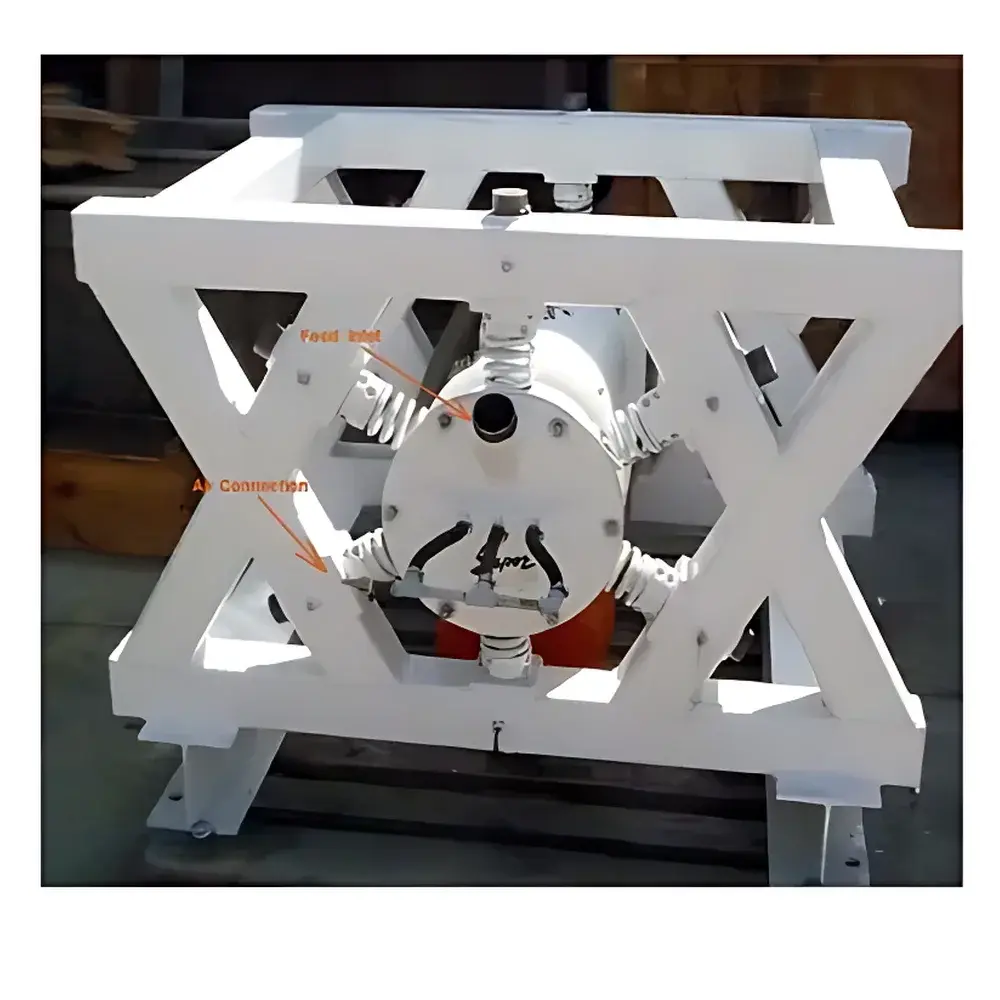
Spectro-Physics Air-Swept Vibratory Ball Mill Model 010E-380/400/420
| Origin | USA |
|---|---|
| Supplier Type | Authorized Distributor |
| Origin Category | Imported |
| Model | 010E-380 / 010E-400 / 010E-420 |
| Pricing | Available Upon Request |
Overview
The Spectro-Physics Air-Swept Vibratory Ball Mill is a high-frequency, dry-grinding comminution system engineered for precision particle size reduction in laboratory, pilot-scale, and production environments. Unlike conventional tumbling or planetary mills, this unit operates on resonant vibratory motion—transmitting mechanical energy directly to the grinding media and feed material via spring-suspended grinding chambers. Its defining feature is the integrated air-sweep injection system: compressed air is introduced tangentially into the grinding chamber to fluidize the particle bed, continuously elutriate fines, and suppress agglomeration. This enables true dry ultrafine grinding down to ≤1 µm (D90) without solvent use, thermal degradation, or moisture-induced caking—making it particularly suitable for heat-sensitive, hygroscopic, or reactive materials such as pharmaceutical actives, battery cathode precursors, ceramic powders, and specialty polymers.
Key Features
- Resonant vibratory drive architecture with spring-isolated grinding chamber—maximizes energy transfer efficiency (>92% of motor output directed to grinding action) while minimizing structural vibration transmission.
- Integrated air-sweep manifold with adjustable flow control (0–15 SCFM), enabling real-time particle classification and continuous removal of sub-45 µm fractions during operation.
- Modular grinding chamber design: interchangeable liners (standard carbon steel; optional polyurethane or hardened alloy variants) and media configurations (steel balls, rods, or ceramic media) support both coarse pre-grinding and final micronization in single- or multi-stage setups.
- Three scalable models: 010E-380 (lab-scale, 6″ × 24″ chamber, 1 HP motor), 010E-400 (pilot-scale, 10″ × 40″ chamber, 5 HP motor), and 010E-420 (production-scale, 20″ × 60″ chamber, 12 HP motor), all compliant with NEMA 4X enclosure ratings and UL 508A industrial control standards.
- Low-maintenance drivetrain with sealed-for-life bearings, direct-coupled induction motor, and no gearboxes or belts—reducing scheduled downtime and eliminating lubrication-related contamination risks.
Sample Compatibility & Compliance
The mill accommodates feed materials with maximum particle size ≤6.35 mm (¼ inch) and handles bulk densities from 0.5–3.2 g/cm³. It is routinely validated for processing quartz, feldspar, alumina, lithium cobalt oxide (LCO), microcrystalline cellulose (MCC), and API intermediates. All models meet ISO 14001 environmental operational guidelines and are designed for integration into GMP-compliant facilities. Optional documentation packages include IQ/OQ protocols aligned with ASTM E2709-22 (validation of powder processing equipment) and support for FDA 21 CFR Part 11-compliant electronic records when paired with certified SCADA interfaces.
Software & Data Management
While the base configuration operates via analog motor controls and manual air-flow regulation, optional digital instrumentation includes a PLC-based HMI panel (Siemens SIMATIC S7-1200) with real-time monitoring of motor current draw, chamber temperature (PT100 sensor), air pressure (0–100 psi range), and cumulative runtime. Data logging supports CSV export for trend analysis of energy consumption per kg processed and specific grinding energy (kWh/kg). Audit trails are retained for ≥36 months, satisfying GLP audit requirements for traceability and process repeatability.
Applications
- Pharmaceutical: Dry micronization of APIs to enhance dissolution rate and bioavailability—validated for USP particle size distribution testing preparation.
- Advanced Materials: Production of nanostructured anode/cathode powders for Li-ion batteries requiring narrow PSD (D10–D90 < 1.5 µm) and minimal iron contamination (<5 ppm).
- Geological & Mining: Rapid sample homogenization and pulverization of rock cores and drill cuttings prior to XRF or ICP-MS analysis.
- Ceramics & Catalysts: Controlled attrition grinding of zirconia, silicon carbide, and zeolite supports without phase transformation or surface amorphization.
- Food & Nutraceuticals: Solvent-free particle size reduction of botanical extracts and mineral fortificants under FDA 21 CFR Part 117-compliant hygiene conditions.
FAQ
What is the typical particle size distribution achievable with the air-sweep system?
With optimized air flow and media charge, D90 values of 0.8–1.2 µm are consistently achieved for brittle inorganic materials; organic polymers may reach D90 ≈ 2.5 µm depending on glass transition temperature and elasticity.
Can the mill operate under inert atmosphere?
Yes—optional nitrogen-purged configurations with sealed feed/discharge ports and pressure-rated chamber housings are available for oxygen-sensitive or pyrophoric materials.
Is wet grinding supported?
Wet grinding is not part of the standard air-sweep design; however, a separate benchtop wet-milling adapter kit (Model WMA-01) can be retrofitted to the 010E-380 for low-volume slurry processing at solids loading ≤35 wt%.
What maintenance intervals are recommended?
Motor and bearing inspections every 2,000 operating hours; liner wear assessment every 500 hours for abrasive feeds; air filter replacement every 200 hours under continuous duty.
Are CE or ATEX certifications available?
CE marking is standard for EU shipment; ATEX Zone 22 certification (for combustible dust environments) is available as a factory-installed option with explosion-relief venting and static-dissipative linings.




