
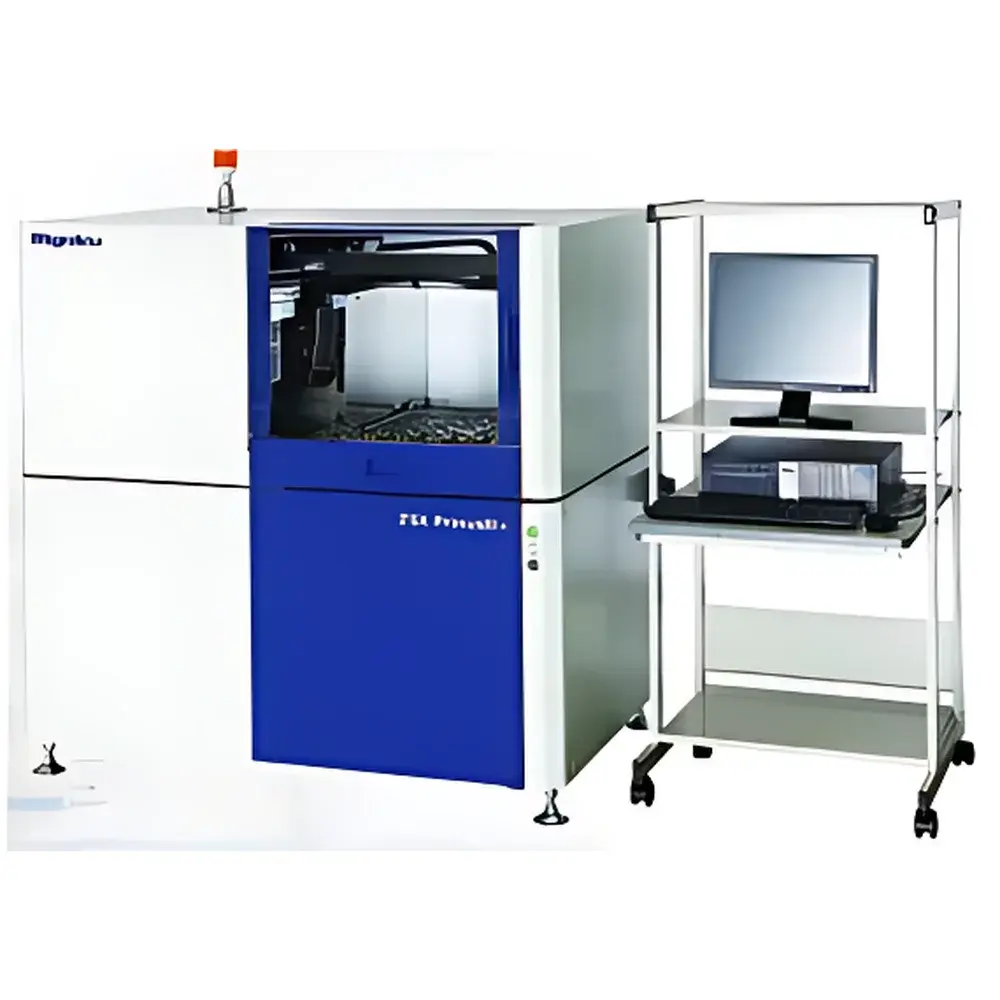
Rigaku ZSX Primus III+ Energy Dispersive X-Ray Fluorescence Spectrometer
| Brand | Rigaku |
|---|---|
| Origin | Japan |
| Model | ZSX Primus III+ |
| Configuration | Benchtop/Floor-standing |
| Application Type | General-purpose |
| Element Range | Na (11) to U (92) |
| Detection Limit | Sub-ppm to % level (matrix-dependent) |
| Energy Resolution | ≤145 eV at Mn Kα |
| Repeatability | RSD < 0.5% for major elements (≥1 wt%), < 2% for trace elements (≤100 ppm) |
| Vacuum Mode | Dual-rate programmable vacuum pump control (fast/slow evacuation & venting) |
| Sample Handling | Motorized XYZ stage with ±1 µm positioning accuracy |
| Optical System | Collimated polycapillary optics with automatic height compensation |
Overview
The Rigaku ZSX Primus III+ is a high-performance energy dispersive X-ray fluorescence (EDXRF) spectrometer engineered for precise, non-destructive elemental analysis of solids, powders, and thin films across academic, industrial, and regulatory laboratories. Operating on the fundamental principle of X-ray fluorescence—where primary X-rays from a high-stability end-window X-ray tube excite characteristic secondary X-rays from sample atoms—the instrument delivers quantitative and semi-quantitative composition data without requiring destructive digestion or complex calibration standards. Its vertical-source geometry places the X-ray tube directly above the sample chamber, eliminating horizontal beam paths that risk contamination of the X-ray window by airborne particulates during powder analysis. This design significantly extends X-ray tube lifetime and reduces maintenance frequency—critical for high-throughput QA/QC environments operating under ISO/IEC 17025 or ASTM E1621 compliance frameworks.
Key Features
- Vertical X-ray source configuration minimizes cross-contamination risk and eliminates need for binders or pressing aids in loose powder analysis.
- Dual-rate vacuum control system enables rapid (<60 s) evacuation for metal samples and gentle (<180 s), low-turbulence venting for fragile or volatile powders—optimizing throughput without compromising spectral integrity.
- High-precision motorized XYZ sample stage with sub-micron repeatability (±1 µm) ensures consistent beam-sample interaction geometry, essential for alloy homogeneity mapping and certified reference material (CRM) validation.
- Polycapillary collimator optics provide focused excitation with automatic Z-height compensation, correcting for surface topography variations up to ±3 mm—reducing matrix-induced intensity fluctuations in irregular or rough samples.
- Modular sample chamber allows full removal without tools for thorough cleaning or rapid configuration changes between solid, pellet, and liquid cell modes.
- Intuitive touchscreen interface with context-aware workflow guidance supports unattended operation and reduces operator training time—fully compatible with Lab Information Management Systems (LIMS) via ASTM E1382-compliant data export.
Sample Compatibility & Compliance
The ZSX Primus III+ accommodates standard 32 mm and 40 mm sample cups, pressed pellets (up to 40 mm diameter), bulk metals (max. 100 × 100 × 50 mm), and thin-film substrates. Its robust vacuum and He-purge options enable reliable detection of light elements from sodium (Na, Z=11) through uranium (U, Z=92). The system meets key international performance standards including ISO 21043 (EDXRF instrumentation requirements), ASTM E1621 (standard test method for elemental analysis by EDXRF), and JIS Z 3211 (Japanese industrial standard for metal coating thickness and composition). Full audit trail logging, user access levels, and electronic signature support align with FDA 21 CFR Part 11 and EU Annex 11 requirements for regulated pharmaceutical and materials testing labs.
Software & Data Management
Rigaku’s proprietary Ultima Analysis software provides comprehensive spectral processing, including peak deconvolution using fundamental parameter (FP) algorithms, matrix correction via empirical coefficients, and multi-layer thin-film quantification. All analyses are stored with full metadata—including acquisition parameters, calibration history, instrument status logs, and environmental conditions—enabling GLP/GMP-compliant reporting. Data export supports CSV, PDF, and XML formats compliant with ASTM E1447 and ISO/IEC 17025 clause 7.8.2. Remote monitoring and diagnostic capabilities allow preventive maintenance scheduling based on tube hours, detector temperature stability, and vacuum integrity metrics.
Applications
- Metallurgy: Rapid grade identification, inclusion analysis, and plating thickness verification for stainless steels, aluminum alloys, and precious metal jewelry.
- Geology & Mining: Bulk ore assay screening, REE distribution profiling, and exploration core scanning with minimal sample preparation.
- Electronics: RoHS-compliant Pb, Cd, Hg, Cr(VI), and Br screening in PCBs, solder, and encapsulants per IEC 62321-5.
- Environmental: Soil heavy metal screening (As, Cd, Pb, Hg) and fly ash composition tracking for waste incineration compliance.
- Academic Research: Quantitative phase analysis of catalysts, battery electrode materials, and ceramic composites where non-destructive depth profiling is required.
FAQ
Does the ZSX Primus III+ require helium purge for light element analysis?
Yes—He purge mode is required for reliable quantification of elements below magnesium (Z<12), such as Na and F; optional vacuum mode suffices for Mg and heavier elements.
Can the system analyze liquids or pastes?
Yes—with optional quartz sample cups and automated tilt-stage alignment, liquids and suspensions can be measured with reproducible meniscus control and minimal evaporation artifacts.
Is method transfer possible between different ZSX Primus units?
Yes—method files include full instrument configuration metadata and FP calibration constants, enabling seamless migration across identical Rigaku EDXRF platforms within a multi-site lab network.
What maintenance intervals are recommended for routine operation?
X-ray tube replacement is typically required after 15,000–20,000 operating hours; Si-PIN detector Peltier cooler inspection every 12 months; vacuum pump oil change every 6 months under continuous use.
Does the system support automated calibration verification with check standards?
Yes—integrated QC routines allow scheduled measurement of user-defined check standards with pass/fail alerts triggered by predefined RSD or bias thresholds, fully documented in the audit trail.







