
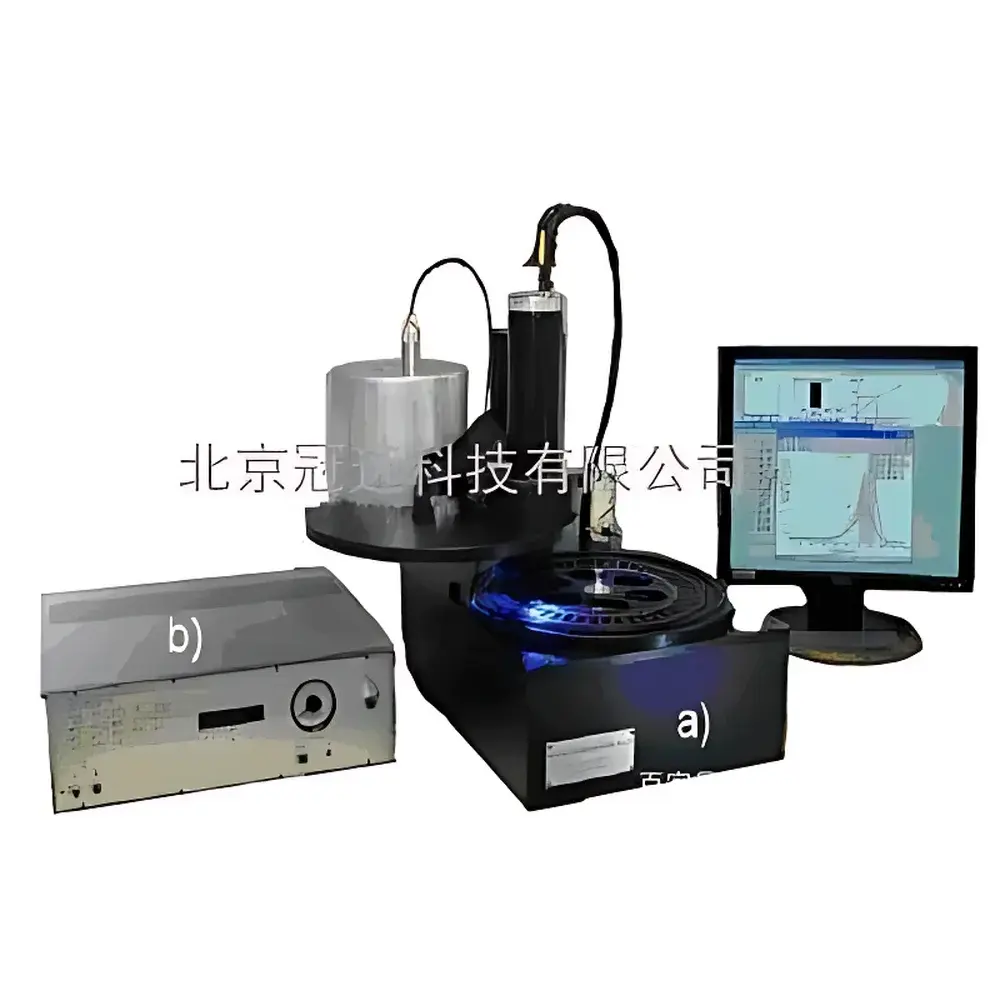
Risø TL/OSL Dating System (e.g., TL/OSL-DA-20 or equivalent benchtop luminescence reader)
| Origin | Beijing, China |
|---|---|
| Manufacturer Type | Authorized Distributor |
| Origin Category | Domestic (PRC) |
| Model | TL/OSL Benchtop Luminescence Reader |
| Price | USD 1,450 (FOB Beijing) |
Overview
The Risø TL/OSL Dating System is a laboratory-grade luminescence reader engineered for thermoluminescence (TL) and optically stimulated luminescence (OSL) measurements in archaeological, geological, and environmental dating applications. It operates on the fundamental principle of trapped-charge luminescence: crystalline materials—such as quartz and feldspar—accumulate energy from natural ionizing radiation (α, β, γ, and cosmic rays) over time. This energy is stored at structural defects (“electron traps”) within the crystal lattice. Upon controlled thermal stimulation (TL) or exposure to specific wavelengths of light (OSL), trapped electrons are released and recombine with luminescent centers, emitting photons detectable by a high-sensitivity photomultiplier tube (PMT). The integrated luminescence signal is directly proportional to the total absorbed radiation dose (paleodose), enabling calculation of burial or last-heating age when combined with independent measurement of the environmental dose rate.
Key Features
- Benchtop modular architecture with interchangeable stimulation units: infrared (IRSL, 830 nm LED array), blue (OSL, 470 nm LED), and green (post-IR IRSL, 532 nm laser optional)
- High-vacuum sample chamber with programmable heating stage (up to 700 °C, ramp rates 0.1–10 °C/s) for precise TL glow-curve analysis
- Low-noise bialkali PMT detector with quartz window and integrated dark-current compensation
- Alpha/beta source calibration port (e.g., 90Sr/90Y) for laboratory beta-dose rate validation
- Integrated alpha spectrometry capability (optional Si surface-barrier detector) for U/Th ratio screening
- Robust electromagnetic shielding and light-tight enclosure compliant with ISO/IEC 17025 environmental control requirements
Sample Compatibility & Compliance
The system accepts standard 9.7 mm diameter aluminum planchets or custom ceramic discs containing quartz or polymineral fine-grain (<63 µm) or coarse-grain (100–200 µm) sediments, pottery sherd aliquots, burnt flint, or volcanic tephra. Sample preparation workflows align with ISO 13831:2021 (Geological and archaeological dating — Luminescence dating — General requirements) and ASTM D7884-22 (Standard Guide for Luminescence Dating of Sediments). Instrument operation supports GLP-compliant data integrity: full audit trail, user access levels, electronic signatures, and raw-data immutability per FDA 21 CFR Part 11 requirements when paired with validated software.
Software & Data Management
Controlled via Luminescence Analyst™ v4.x (Windows-based), the software provides real-time acquisition, automated glow-curve deconvolution (GCD), dose-response curve fitting (single-aliquot regenerative-dose protocol), and anomalous fading correction (for feldspar IRSL). All datasets are stored in vendor-neutral XML format with embedded metadata (sample ID, irradiation history, stimulation parameters, calibration coefficients). Export options include CSV, Excel, and direct integration with Bayesian age modeling tools (e.g., BayLum, R package ‘Luminescence’). Software validation documentation (IQ/OQ/PQ protocols) is provided for regulated laboratories conducting archaeological chronology or nuclear environmental monitoring.
Applications
- Archaeological dating of ceramics, burnt lithics, and mudbrick (TL-based, 50–500 ka range)
- Quaternary geochronology of aeolian, fluvial, and glacial sediments (OSL, 100 a–200 ka)
- Radiation dosimetry for retrospective environmental dose reconstruction (e.g., post-nuclear incident soil mapping)
- Authentication of antiquities through consistency checks between TL signal intensity and stylistic attribution
- Quality control in radiation-processed foodstuffs (detection of irradiated spices/herbs via TL signal in silicate contaminants)
- Fundamental trap spectroscopy: kinetic parameter extraction (E, s, b) using variable heating-rate and isothermal decay protocols
FAQ
What is the difference between TL and OSL dating?
TL relies on thermal release of trapped charge; OSL uses photon-induced detrapping. TL is preferred for heated artifacts (pottery); OSL is optimal for unheated sediments.
Can this system measure both quartz and feldspar?
Yes—quartz is measured using blue-light OSL or NLL (non-linear OSL); feldspar requires IRSL or post-IR IRSL protocols to mitigate anomalous fading.
Is external gamma spectrometry required for dose-rate determination?
Yes. Accurate age calculation requires independent measurement of environmental radioactivity (U, Th, K concentrations and cosmic dose rate), typically performed via HPGe gamma spectrometry or ICP-MS.
Does the system support SAR (Single-Aliquot Regenerative-Dose) protocol?
Yes—fully automated SAR sequence execution, including preheat optimization, recycling ratio checks, and recuperation correction.
What maintenance is required for long-term operational stability?
Annual PM includes PMT gain calibration, LED output verification, vacuum pump oil replacement, and thermal sensor recalibration traceable to NIST standards.





