
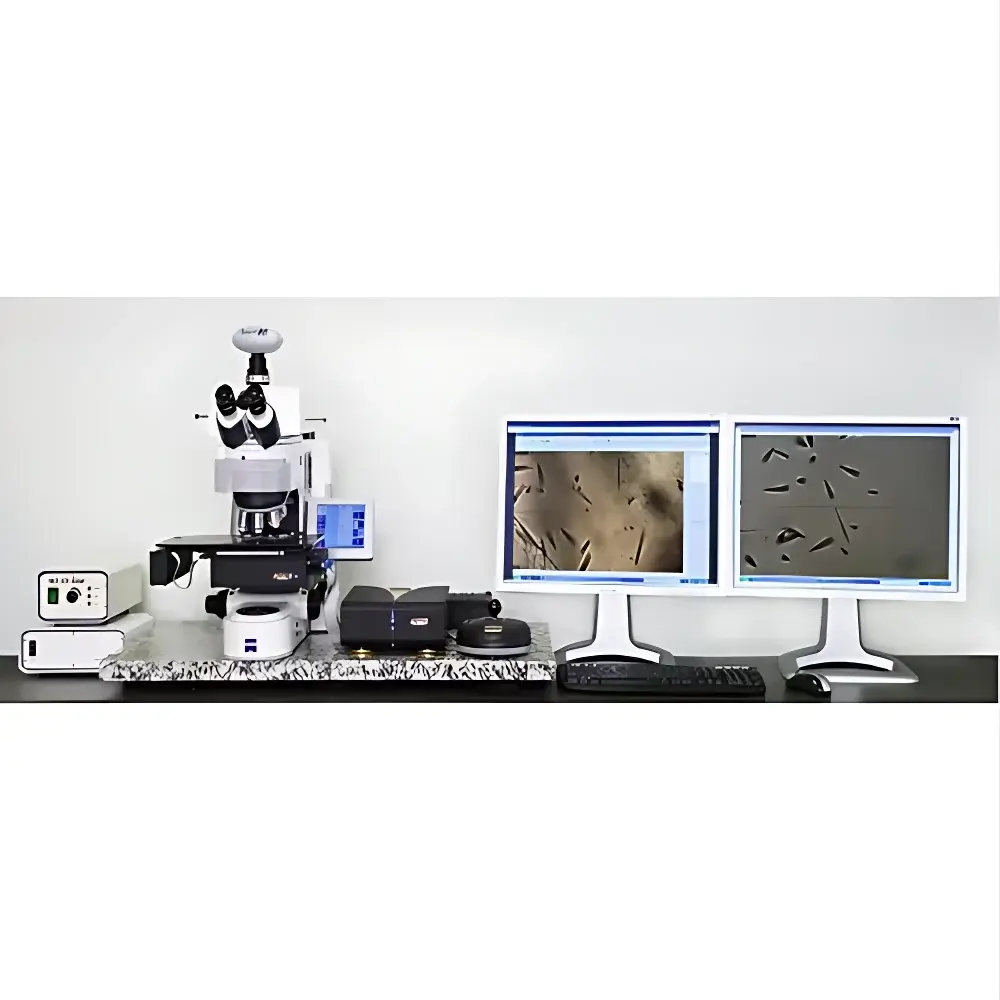
Autoscan Fission Track Dating System
| Brand | AUTOSCAN |
|---|---|
| Origin | Australia |
| Manufacturer Type | Authorized Distributor |
| Origin Category | Imported |
| Model | Autoscan |
| Pricing | Upon Request |
Overview
The Autoscans Fission Track Dating System is a fully automated, high-precision optical microscopy platform engineered for quantitative fission track (FT) analysis in apatite and zircon geochronology. It operates on the fundamental principle that spontaneous fission of 238U nuclei within mineral grains produces linear damage trails—fission tracks—that are preserved under specific thermal conditions. By measuring the length distribution, density, and orientation of these etched tracks via high-resolution reflected-light microscopy, the system reconstructs the thermal history of geological samples through kinetic modeling (e.g., using the Laslett et al. 1987 or Gallagher et al. 1998 annealing models). The system integrates motorized Z-axis autofocus with sub-25 nm axial resolution, enabling reliable track length measurement across variable grain topography—critical for accurate thermal history inversion and age calculation in low-temperature thermochronology.
Key Features
- Motorized Z-axis autofocus with ≤25 nm axial resolution and repeatability <1.0 µm, ensuring consistent focus across irregular mineral surfaces during extended automated scanning.
- 7-position encoded nosepiece with centering-adjustable objectives, supporting standardized magnification scaling and minimizing optical misalignment-induced measurement bias.
- 1.6× intermediate zoom changer integrated into the optical path, extending usable magnification range while preserving parfocality and numerical aperture integrity.
- High-stability XY stage with ≥130 mm × 85 mm travel range and 0.1 µm step resolution, enabling precise multi-field-of-view (FOV) navigation and statistically robust track counting across large grain areas.
- Optimized optical train featuring plan-apochromatic objectives with enhanced short-wavelength transmission and strain-free design—critical for high-contrast imaging of sub-micron etch pits in apatite and zircon under UV-enhanced illumination.
Sample Compatibility & Compliance
The system is validated for use with standard FT preparation protocols compliant with ASTM D7279-22 (Standard Guide for Fission Track Analysis in Apatite) and ISO/IEC 17025-accredited laboratory workflows. It supports both external detector (ED) and internal dosimeter methods following IUGS-recommended irradiation procedures using thermal neutron fluence calibration (e.g., at reactor facilities such as OPAL, ANSTO). Sample mounts must conform to standard 25 mm petrographic thin-section geometry; compatibility extends to polished grain mounts, epoxy-embedded separates, and cathodoluminescence-screened zircon fractions. All hardware and software components meet CE electromagnetic compatibility (EMC) Directive 2014/30/EU and RoHS 2011/65/EU requirements.
Software & Data Management
The bundled FissionTrack Pro™ software provides full GLP-compliant data acquisition, real-time image streaming, and traceable statistical analysis. It supports synchronized dual-camera capture (reflected-light + optional cathodoluminescence), lossless TIFF/PNG export, and embedded audit trails per FDA 21 CFR Part 11 requirements—including user authentication, electronic signatures, and immutable timestamped metadata for every acquired FOV and measurement event. Automated track detection employs machine-learning-assisted thresholding calibrated against NIST-traceable reference standards (e.g., Durango apatite RM). Exported datasets comply with FAIR principles and integrate natively with common geochronological modeling environments (e.g., QTQt, HeFTy, and TraX).
Applications
- Low-temperature thermochronology of sedimentary basins and orogenic belts using apatite fission track (AFT) analysis.
- Provenance studies and crustal thermal evolution modeling via zircon fission track (ZFT) and (U–Th)/He double-dating integration.
- Calibration of basin thermal models in petroleum system analysis and hydrocarbon charge timing assessment.
- Validation of cooling histories derived from (U–Th)/He and Ar–Ar systems in metamorphic terranes.
- Quality assurance in commercial geochronology laboratories requiring ISO/IEC 17025 accreditation for reporting certified ages.
FAQ
What neutron irradiation facility is required for sample activation?
Thermal neutron irradiation must be performed at a certified nuclear reactor (e.g., OPAL, HFIR, or BR2) with fluence monitored using co-irradiated SRM-962a or CN-5 uranium glass dosimeters. Irradiation duration is determined by sample U-content and desired track density.
Does the system support dual-detection mode (track + CL) simultaneously?
Yes—via configurable beam-splitter configuration and synchronized camera triggering; CL imaging requires optional cathodoluminescence accessory module and SEM integration.
Is the software compatible with Windows 10/11 64-bit and networked lab environments?
Yes—FissionTrack Pro™ is built on .NET 6 and supports domain-authenticated deployment, SQL Server-backed centralized database storage, and remote monitoring via TLS-secured API endpoints.
Can the system be upgraded for automated grain boundary detection and orientation mapping?
Yes—optional EBSD integration kit enables correlative fission track–crystallographic orientation analysis when coupled with compatible SEM platforms.
What maintenance intervals are recommended for optical calibration and stage alignment?
Biannual verification using NIST-traceable stage calibration rulers and interferometric focus sensors is recommended; full optical alignment service is advised every 24 months or after 5000 hours of operation.





