
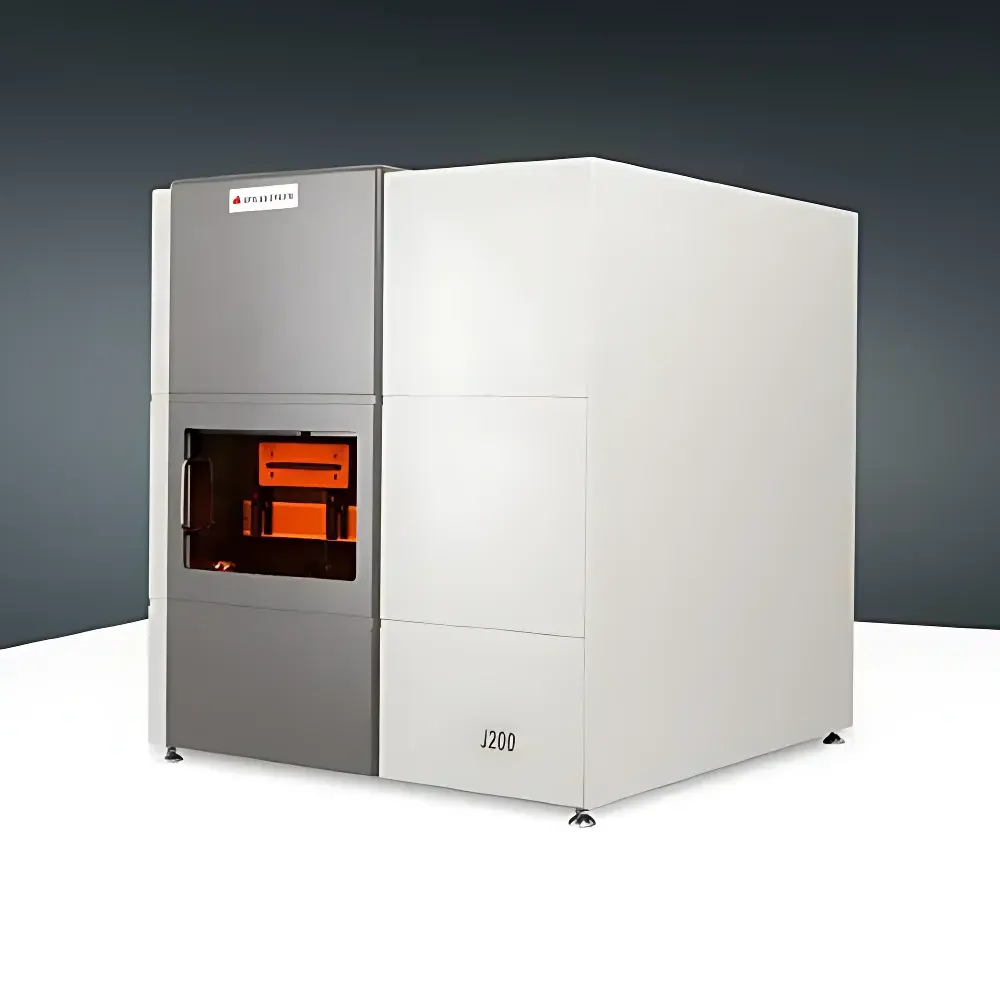
ASI J200-3 LA-LIBS Integrated Laser Ablation–Laser Induced Breakdown Spectroscopy System
| Brand | ASI |
|---|---|
| Origin | USA |
| Model | J200-3 |
| Form Factor | Benchtop |
| Integration | Fully Integrated |
| Laser Wavelength | 213 nm (Q-switched Nd:YAG) |
| Pulse Energy | 200 mJ (adjustable) |
| Dual-Spectrometer Capability | LIBS + Optional ICP-MS Interface |
| Depth Profiling Resolution | Sub-micron per pulse (dependent on ablation rate and matrix) |
| Sample Chamber | Flex™ Modular Vacuum-Compatible Chamber with Interchangeable Liners |
| Gas Control | Dual High-Precision Digital Mass Flow Controllers (MFCs) |
| Imaging | Co-registered Dual-Camera System (High-Magnification Microscope + Wide-Field Surface View) |
Overview
The ASI J200-3 LA-LIBS Integrated Laser Ablation–Laser Induced Breakdown Spectroscopy System is a benchtop analytical platform engineered for spatially resolved, depth-resolved elemental analysis of solid materials without requiring conductive coating or vacuum-compatible sample preparation. It combines two complementary laser-based spectrochemical techniques—laser ablation (LA) and laser-induced breakdown spectroscopy (LIBS)—within a single, co-aligned optical path. The system employs a high-repetition-rate, Q-switched Nd:YAG laser operating at 213 nm, delivering short-duration pulses (<5 ns) with tunable energy up to 200 mJ. This enables precise material removal (ablation) while simultaneously generating a transient microplasma from the ablated volume; the emitted atomic/ionic line spectra are collected in real time via a high-throughput Czerny–Turner spectrometer with gated ICCD detection. Unlike standalone LIBS systems, the J200-3 architecture supports direct coupling to external mass spectrometers—including time-resolved ICP-MS—enabling hybrid spectral fingerprinting and isotopic quantification where required.
Key Features
- 213 nm deep-UV Q-switched Nd:YAG laser with stable pulse-to-pulse energy delivery and <5 ns pulse width—optimized for reduced thermal diffusion and improved spatial resolution in heterogeneous matrices.
- Fully integrated dual-spectroscopic capability: simultaneous acquisition of LIBS emission spectra (200–900 nm range) and optional time-resolved ICP-MS signals via standardized interface protocols.
- Flex™ modular sample chamber with interchangeable ceramic and metal liners—engineered to optimize carrier gas dynamics (Ar, He, N₂), particle transport efficiency, and plasma confinement for reproducible aerosol generation.
- Dual digital mass flow controllers (MFCs) with closed-loop electronic valve regulation—supporting automated gas switching, pressure ramping, and pulse-synchronized flow modulation during depth profiling.
- Co-registered dual-camera imaging system: one high-resolution microscope (5×–50× magnification) for crater morphology and feature targeting; one wide-field CCD camera for real-time macro-scale sample navigation and positional referencing.
- Clarity™ LIBS Analysis Software suite with embedded chemometric tools—including Principal Component Analysis (PCA), hierarchical clustering, and supervised classification algorithms—validated for forensic glass, polymer additives, geological silicates, and coated substrates.
Sample Compatibility & Compliance
The J200-3 accommodates flat, irregular, and polished solid samples up to 100 mm × 100 mm × 50 mm (W × L × H), including non-conductive materials such as borosilicate glass, automotive paint layers, inkjet-printed polymers, mineral thin sections, and sintered ceramics. No metallization or vacuum drying is required. All hardware control logic and data acquisition modules comply with IEC 61000-6-3 (EMC emissions) and IEC 61000-6-2 (immunity). Software architecture supports audit-trail logging, user-role-based access control, and electronic signature workflows aligned with FDA 21 CFR Part 11 requirements when deployed in regulated QC/QA environments. Method validation documentation includes traceable calibration against NIST SRM 610, 612, and 614 for multi-element quantification across concentration ranges spanning ppm to wt% levels.
Software & Data Management
Clarity™ software provides synchronized control of laser parameters, gas flow profiles, stage motion, and detector gating. Depth profiling is executed via sequential pulse accumulation at a fixed spot, with real-time visualization of selected element intensities using the proprietary DepthTracker® module. DepthTracker® computes integrated peak area, relative standard deviation (RSD), and normalized intensity ratios across pulse trains—enabling quantitative assessment of surface contamination, interfacial diffusion, coating thickness, and subsurface inclusion distribution. Time-resolved ICP-MS signal integration is supported with TRSD (Time-Relative Standard Deviation) calculation per analyte channel. All spectral datasets are stored in HDF5 format with embedded metadata (wavelength calibration, laser fluence, ambient conditions), ensuring FAIR (Findable, Accessible, Interoperable, Reusable) data principles. Export options include CSV, ASCII, and vendor-neutral JCAMP-DX for third-party chemometric platforms.
Applications
- Forensic material comparison: discrimination of glass fragments, paint chips, and toner particles based on minor/trace elemental ratios.
- Geological provenance studies: rapid screening of zircon U–Pb age domains and rare earth element (REE) fractionation patterns in situ.
- Thin-film and multilayer characterization: quantification of TiN/TiO₂ stack composition, interdiffusion at metal–oxide interfaces, and residual substrate contamination.
- Pharmaceutical solid dosage form analysis: mapping of excipient distribution, active pharmaceutical ingredient (API) homogeneity, and coating uniformity in tablets.
- Archaeometric analysis: non-destructive stratigraphic profiling of pigment layers in historical paintings and ceramic glazes.
- Failure analysis in microelectronics: identification of solder joint intermetallic compounds and detection of Cu/Ni/Sn interdiffusion zones.
FAQ
Can the J200-3 operate without an external ICP-MS?
Yes—the system functions as a standalone LA-LIBS instrument with full spectral acquisition, depth profiling, and chemometric analysis capabilities independent of mass spectrometry.
What is the typical lateral resolution achievable with the 213 nm laser?
At optimal fluence (2–5 J/cm²), ablation craters range from 5–20 µm in diameter depending on material hardness and thermal conductivity; sub-10 µm spatial resolution is routinely achieved on glasses and oxides.
Is DepthTracker® compatible with third-party spectral libraries?
DepthTracker® accepts user-defined spectral references in ASCII or JCAMP-DX format and supports library matching against custom or commercial databases (e.g., NIST Atomic Spectra Database, USGS Mineral Spectral Library).
How is calibration performed for quantitative analysis?
Quantitative workflows use matrix-matched certified reference materials (CRMs) and internal standard normalization (e.g., Ca II 393.37 nm for silicates); calibration curves are generated per-element with R² > 0.998 over three orders of magnitude.
Does the system support automated multi-point mapping?
Yes—Clarity™ includes grid-based stage scripting with auto-focus, crater centroid registration, and batch processing of >1,000 ablation sites per session, with metadata-tagged export of all spectral and imaging files.
Related Products





