
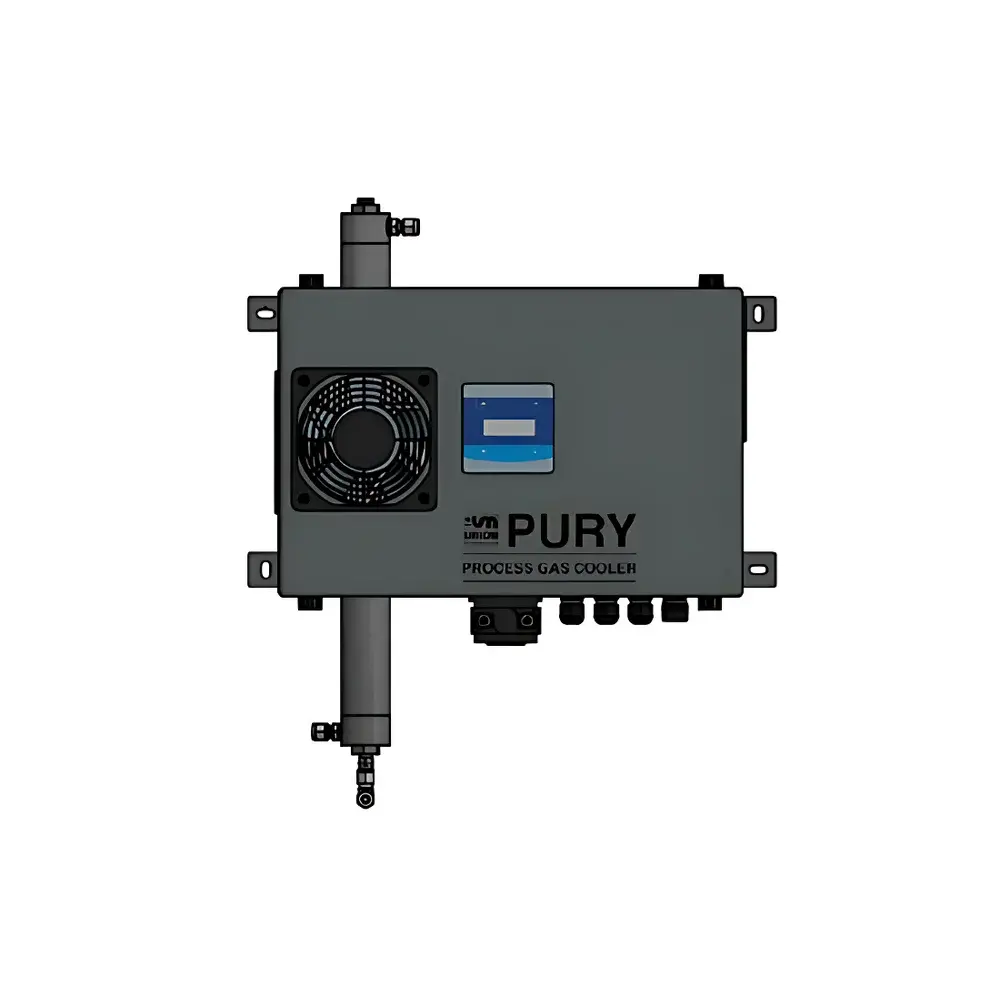
UNION PURY250S Gas Preconditioning System for Calorimetric and Combustion Analysis
| Brand | UNION |
|---|---|
| Origin | Germany |
| Model | PURY250S |
| Application | Preconditioning of dirty industrial fuel gases prior to calorific value (CV) measurement and elemental combustion analysis |
| Compliance | Designed for integration with ASTM D1826, ISO 6976, EN 15403-compliant calorimeters and elemental analyzers |
| Construction | All-wetted components fabricated from corrosion-resistant alloys (e.g., Hastelloy C-276, PTFE-lined SS316) and high-temp polymers |
| Filtration Performance | Particulates < 5 µm removed |
| Operational Features | Automatic condensate ejection via peristaltic pump |
| Certifications | CE marked |
Overview
The UNION PURY250S Gas Preconditioning System is an engineered solution for the rigorous sample conditioning of raw, contaminated fuel gases—primarily blast furnace gas (BFG), coke oven gas (COG), converter gas (LDG), syngas, biogas, and refinery off-gases—prior to high-accuracy calorific value determination and elemental combustion analysis. Unlike generic gas filters or simple chillers, the PURY250S implements a multi-stage, thermodynamically controlled purification sequence grounded in fundamental principles of phase separation, selective adsorption, and laminar-flow inertial filtration. Its architecture follows the ISO 8573-1 Class 2:2:2 contamination control framework for compressed gases, adapted specifically for low-pressure, high-humidity, high-tar industrial streams. The system ensures that downstream calorimeters (e.g., oxygen bomb or continuous flow CV analyzers) and elemental analyzers (CHNS/O instruments) receive gas samples meeting stringent inlet specifications: dew point ≤ 3 °C, particulate load < 5 µm, tar and naphthalene concentrations ≤ 0.5 mg/m³, and zero free liquid carryover. This level of conditioning is essential to prevent catalytic poisoning, thermal sensor fouling, orifice clogging, and long-term drift in combustion-based quantification.
Key Features
- Multi-stage conditioning train: integrated coarse particulate filter (washable stainless steel sinter), refrigerated condenser (PID-controlled down to 3 °C), coalescing gas–liquid separator, peristaltic condensate removal pump, and sub-micron hydrophobic fine filter (PTFE membrane, 0.1 µm absolute rating)
- Corrosion-resilient wetted path: all gas-contact surfaces constructed from acid-resistant alloys (Hastelloy C-276 for critical valves and heat exchangers) and fluoropolymer linings (PFA, ETFE) to withstand H₂S, NH₃, HCl, and organic condensates typical in metallurgical and petrochemical off-gases
- Self-sustaining maintenance design: primary coarse filter requires no replacement—cleaned on-site using UNION-approved solvent (e.g., xylene-free alkaline cleaner); validated for ≥10,000 hours of continuous operation under ISO 8573-4 dust loading conditions
- Intelligent pressure & flow management: dual-stage pressure regulation (inlet coarse + outlet precision) with digital setpoint control; flow stability maintained ±1.5% over 10–100 L/h range; integrated thermal mass flow sensor (optional)
- Industrial-grade control architecture: embedded PLC with 4–20 mA analog inputs/outputs, Modbus RTU (RS-485), and configurable alarm thresholds for condensate level, filter differential pressure, refrigerant temperature deviation, and power loss
Sample Compatibility & Compliance
The PURY250S is validated for use with gas matrices containing up to 40% CO, 35% H₂, 25% CH₄, 15% N₂, 5% CO₂, and trace contaminants (H₂S ≤ 200 ppmv, NH₃ ≤ 50 ppmv, benzene ≤ 10 ppmv). It complies with sampling prerequisites defined in ASTM D1826 (calorific value of gaseous fuels), ISO 6976 (calculation of gross/net calorific values), and EN 15403 (determination of higher heating value of solid recovered fuels—adapted for gas-phase validation). When deployed upstream of certified elemental analyzers (e.g., Elementar vario MICRO cube or Thermo Scientific FlashSmart), it satisfies GLP data integrity requirements by eliminating matrix-induced bias. Optional ATEX Zone 2 certification enables safe deployment in classified areas adjacent to coke ovens or blast furnaces per Directive 2014/34/EU.
Software & Data Management
The system includes UNION’s proprietary PreConLog firmware (v3.2+), supporting audit-trail-enabled event logging compliant with FDA 21 CFR Part 11 Annex 11 requirements. All operational parameters—including refrigerant temperature, inlet/outlet pressure, condensate volume, filter ΔP, and system uptime—are timestamped and exportable via USB or Ethernet as CSV or XML. Remote monitoring is achievable through OPC UA server integration (IEC 62541), enabling seamless connection to DCS platforms (e.g., Siemens Desigo, Emerson DeltaV) or MES systems. Firmware updates are performed via secure signed packages; configuration backups support full system restore within <90 seconds.
Applications
- Continuous calorific value monitoring in integrated steel plants: real-time BFG/COG quality control for hot stove and power generation optimization
- Refinery fuel gas balancing: conditioning of FCC off-gas and hydrogen plant purge streams prior to ASTM D3588 analysis
- Waste-to-energy facilities: preprocessing of landfill gas and digester biogas for ISO 19453-compliant energy content reporting
- R&D laboratories: standardized sample preparation for CHNS/O combustion analysis of synthetic fuels, pyrolysis vapors, and coal-derived syngas
- Gas trading hubs: metrologically traceable conditioning for custody transfer calorimetry per ISO 6976 Annex E
FAQ
What is the maximum allowable inlet gas temperature and pressure?
Maximum continuous inlet temperature: 120 °C; maximum allowable pressure: 1.5 bar(g). Optional high-temp variant (PURY250S-HT) supports 200 °C inlet.
Can the PURY250S be used with hydrogen-rich syngas containing >50% H₂?
Yes—its material selection and non-catalytic design eliminate risk of hydrogen embrittlement or unintended recombination reactions. Verified per NACE MR0175/ISO 15156.
Is calibration required, and how often?
No field calibration is needed for the conditioning function itself; however, periodic verification of refrigerant temperature accuracy (±0.3 °C) and pressure transducer linearity (±0.5% FS) is recommended annually per ISO/IEC 17025.
Does the system meet environmental regulations for condensate disposal?
Condensate is collected in sealed, chemically resistant reservoirs compatible with hazardous waste protocols; UNION provides SDS-compliant documentation for tar/naphthalene-laden condensate handling per EU Waste Framework Directive 2008/98/EC.
How is compatibility ensured with third-party analyzers (e.g., Servomex, Sick, or Horiba)?
Standard 6 mm OD × 1 mm wall PTFE tubing output; 4–20 mA analog interface; Modbus register map published in UNION Integration Handbook v4.1; mechanical mounting brackets conform to DIN 43650-A (Form A) standards.
Related Products






