
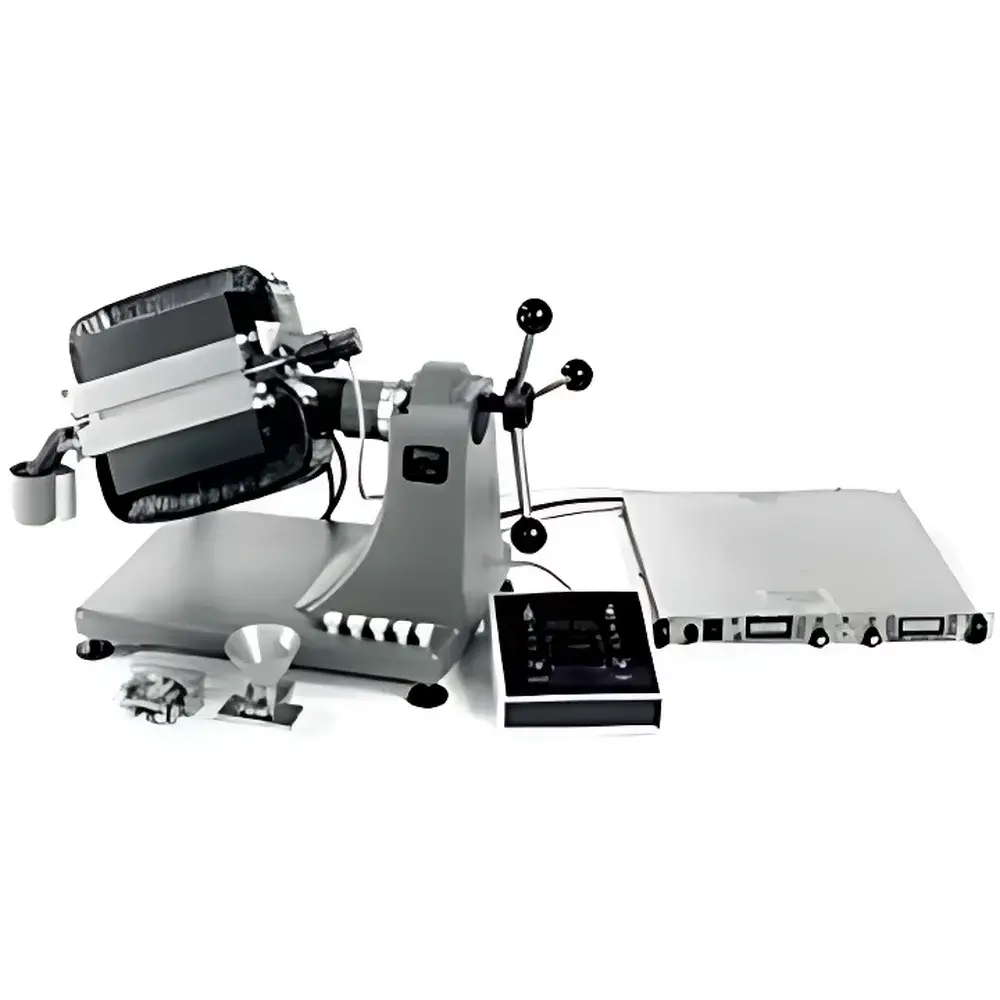
Frantz L-1 / L-1CN / LFC-3 Isodynamic Magnetic Separator Series
| Brand | Frantz |
|---|---|
| Origin | USA |
| Model | L-1, L-1CN, LFC-3 |
| Power Supply | 110–120 V AC, 3.0 A, 50–60 Hz |
| Dimensions (L×W×H) | 41 × 81 × 86 cm |
| Net Weight | 150 kg |
| Shipping Weight | 252 kg |
| Maximum Field Strength | ~20 kG (at 1.8 A, ambient 32°C) |
| Magnetic Gap Width (L-1CN) | 0.03 mm |
| Separation Chamber Volume (L-1CN) | 35.3 cm³ |
| Particle Size Limitation | <45 µm recommended for slurry applications |
| Compliance | Designed for GLP-compliant labs |
Overview
The Frantz L-1, L-1CN, and LFC-3 magnetic separator series represent the culmination of over 75 years of precision engineering in laboratory-scale magnetic susceptibility-based particle separation. These instruments operate on the principle of isodynamic (constant-force) magnetic separation—where particles experience a uniform magnetic force proportional to their volume-specific magnetic susceptibility (χ) within a precisely engineered magnetic field gradient. Unlike conventional ferromagnetic capture devices, Frantz separators resolve paramagnetic, diamagnetic, and weakly ferromagnetic species based on subtle differences in χ—enabling discrimination between mineral phases with susceptibility contrasts as low as 10⁻⁶ emu/g. The L-1 employs a dual-pole electromagnet generating a narrow, vertically oriented separation slot; the L-1CN integrates a high-gradient stainless-steel wool matrix within a compact cylindrical chamber for aqueous or colloidal suspensions; and the LFC-3 serves as an auxiliary low-field control module enabling zero-field calibration, current polarity reversal, and pulsed-field operation (3/30 Hz) to disrupt magnetic agglomerates. All models share a common electromagnetic core architecture and modular mechanical platform, ensuring cross-model compatibility and reduced total cost of ownership.
Key Features
- Isodynamic field geometry: Uniform magnetic force distribution across the separation plane ensures reproducible partitioning independent of particle position—critical for quantitative mineralogical analysis.
- Dual-mode operation (L-1): Switch between free-fall (rapid coarse separation) and inclined-channel feed (high-sensitivity fine separation) via adjustable aluminum base with built-in bubble level and leveling screws.
- High-gradient matrix design (L-1CN): 0.03 mm gap stainless-steel wool cartridge generates localized field intensities exceeding background by >3×, optimized for sub-45 µm suspended particles in liquids.
- Intelligent power regulation (EMS-150 supply): Digitally stabilized DC output automatically compensates for coil resistance drift due to thermal rise—maintaining set current (0–2.0 A) within ±0.05 A under intermittent duty cycles.
- Real-time visual separation (LB-1 variant): Transparent separation zone allows direct observation of particle trajectories, facilitating method development and troubleshooting without disassembly.
- Modular accessory ecosystem: LFC-3 low-field controller enables milliamp-level current modulation, field nulling, and programmable pulsing—essential for isolating magnetically “sticky” iron-bearing phases.
Sample Compatibility & Compliance
Frantz separators accommodate dry powders, slurries, gas-borne aerosols, and viscous pastes—provided particle size remains below 45 µm for matrix-based (L-1CN) operation to prevent clogging. Materials processed include geological samples (zircon, monazite, garnet), synthetic ceramics, catalysts, battery electrode precursors, and pharmaceutical excipients. The system complies with ASTM D7504 for magnetic susceptibility measurement of minerals and supports audit-ready workflows under GLP and GMP frameworks. Electromagnetic components meet IEC 61000-6-3 emissions standards; all structural castings are anodized aluminum or 316 stainless steel for chemical resistance in acidic, alkaline, or high-temperature environments (up to 80°C ambient). No moving parts contact samples—eliminating cross-contamination risk during sequential runs.
Software & Data Management
While Frantz magnetic separators operate as hardware-controlled analog instruments, they integrate seamlessly into regulated digital lab environments. The EMS-150 power supply includes analog voltage/current monitoring outputs compatible with third-party data acquisition systems (e.g., LabVIEW, MATLAB) for time-stamped field intensity logging. When paired with automated feeders or peristaltic pumps, full traceability—including current setpoint, run duration, sample ID, and operator signature—is achievable via LIMS interfaces. The LFC-3 module provides TTL-compatible trigger outputs for synchronization with imaging systems or fraction collectors. All instruments support 21 CFR Part 11-compliant electronic records when used with validated software layers—enabling secure audit trails, user access controls, and electronic signatures for QA/QC documentation.
Applications
- Geochronology: Isolation of zircon, titanite, and monazite from crushed rock matrices for U-Pb dating—leveraging differential paramagnetic responses.
- Mineral processing R&D: Quantitative separation of ilmenite, hematite, and magnetite fractions in ore characterization studies.
- Materials science: Purification of graphene oxide dispersions, magnetic nanoparticle synthesis intermediates, and rare-earth element carriers.
- Environmental analysis: Extraction of ferromagnetic microplastics or heavy metal–bearing particulates from soil leachates.
- Pharmaceutical QC: Removal of catalytic iron residues from active pharmaceutical ingredients (APIs) post-synthesis.
- Paleomagnetism: Preparation of single-domain magnetite fractions for rock magnetic property measurements.
FAQ
What distinguishes isodynamic separation from conventional magnetic separation?
Isodynamic separation applies a spatially uniform magnetic force proportional to magnetic susceptibility (χ), enabling resolution of paramagnetic/diamagnetic species. Conventional separators rely on field gradients attracting only strongly ferromagnetic materials.
Can the L-1CN process organic solvents?
Yes—the stainless-steel wool matrix and PTFE-sealed chamber are chemically inert to alcohols, acetone, chloroform, and hydrocarbon solvents. Verify compatibility with aggressive oxidizers (e.g., HNO₃) via material safety data sheets.
How often does the stainless-steel wool matrix require replacement?
Under standard use (≤100 g/day dry equivalent), matrix life exceeds 500 operating hours. Performance degradation is indicated by reduced separation sharpness or increased pressure drop in slurry mode.
Is calibration traceable to national standards?
Field strength calibration uses NIST-traceable Hall-effect gaussmeters. Frantz provides factory calibration certificates with uncertainty budgets compliant with ISO/IEC 17025 requirements.
Can multiple units be networked for parallel processing?
Each unit operates independently but shares identical electrical and mechanical interfaces—enabling synchronized operation via centralized PLC control or custom Python scripts using RS-232/USB adapters.





