
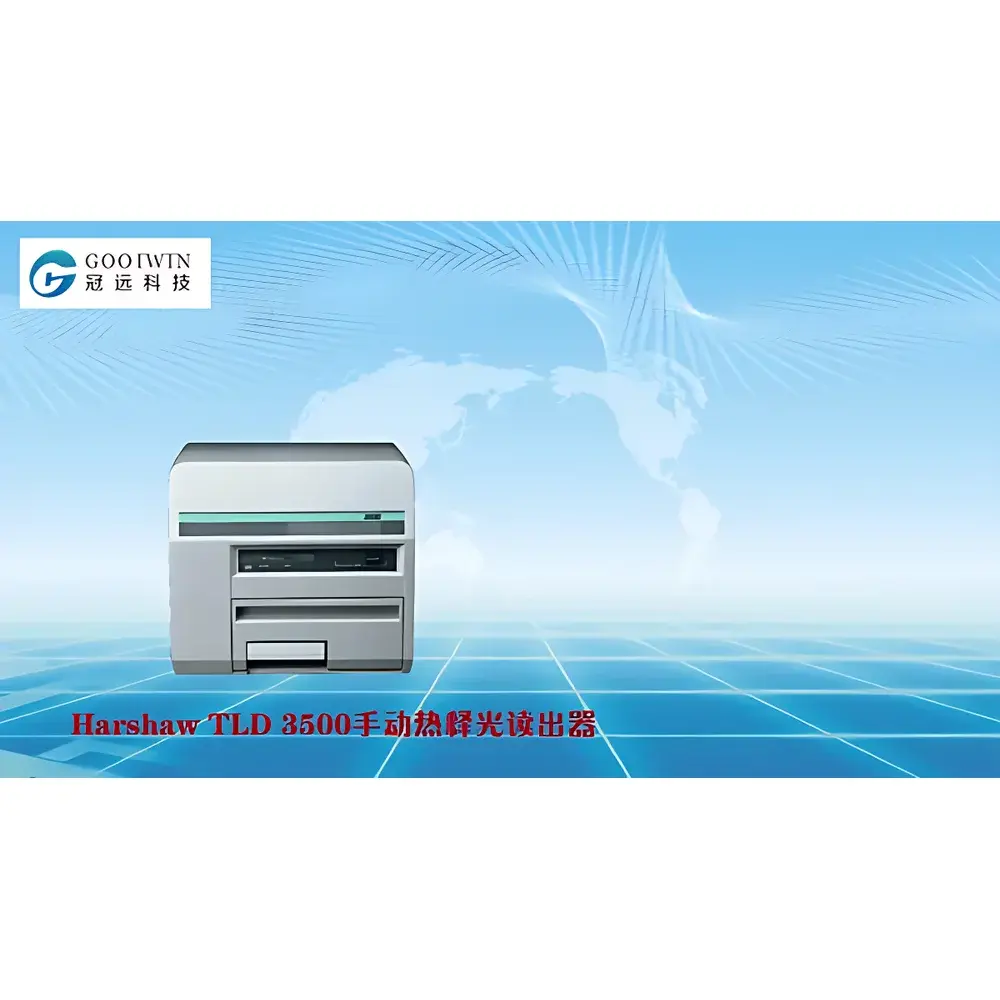
Harshaw TLD 3500 Manual Thermoluminescence Dosimeter Reader
| Brand | UNION |
|---|---|
| Origin | Germany |
| Manufacturer Type | Authorized Distributor |
| Import Status | Imported |
| Model | TLD 3500 |
| Price Range | USD 1,400 – 7,000 |
Overview
The Harshaw TLD 3500 Manual Thermoluminescence Dosimeter Reader is a precision-engineered instrument designed for quantitative readout of thermoluminescent dosimeters (TLDs), primarily lithium fluoride (LiF:Mg,Ti) and calcium sulfate (CaSO4:Dy) chips or powders. It operates on the fundamental principle of thermoluminescence: when previously irradiated TLD materials are heated under controlled conditions, trapped electrons recombine with lattice defects, emitting visible photons proportional to the absorbed ionizing radiation dose. The TLD 3500 employs a calibrated heating ramp (typically 1–10 °C/s), a photomultiplier tube (PMT) detector with spectral filtering optimized for the emission bands of common phosphors, and analog-to-digital conversion for high-fidelity glow curve acquisition. Its manual operation mode—requiring user-initiated sample insertion, heating cycle start, and data recording—ensures full procedural transparency and operator control, making it especially suitable for laboratories requiring traceable, auditable dose assessment under GLP or ISO/IEC 17025 frameworks.
Key Features
- Manual, operator-controlled readout workflow with tactile feedback and visual status indicators for precise timing of heating initiation and data capture.
- Stable thermal ramp profile with pre-heat stabilization protocol: instrument requires ≥30 minutes warm-up prior to calibration or measurement to ensure electronic and thermal equilibrium of PMT, heater, and signal conditioning circuitry.
- Zero-point recalibration every 20 minutes during continuous operation to compensate for baseline drift—critical for multi-sample batch processing in environmental or personnel monitoring programs.
- Dedicated optical path with interchangeable interference filters; filter maintenance via lens-tissue cleaning recommended to prevent transmission loss from dust or hydrocarbon deposition.
- Robust mechanical design supporting reusable TLD elements—including custom geometries (rods, discs, ribbons, micro-pellets)—enabling flexible deployment in constrained or irregular irradiation geometries (e.g., phantom dosimetry, food package surface mapping).
- Compatible with standard annealing ovens (e.g., 400 °C for 1 h + 80 °C for 24 h for LiF:Mg,Ti), enabling full dose recovery and multi-cycle reuse without degradation of dosimetric sensitivity.
Sample Compatibility & Compliance
The TLD 3500 supports all widely accepted thermoluminescent phosphors used in regulatory and research applications, including but not limited to LiF:Mg,Ti (TLD-100), LiF:Mg,Cu,P (TLD-100H), CaF2:Dy, and CaSO4:Dy. Its readout protocol aligns with ASTM E1192–22 (“Standard Practice for Use of Thermoluminescence Dosimetry Systems”) and IEC 62387–1:2012 (“Radiation protection instrumentation — Passive integrating dosimetry systems for environmental and personal monitoring”). For food irradiation verification, it satisfies the technical requirements outlined in ISO/ASTM 51275:2021 (“Standard Practice for Use of Calorimetric Dosimetry Systems in Radiation Processing”) when paired with appropriate reference standards and uncertainty budgeting per GUM (JCGM 100:2008). All measurements are fully traceable to national metrology institutes (e.g., PTB, NIST) via certified TLD calibration services.
Software & Data Management
While the TLD 3500 is a standalone manual reader without embedded digital storage, its analog output (0–10 V DC or RS-232 serial interface optional) enables integration into validated laboratory information management systems (LIMS) or custom data acquisition platforms. When connected to compliant software, raw glow curves and integrated counts can be archived with full audit trail—including operator ID, date/time stamp, calibration certificate ID, and environmental parameters (room temperature, humidity)—meeting FDA 21 CFR Part 11 requirements for electronic records and signatures. Dose calculation algorithms must be independently verified and documented per ISO/IEC 17025 Clause 7.7; no proprietary black-box processing is performed internally.
Applications
- Personal and environmental radiation monitoring in nuclear facilities, medical radiotherapy departments, and research reactors.
- Post-irradiation dose verification in food safety programs—particularly for tropical fruit, spices, and grain sterilization where long-term cumulative dose assessment (>1 year) is required due to ambient thermal history.
- Archaeological and geological dating (e.g., pottery, sediments) where natural background accumulation over centuries must be resolved with sub-mGy sensitivity.
- Radiation processing validation in polymer crosslinking, sterilization of medical devices, and gemstone color enhancement.
- Retrospective dosimetry in emergency response scenarios using deployed passive badges recovered after incident resolution.
FAQ
What is the minimum detectable dose for LiF:Mg,Ti using the TLD 3500?
Typical lower limit of detection (LLD) is 10 µGy under optimal counting conditions (low-noise PMT, dark-adapted chamber, 10 mg chip); actual LLD depends on background subtraction method and integration time.
Can the TLD 3500 be used for routine quality assurance in food irradiation facilities?
Yes—when operated within a documented QA program that includes daily zero checks, weekly calibration against traceable sources, and annual intercomparison with accredited dosimetry laboratories per ISO/IEC 17043.
Is firmware or software upgrade support available from UNION?
No—the TLD 3500 is a fixed-function analog instrument; no firmware exists. All performance specifications are hardware-defined and stable across production batches.
Does the device comply with EU Directive 2013/59/Euratom for personal dosimetry?
It meets the functional requirements for Category B passive dosimeters as defined in Annex IV; final compliance depends on the full system—including TLD element type, annealing procedure, and calibration methodology—validated by an accredited body.
Related Products





